Schwendicke Falk, Schweigel Hardy, Petrou Marina Agathi, Santamaria Ruth, Hopfenmüller Werner, Finke Christian, Paris Sebastian
Department of Operative and Preventive Dentistry, Charité - Universitätsmedizin, Aßmannshauser Str 4-6, Berlin, 14197, Germany.
DMG Dental Material Gesellschaft, Department of Clinical Research, Elbgaustr 248, Hamburg, 22547, Germany.
Trials. 2015 Jan 6;16:11. doi: 10.1186/s13063-014-0525-9.
For treating deep caries lesions, selective or stepwise (one- and two-step) incomplete excavation seems advantageous compared with complete caries removal. However, current evidence regarding the success, as defined by not requiring any retreatments, or survival of teeth after different excavations is insufficient for definitive recommendation, especially when treating deciduous teeth. Moreover, restoration integrity has not been comparatively analyzed longitudinally, and neither patients', dentists' or parents' preferences nor the clinical long-term costs emanating from both initial and retreatments have been reported yet.
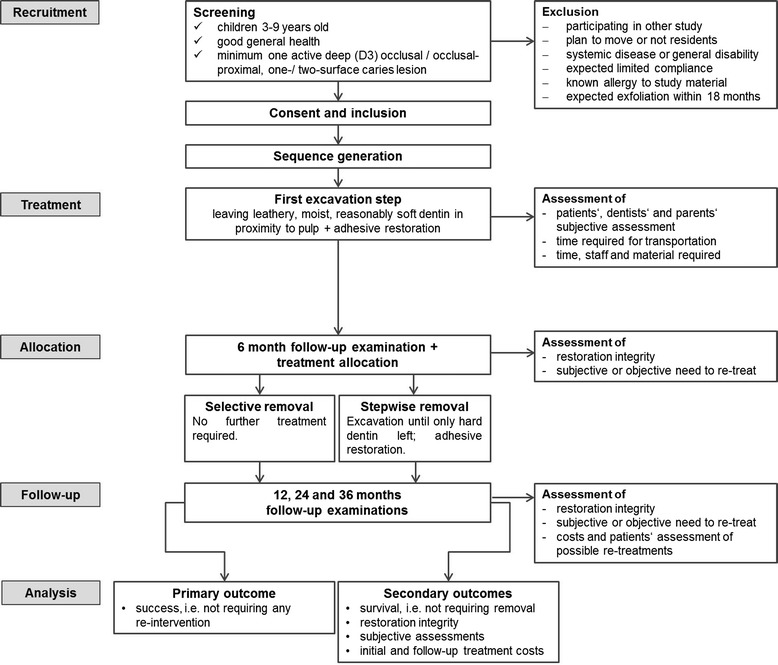
METHODS/DESIGN: The planned study is a prospective multicenter, two-arm parallel group, randomized controlled clinical trial comparing selective and stepwise excavation in deciduous molars with deep, active caries lesions without pulpal symptoms. We will recruit 300 children aged between three and nine-years-old with a minimum of one such molar. Patients participating in another study, or those with systemic diseases, disabilities or known allergies to used materials as well patients with teeth expected to exfoliate within the next 18 months will be excluded. After inclusion, sequence generation will be performed. Initial treatment will follow dental routine. During excavation, leathery, moist and reasonably soft dentin will be left in proximity to the pulp followed by adhesive restoration of the cavity. Afterwards, patients', dentists' and parents' subjective assessment of the treatment will be recorded using visual analogue or Likert scales. Re-examination will be performed after six months, and only then teeth will be allocated to one of the two interventions. Selectively excavated teeth will not be treated further, whilst for stepwise caries removal, a second excavation will be performed until only hard dentin remains. Clinical re-evaluations will be performed after 12, 24 and 36 months. Restorations will be reassessed using modified Ryge criteria. Objectively or subjectively required retreatments will determine success and survival. Retreatments will be evaluated both subjectively and regarding generated costs.
Based on the results of the trial, decision-making for treating deep caries lesions in deciduous molars based on multiple criteria should be feasible.
Clinicaltrials.gov identifier: NCT02232828 (registered on 29 November 2014).
对于治疗深龋病变,与完全去除龋坏组织相比,选择性或逐步(一步和两步)不完全去龋似乎更具优势。然而,目前关于不同去龋方式后牙齿成功(定义为无需任何再治疗)或存留情况的证据不足,无法给出明确推荐,尤其是在治疗乳牙时。此外,尚未对修复体完整性进行纵向比较分析,也未报告患者、牙医或家长的偏好以及初次治疗和再治疗产生的临床长期成本。
方法/设计:计划中的研究是一项前瞻性多中心、双臂平行组随机对照临床试验,比较对有深的、活动性龋损且无牙髓症状的乳牙磨牙进行选择性去龋和逐步去龋的效果。我们将招募300名3至9岁的儿童,每人至少有一颗这样的磨牙。参与另一项研究的患者、患有全身性疾病、残疾或对所用材料已知过敏的患者,以及预计在未来18个月内会脱落的牙齿的患者将被排除。纳入后,将进行序列生成。初始治疗将遵循牙科常规。去龋时,靠近牙髓处将保留坚韧、湿润且质地适中柔软的牙本质,随后对窝洞进行粘结修复。之后,使用视觉模拟或李克特量表记录患者、牙医和家长对治疗的主观评估。6个月后进行复查,届时才将牙齿分配到两种干预措施之一。选择性去龋的牙齿不再进一步治疗,而对于逐步去龋,将进行第二次去龋,直到仅留下硬牙本质。在12、24和36个月后进行临床重新评估。使用改良的Ryge标准重新评估修复体。客观或主观上需要的再治疗将决定治疗的成功和牙齿的存留。将对再治疗进行主观评估并评估其产生的成本。
基于该试验的结果,基于多个标准对乳牙磨牙深龋病变进行治疗决策应是可行的。
Clinicaltrials.gov标识符:NCT⁃02232828(于2014年11月29日注册)。