Aboshady Omar A, Radwan Ahmed E, Eltaweel Asmaa R, Azzam Ahmed, Aboelnaga Amr A, Hashem Heba A, Darwish Salma Y, Salah Rehab, Kotb Omar N, Afifi Ahmed M, Noaman Aya M, Salem Dalal S, Hassouna Ahmed
Faculty of Medicine, Menoufia University, Shebin El-Kom, Menoufia, Egypt.
Faculty of Medicine, Alexandria University, Alexandria, Egypt.
BMJ Open. 2015 Jan 5;5(1):e006804. doi: 10.1136/bmjopen-2014-006804.
To assess the prevalence of awareness and use of massive open online courses (MOOCs) among medical undergraduates in Egypt as a developing country, as well as identifying the limitations and satisfaction of using these courses.
A multicentre, cross-sectional study using a web-based, pilot-tested and self-administered questionnaire.
Ten out of 19 randomly selected medical schools in Egypt.
2700 undergraduate medical students were randomly selected, with an equal allocation of participants in each university and each study year.
Primary outcome measures were the percentages of students who knew about MOOCs, students who enrolled and students who obtained a certificate. Secondary outcome measures included the limitations and satisfaction of using MOOCs through five-point Likert scale questions.
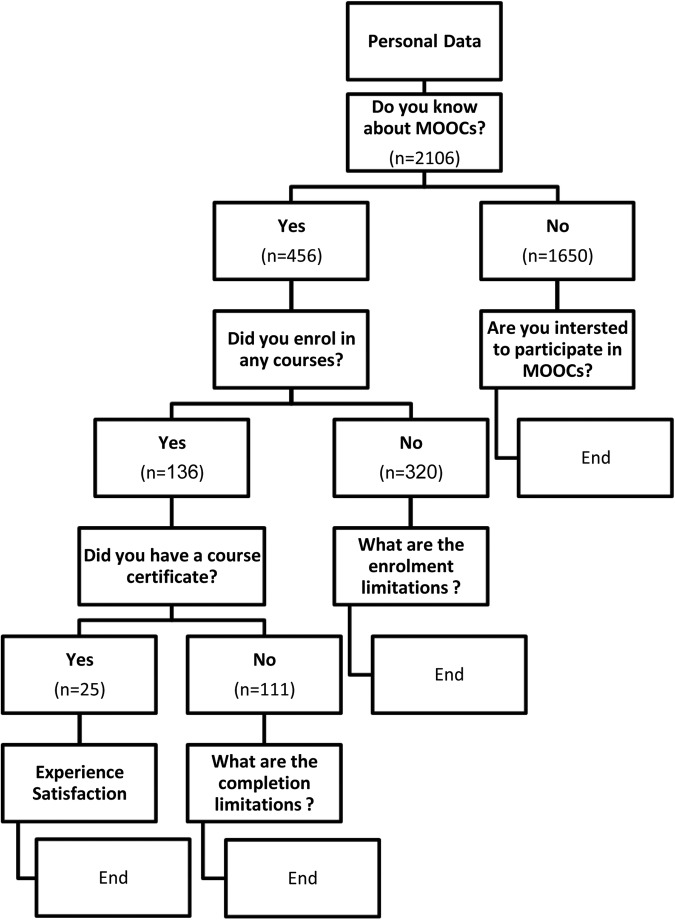
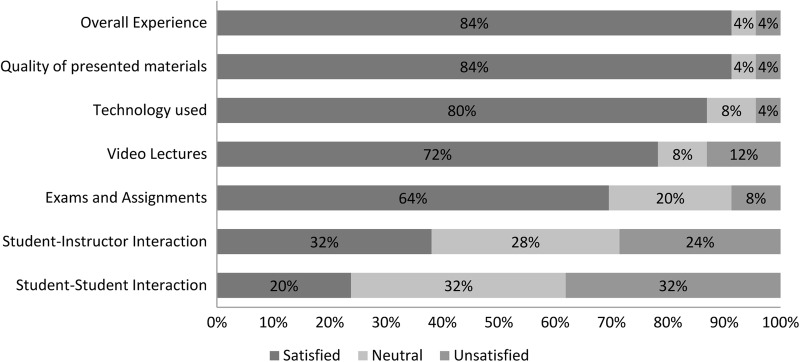
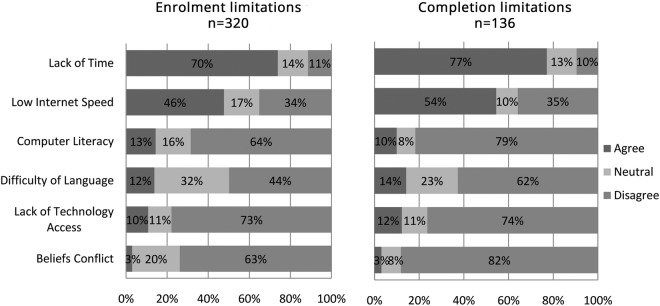
Of 2527 eligible students, 2106 completed the questionnaire (response rate 83.3%). Of these students, 456 (21.7%) knew the term MOOCs or websites providing these courses. Out of the latter, 136 (29.8%) students had enrolled in at least one course, but only 25 (18.4%) had completed courses earning certificates. Clinical year students showed significantly higher rates of knowledge (p=0.009) and enrolment (p<0.001) than academic year students. The primary reasons for the failure of completion of courses included lack of time (105; 77.2%) and slow Internet speed (73; 53.7%). Regarding the 25 students who completed courses, 21 (84%) were satisfied with the overall experience. However, there was less satisfaction regarding student-instructor (8; 32%) and student-student (5; 20%) interactions.
About one-fifth of Egyptian medical undergraduates have heard about MOOCs with only about 6.5% actively enrolled in courses. Students who actively participated showed a positive attitude towards the experience, but better time-management skills and faster Internet connection speeds are required. Further studies are needed to survey the enrolled students for a better understanding of their experience.
评估作为发展中国家的埃及医学本科生对大规模开放在线课程(MOOCs)的知晓率和使用率,以及确定使用这些课程的局限性和满意度。
一项多中心横断面研究,采用基于网络的、经过预试验和自行填写的问卷。
埃及19所随机选择的医学院校中的10所。
随机选择2700名医学本科学生,每所大学和每个学年的参与者分配均等。
主要结局指标是知晓MOOCs的学生百分比、注册的学生百分比和获得证书的学生百分比。次要结局指标包括通过五点李克特量表问题得出的使用MOOCs的局限性和满意度。
在2527名符合条件的学生中,2106名完成了问卷(回复率83.3%)。在这些学生中,456名(21.7%)知晓MOOCs一词或提供这些课程的网站。在后者中,136名(29.8%)学生至少注册了一门课程,但只有25名(18.4%)完成课程并获得证书。临床年级学生的知晓率(p = 0.009)和注册率(p < 0.001)显著高于学术年级学生。课程未完成的主要原因包括时间不足(105名;77.2%)和网速慢(73名;53.7%)。对于完成课程的25名学生,21名(84%)对总体体验感到满意。然而,对师生互动(8名;32%)和生生互动(5名;20%)的满意度较低。
约五分之一的埃及医学本科生听说过MOOCs,只有约6.5%的学生积极注册课程。积极参与的学生对这种体验持积极态度,但需要更好的时间管理技能和更快的网络连接速度。需要进一步研究对注册学生进行调查,以更好地了解他们的体验。