Department of Biomedical Sciences, Faculty of Health and Medical Sciences, University of Copenhagen, Signe Sørensen Torekov, Blegdamsvej 3B, 2200, Copenhagen, Denmark, Denmark.
NNF Center for Basic Metabolic Research, Faculty of Health and Medical Sciences, University of Copenhagen, Copenhagen, Denmark.
BMC Med Educ. 2017 May 31;17(1):97. doi: 10.1186/s12909-017-0935-y.
Medical education is a cornerstone in the global combat against diseases such as diabetes and obesity which together affect more than 500 million humans. Massive Open Online Courses (MOOCs) are educational tools for institutions to teach and share their research worldwide. Currently, millions of people have participated in evidence-based MOOCs, however educational and professional benefit(s) for course participants of such initiatives have not been addressed sufficiently. We therefore investigated if participation in a 6 week open online course in the prevention and treatment of diabetes and obesity had any impact on the knowledge, skills, and career of health care professionals contrasting participants from developing countries versus developed countries.
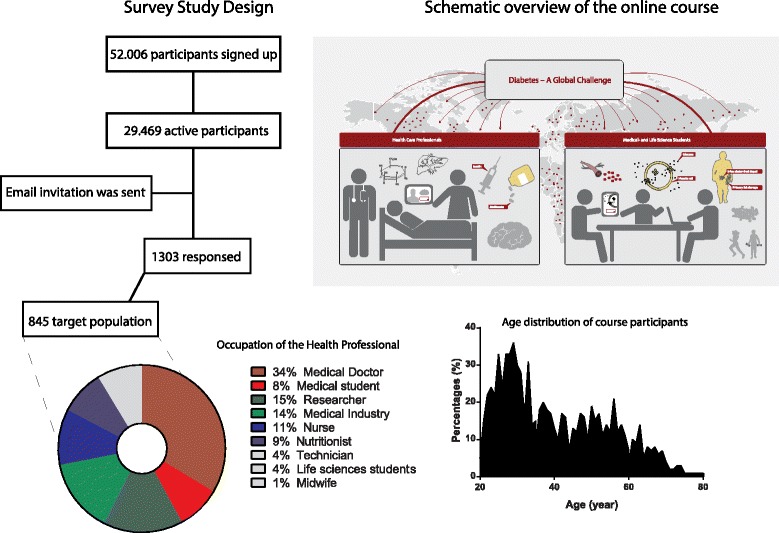
52.006 participants signed up and 29.469 participants were active in one of the three sessions (2014-2015) of Diabetes - a Global Challenge. Using an online based questionnaire (nine sections) software (Survey Monkey), email invitations were send out using a Coursera based database to the 29.469 course participants. Responses were analyzed and stratified, according to the United Nations stratification method, by developing and developed countries.
1.303 (4.4%) of the 29.469 completed the questionnaire. 845 of the 1303 were defined as health care professionals, including medical doctors (34%), researchers (15%), nurses (11%) and medical students (8%). Over 80% of the health care participants report educational benefits, improved knowledge about the prevention and treatment therapies of diabetes and furthermore improved professional life and practice. Over 40% reported that their professional network expanded after course participation. Study participants who did not complete all modules of the course reported similar impact as the ones that completed the entire course(P = 0.9). Participants from developing countries gained more impact on their clinical practice (94%) compared to health care professionals from developed regions (88%) (Mean of differences = 6%, P = 0.03.
Based on self-reports from course participants, MOOC based medical education seems promising with respect to providing accessible and free research-based education to health professionals in both developing and developed countries. Course participants from developing countries report more benefits from course participation than their counterparts in the developed world.
医学教育是对抗糖尿病和肥胖等疾病的全球斗争的基石,这两种疾病加起来影响着超过 5 亿人。大规模开放在线课程(MOOCs)是机构在全球范围内教学和分享研究成果的教育工具。目前,数百万人已经参加了基于证据的 MOOCs,但是这些举措对课程参与者的教育和职业利益尚未得到充分解决。因此,我们调查了参加为期 6 周的关于糖尿病和肥胖症预防和治疗的开放在线课程是否对发展中国家和发达国家的医疗保健专业人员的知识、技能和职业发展有任何影响。
52006 名参与者报名,29469 名参与者在 2014-2015 年的三个课程(糖尿病-全球挑战)中的一个课程中活跃。使用在线问卷(九个部分)软件(Survey Monkey),使用 Coursera 数据库向 29469 名课程参与者发送电子邮件邀请。根据联合国分层方法,对响应进行了分析和分层,根据发展中国家和发达国家进行了分层。
1303 名(4.4%)完成了问卷。1303 名中的 845 名被定义为医疗保健专业人员,包括医生(34%)、研究人员(15%)、护士(11%)和医学生(8%)。超过 80%的医疗保健参与者报告了教育收益,提高了对糖尿病预防和治疗疗法的认识,并且提高了专业生活和实践。超过 40%的人报告说,他们的专业网络在课程参与后扩大了。没有完成课程所有模块的研究参与者报告的影响与完成整个课程的参与者相似(P=0.9)。与来自发达地区的医疗保健专业人员相比(88%),来自发展中国家的参与者在临床实践中获得了更大的收益(94%)(差异平均值为 6%,P=0.03)。
根据课程参与者的自我报告,基于 MOOC 的医学教育似乎很有前景,可以为发展中国家和发达国家的医疗保健专业人员提供可访问且免费的基于研究的教育。来自发展中国家的课程参与者报告说,他们从课程参与中获得的收益比来自发达国家的同行更多。