Plancoulaine Benoît, Laurinaviciene Aida, Meskauskas Raimundas, Baltrusaityte Indra, Besusparis Justinas, Herlin Paulette, Laurinavicius Arvydas
Diagn Pathol. 2014;9 Suppl 1(Suppl 1):S8. doi: 10.1186/1746-1596-9-S1-S8. Epub 2014 Dec 19.
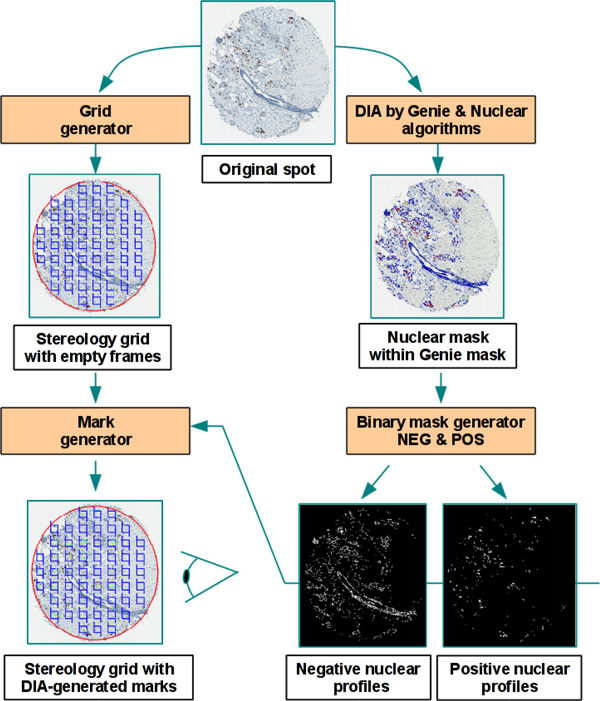
Digital image analysis (DIA) enables better reproducibility of immunohistochemistry (IHC) studies. Nevertheless, accuracy of the DIA methods needs to be ensured, demanding production of reference data sets. We have reported on methodology to calibrate DIA for Ki67 IHC in breast cancer tissue based on reference data obtained by stereology grid count. To produce the reference data more efficiently, we propose digital IHC wizard generating initial cell marks to be verified by experts.
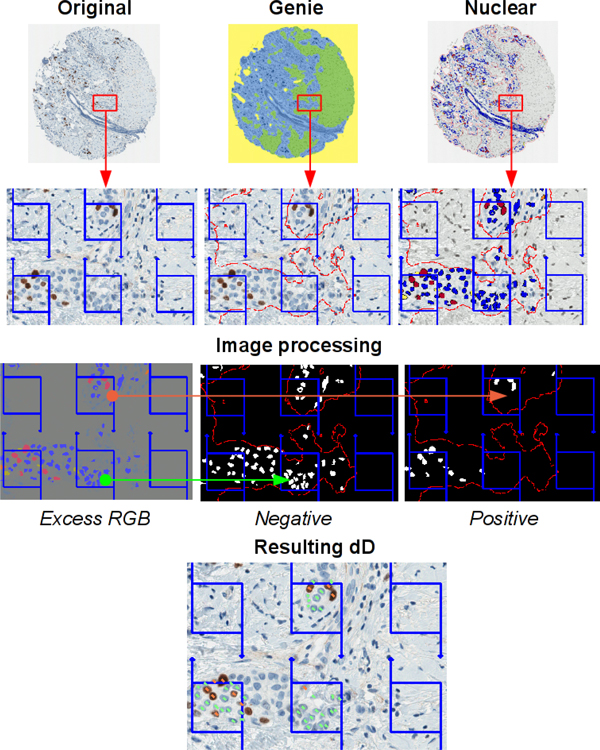
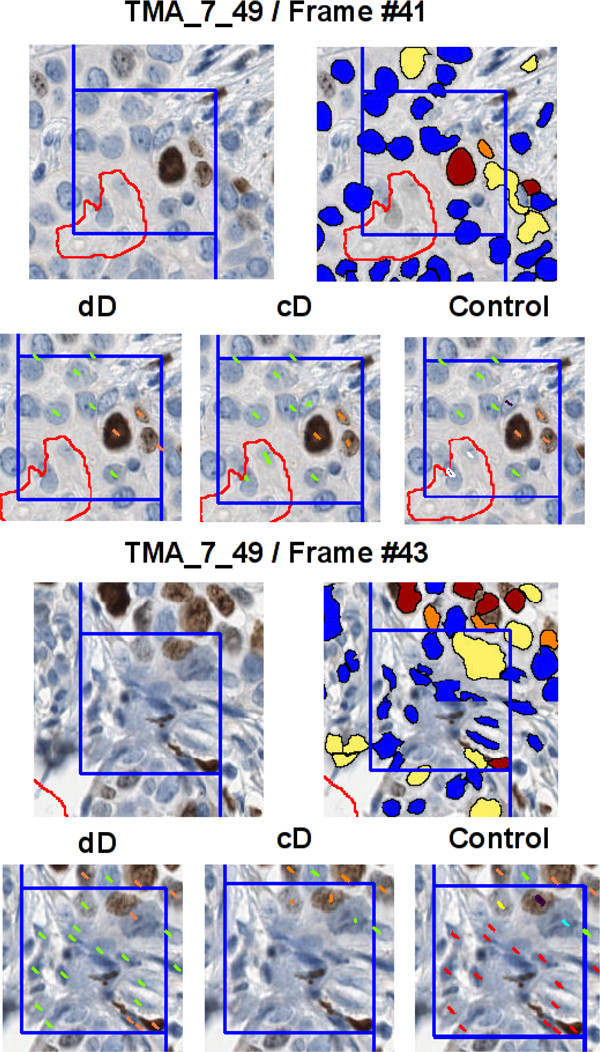
Digital images of proliferation marker Ki67 IHC from 158 patients (one tissue microarray spot per patient) with an invasive ductal carcinoma of the breast were used. Manual data (mD) were obtained by marking Ki67-positive and negative tumour cells, using a stereological method for 2D object enumeration. DIA was used as an initial step in stereology grid count to generate the digital data (dD) marks by Aperio Genie and Nuclear algorithms. The dD were collected into XML files from the DIA markup images and overlaid on the original spots along with the stereology grid. The expert correction of the dD marks resulted in corrected data (cD). The percentages of Ki67 positive tumour cells per spot in the mD, dD, and cD sets were compared by single linear regression analysis. Efficiency of cD production was estimated based on manual editing effort.
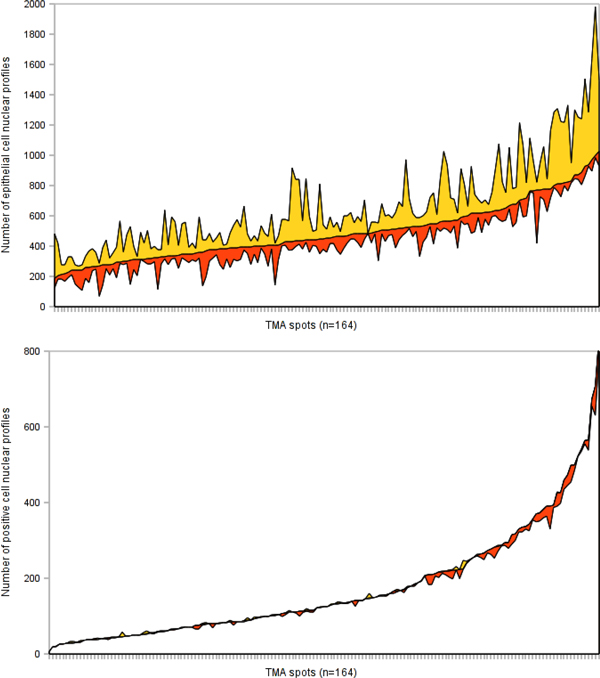
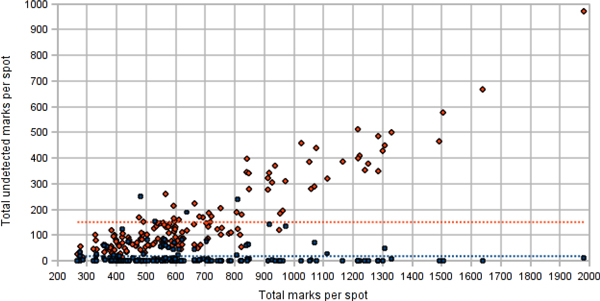
The percentage of Ki67-positive tumor cells was in very good agreement in the mD, dD, and cD sets: regression of cD from dD (R2=0.92) reflects the impact of the expert editing the dD as well as accuracy of the DIA used; regression of the cD from the mD (R2=0.94) represents the consistency of the DIA-assisted ground truth (cD) with the manual procedure. Nevertheless, the accuracy of detection of individual tumour cells was much lower: in average, 18 and 219 marks per spot were edited due to the Genie and Nuclear algorithm errors, respectively. The DIA-assisted cD production in our experiment saved approximately 2/3 of manual marking.
Digital IHC wizard enabled DIA-assisted stereology to produce reference data in a consistent and efficient way. It can provide quality control measure for appraising accuracy of the DIA steps.
数字图像分析(DIA)可提高免疫组织化学(IHC)研究的可重复性。然而,需要确保DIA方法的准确性,这就要求生成参考数据集。我们曾报道过基于体视学网格计数获得的参考数据对乳腺癌组织中Ki67免疫组化的DIA进行校准的方法。为了更高效地生成参考数据,我们提出了数字免疫组化向导,用于生成待专家验证的初始细胞标记。
使用了158例乳腺浸润性导管癌患者(每位患者一个组织微阵列点)的增殖标记Ki67免疫组化的数字图像。通过标记Ki67阳性和阴性肿瘤细胞,采用体视学方法进行二维物体计数来获得手动数据(mD)。在体视学网格计数中,首先使用DIA,通过Aperio Genie和Nuclear算法生成数字数据(dD)标记。将dD从DIA标记图像收集到XML文件中,并与体视学网格一起叠加在原始点上。专家对dD标记进行校正后得到校正数据(cD)。通过单线性回归分析比较mD、dD和cD组中每个点的Ki67阳性肿瘤细胞百分比。基于手动编辑工作量评估cD生成的效率。
mD、dD和cD组中Ki67阳性肿瘤细胞的百分比非常一致:dD生成cD的回归(R2 = 0.92)反映了专家编辑dD的影响以及所使用DIA的准确性;mD生成cD的回归(R2 = 0.94)代表了DIA辅助的地面真值(cD)与手动程序的一致性。然而,单个肿瘤细胞的检测准确性要低得多:由于Genie和Nuclear算法错误,平均每个点分别有18个和219个标记需要编辑。在我们的实验中,DIA辅助的cD生成节省了大约三分之二的手动标记。
数字免疫组化向导使DIA辅助的体视学能够以一致且高效的方式生成参考数据。它可为评估DIA步骤的准确性提供质量控制措施。