Nolte Sarah, Zlobec Inti, Lugli Alessandro, Hohenberger Werner, Croner Roland, Merkel Susanne, Hartmann Arndt, Geppert Carol I, Rau Tilman T
Institute of Pathology Friedrich Alexander University Erlangen-Nuremberg Erlangen Germany.
Institute of Pathology University Bern Bern Switzerland.
J Pathol Clin Res. 2017 Jan 13;3(1):58-70. doi: 10.1002/cjp2.62. eCollection 2017 Jan.
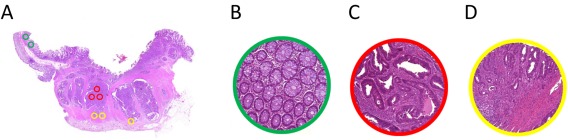
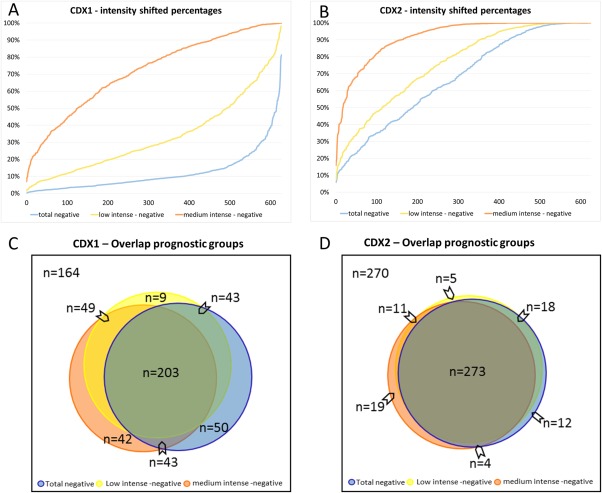
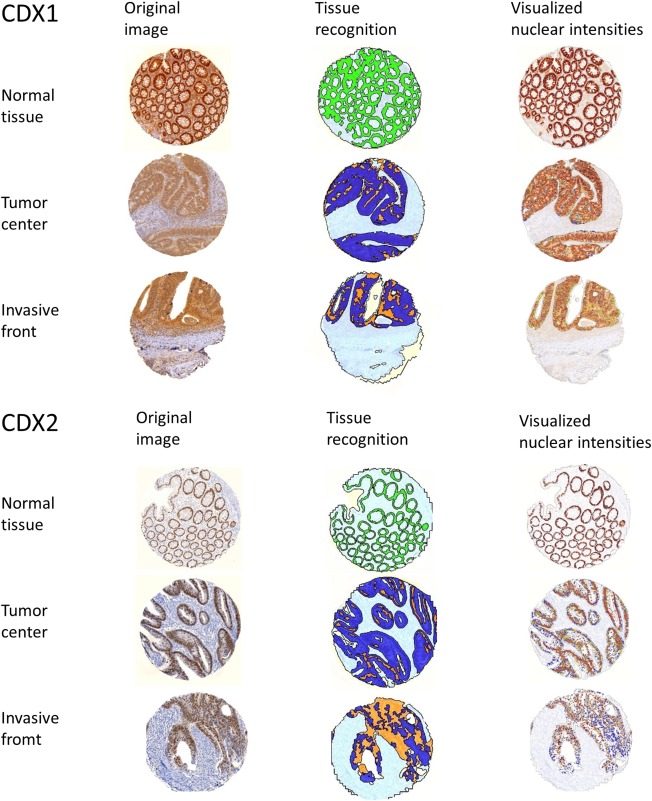
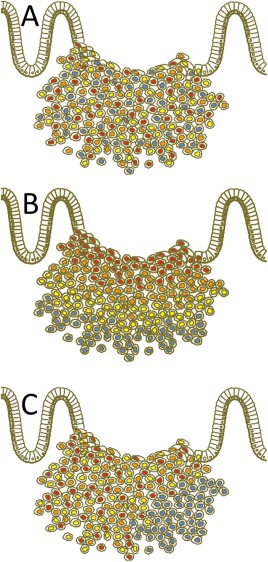
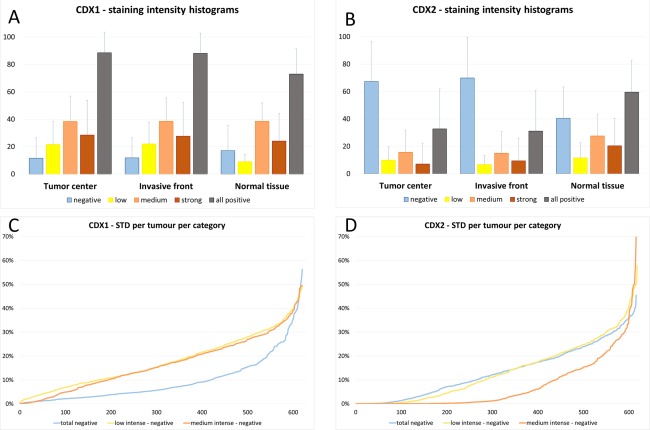
CDX1 and CDX2 are possibly predictive biomarkers in colorectal cancer. We combined digitally-guided (next generation) TMA construction (ngTMA) and the utility of digital image analysis (DIA) to assess accuracy, tumour heterogeneity and the selective impact of different combined intensity-percentage levels on prognosis.CDX1 and CDX2 immunohistochemistry was performed on ngTMAs covering normal tissue, tumour centre and invasive front. The percentages of all epithelial cells per staining intensity per core were analysed digitally. Beyond classical prognosis analysis following REMARK guidelines, we investigated pre-analytical conditions, three different types of heterogeneity (mosaic-like, targeted and haphazard) and influences on cohort segregation and patient selection. The ngTMA-DIA approach produced robust biomarker data with infrequent core loss and excellent on-target punching. The detailed assessment of tumour heterogeneity could - except for a certain diffuse mosaic-like heterogeneity - exclude differences between the invasive front and tumour centre, as well as detect haphazard clonal heterogeneous elements. Moreover, lower CDX1 and CDX2 counts correlated with mucinous histology, higher TNM stage, higher tumour grade and worse survival ( < 0.01, all). Different protein expression intensity levels shared comparable prognostic power and a great overlap in patient selection. The combination of ngTMA with DIA enhances accuracy and controls for biomarker analysis. Beyond the confirmation of CDX1 and CDX2 as prognostically relevant markers in CRC, this study highlights the greater robustness of CDX2 in comparison to CDX1. For the assessment of CDX2 protein loss, cut-points as percentage data of complete protein loss can be deduced as a recommendation.
CDX1和CDX2可能是结直肠癌的预测生物标志物。我们将数字引导(下一代)组织微阵列构建(ngTMA)与数字图像分析(DIA)的应用相结合,以评估准确性、肿瘤异质性以及不同组合强度百分比水平对预后的选择性影响。对覆盖正常组织、肿瘤中心和浸润前沿的ngTMA进行CDX1和CDX2免疫组织化学检测。对每个核心中每种染色强度下的所有上皮细胞百分比进行数字分析。除了遵循REMARK指南进行经典的预后分析外,我们还研究了分析前条件、三种不同类型的异质性(马赛克样、靶向性和随机性)以及对队列分离和患者选择的影响。ngTMA-DIA方法产生了可靠的生物标志物数据,核心丢失罕见且靶点打孔效果良好。对肿瘤异质性的详细评估,除了某种弥漫性马赛克样异质性外,可以排除浸润前沿和肿瘤中心之间的差异,并检测到随机的克隆异质性成分。此外,较低的CDX1和CDX2计数与黏液组织学、较高的TNM分期、较高的肿瘤分级和较差的生存率相关(均P<0.01)。不同的蛋白表达强度水平具有相当的预后能力,并且在患者选择方面有很大的重叠。ngTMA与DIA的结合提高了准确性并控制了生物标志物分析。除了证实CDX1和CDX2是结直肠癌中与预后相关的标志物外,本研究还强调了CDX2与CDX1相比具有更强的稳健性。对于评估CDX2蛋白缺失,可推导出作为完全蛋白缺失百分比数据的切点作为建议。