Alexander Jessy J, Chaves Lee D, Chang Anthony, Jacob Alexander, Ritchie Maria, Quigg Richard J
Division of Nephrology, Department of Medicine, Clinical and Translational Research Center, University at Buffalo School of Medicine and Biomedical Sciences, Buffalo, New York, USA.
Department of Pathology, The University of Chicago, Chicago, Illinois, USA.
Kidney Int. 2015 May;87(5):930-9. doi: 10.1038/ki.2014.373. Epub 2015 Jan 7.
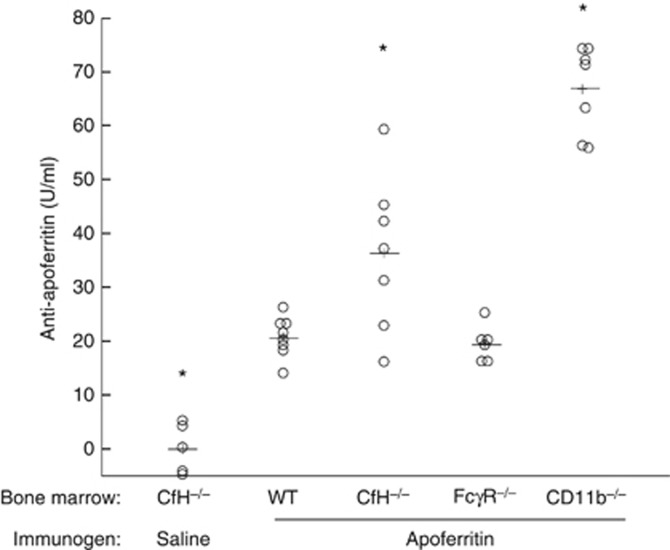
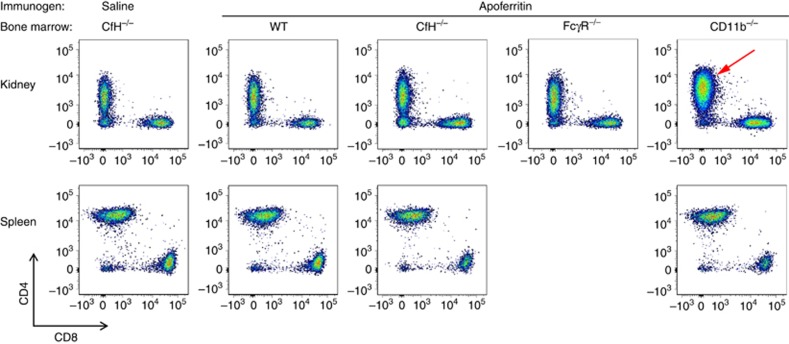
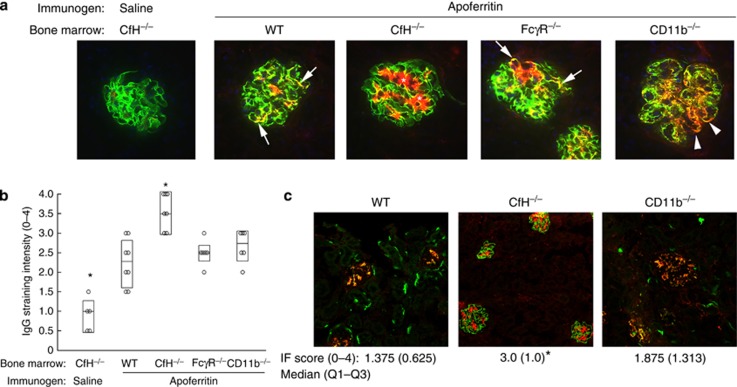
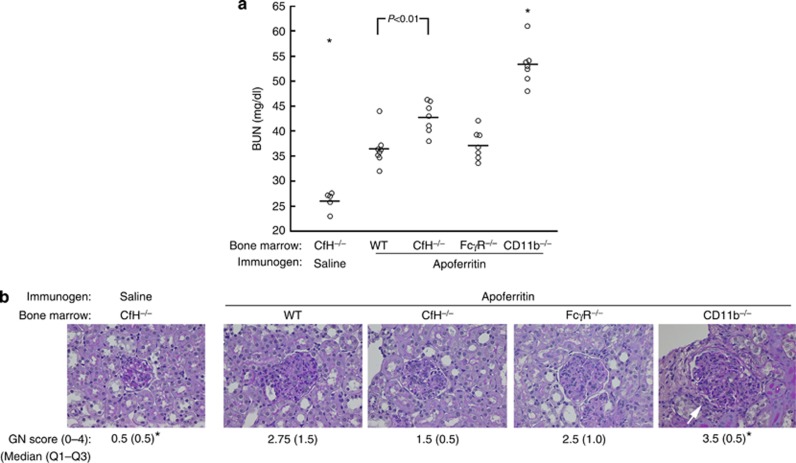
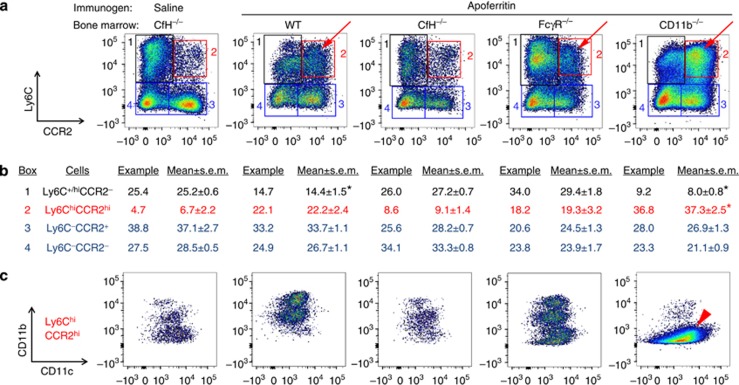
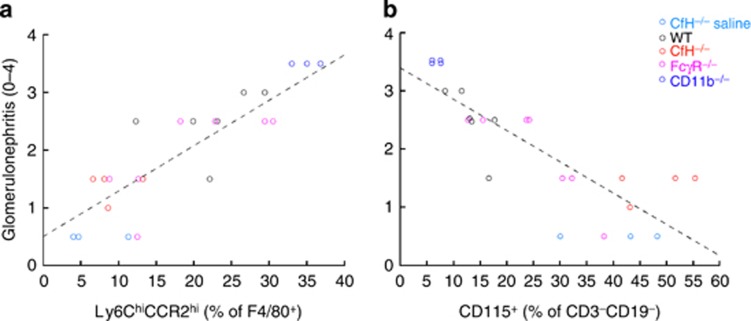
In chronic serum sickness, glomerular immune complexes form, yet C57BL/6 mice do not develop glomerulonephritis unless complement factor H (CfH) is absent, indicating the relevance of complement regulation. Complement receptor 3 (CD11b) and Fcγ receptors on leukocytes, and CfH on platelets, can bind immune complexes. Here we induced immune complex-mediated glomerulonephritis in CfH(-/-) mice chimeric for wild-type, CfH(-/-), CD11b(-/-), or FcRγ(-/-) bone marrow stem cells. Glomerulonephritis was worse in CD11b(-/-) chimeras compared with all others, whereas disease in FcRγ(-/-) and wild-type chimeras was comparable. Disease tracked strongly with humoral immune responses, but not glomerular immune complex deposits. Interstitial inflammation with M1 macrophages strongly correlated with glomerulonephritis scores. CD11b(-/-) chimeras had significantly more M1 macrophages and CD4(+) T cells. The renal dendritic cell populations originating from bone marrow-derived CD11c(+) cells were similar in all experimental groups. CD11b(+) cells bearing colony-stimulating factor 1 receptor were present in kidneys, including CD11b(-/-) chimeras; these cells correlated negatively with glomerulonephritis scores. Thus, experimental immune complex-mediated glomerulonephritis is associated with accumulation of M1 macrophages and CD4(+) T cells in kidneys and functional renal insufficiency. Hence, CD11b on mononuclear cells is instrumental in generating an anti-inflammatory response in the inflamed kidney.
在慢性血清病中,肾小球免疫复合物形成,但C57BL/6小鼠除非缺乏补体因子H(CfH),否则不会发生肾小球肾炎,这表明补体调节的相关性。白细胞上的补体受体3(CD11b)和Fcγ受体以及血小板上的CfH可以结合免疫复合物。在这里,我们在嵌合有野生型、CfH(-/-)、CD11b(-/-)或FcRγ(-/-)骨髓干细胞的CfH(-/-)小鼠中诱导免疫复合物介导的肾小球肾炎。与所有其他组相比,CD11b(-/-)嵌合体中的肾小球肾炎更严重,而FcRγ(-/-)和野生型嵌合体中的疾病程度相当。疾病与体液免疫反应密切相关,但与肾小球免疫复合物沉积无关。M1巨噬细胞引起的间质炎症与肾小球肾炎评分密切相关。CD11b(-/-)嵌合体中的M1巨噬细胞和CD4(+)T细胞明显更多。所有实验组中源自骨髓来源的CD11c(+)细胞的肾树突状细胞群体相似。肾脏中存在携带集落刺激因子1受体的CD11b(+)细胞,包括CD11b(-/-)嵌合体;这些细胞与肾小球肾炎评分呈负相关。因此,实验性免疫复合物介导的肾小球肾炎与肾脏中M1巨噬细胞和CD4(+)T细胞的积累以及功能性肾功能不全有关。因此,单核细胞上的CD11b有助于在发炎的肾脏中产生抗炎反应。