Audet Marie-Claude, McQuaid Robyn J, Merali Zul, Anisman Hymie
Institute of Mental Health Research Ottawa, ON, Canada ; Department of Neuroscience, Carleton University Ottawa, ON, Canada.
Department of Neuroscience, Carleton University Ottawa, ON, Canada.
Front Neurosci. 2014 Dec 16;8:416. doi: 10.3389/fnins.2014.00416. eCollection 2014.
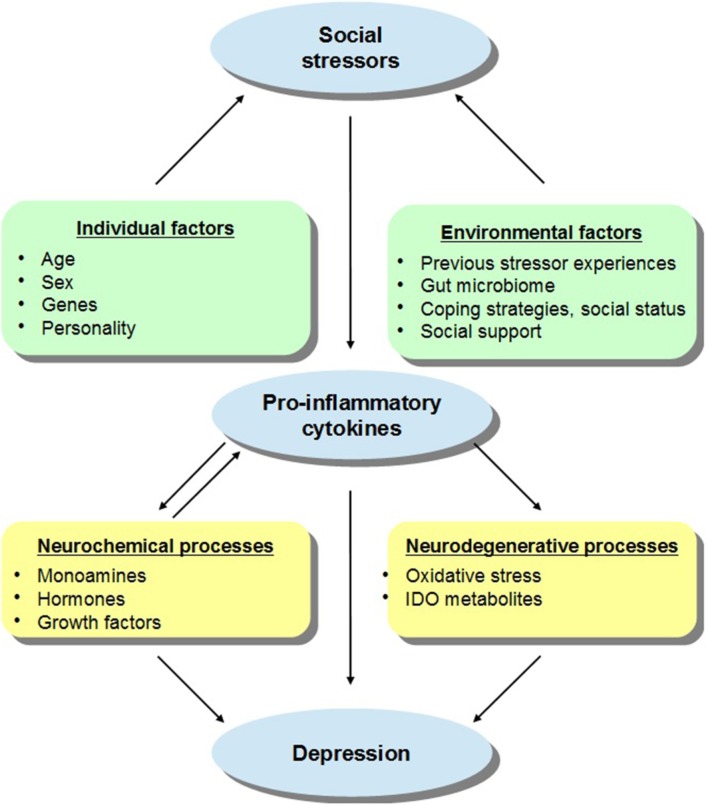
Stressful events have been implicated in the evolution of mood disorders. In addition to brain neurotransmitters and growth factors, the view has been offered that these disorders might be provoked by the activation of the inflammatory immune system as well as by de novo changes of inflammatory cytokines within the brain. The present review describes the impact of social stressors in animals and in humans on behavioral changes reminiscent of depressive states as well as on cytokine functioning. Social stressors increase pro-inflammatory cytokines in circulation as well as in brain regions that have been associated with depression, varying with the animal's social status and/or behavioral methods used to contend with social challenges. Likewise, in humans, social stressors that favor the development of depression are accompanied by elevated circulating cytokine levels and conversely, conditions that limit the cytokine elevations correlated with symptom attenuation or reversal. The implications of these findings are discussed in relation to the potentially powerful effects of social support, social identity, and connectedness in maintaining well-being and in diminishing symptoms of depression.
应激事件与情绪障碍的发生发展有关。除了大脑神经递质和生长因子外,还有观点认为,这些障碍可能是由炎症免疫系统的激活以及大脑内炎症细胞因子的新生变化所引发的。本综述描述了动物和人类社会应激源对类似于抑郁状态的行为变化以及细胞因子功能的影响。社会应激源会增加循环系统以及与抑郁症相关的脑区中的促炎细胞因子,其变化取决于动物的社会地位和/或应对社会挑战所采用的行为方式。同样,在人类中,有利于抑郁症发展的社会应激源伴随着循环细胞因子水平的升高,反之,限制细胞因子升高的情况则与症状减轻或逆转相关。本文将结合社会支持、社会认同和人际关系在维持幸福感以及减轻抑郁症状方面的潜在强大作用来讨论这些发现的意义。