Mitsiou Eleni, Kyriakou Aikaterini, Parlapani Eleni, Trigoni Anastasia, Trakatelli Myrto, Apalla Zoe, Sotiriadis Dimitrios, Lazaridou Elizabeth, Patsatsi Aikaterini
2nd Dermatology Department, Aristotle University School of Medicine, Papageorgiou Hospital, Thessaloniki, Greece.
1st Department of Psychiatry, Faculty of Medicine, Aristotle University of Thessaloniki, Thessaloniki, Greece.
Dermatol Pract Concept. 2024 Apr 1;14(2):e2024104. doi: 10.5826/dpc.1402a104.
Psoriasis is a systemic disease of the skin and nails associated with a wide range of comorbidities such as depression, psoriatic arthritis and metabolic syndrome.
The study aimed to examine a potential association between inflammatory markers (C- reactive protein [CRP] and erythrocyte sedimentation rate [ESR]) and depression in patients with psoriasis.
A total of 80 individuals were enrolled in the study. Case participants included 28 patients diagnosed with Psoriasis (Beck Depression Inventory-II: :0-13) and 24 patients diagnosed with Psoriasis and Depression (Beck Depression Inventory-II:14-63). Twenty-eight (28) healthy participants comprised the control group.Psoriasis severity was evaluated by using Psoriasis Area and Severity Index, Physician Global Assessment, Body Surface Area and Dermatology Life Quality Index. Written approval was obtained for its use in this study: Cardiff University (09/2015). Other factors considered in the study were obesity using the Body Mass Index, the levels of stress using the Beck Anxiety Inventory, and the presence of insomnia using the Athens Insomnia Scale. Blood draws and inflammatory markers measurements were performed for all participants.
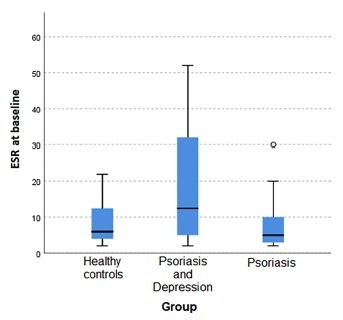
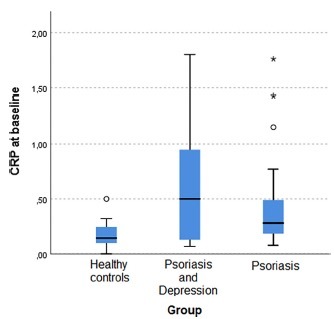
Both CRP and ESR levels were higher in the case group (ie Psoriasis and Depression and Psoriasis) compared to healthy controls. Furthermore, psoriatic patients with depression showed increased CRP and ESR levels compared to those of psoriatic patients without depression.
The evaluation of both CRP and ESR and their use to detect the presence of depression in patients with psoriasis can be an important tool for their holistic treatment of theirs.
银屑病是一种皮肤和指甲的系统性疾病,与多种合并症相关,如抑郁症、银屑病关节炎和代谢综合征。
本研究旨在探讨炎症标志物(C反应蛋白[CRP]和红细胞沉降率[ESR])与银屑病患者抑郁症之间的潜在关联。
共有80人参与本研究。病例参与者包括28例被诊断为银屑病的患者(贝克抑郁量表-II:0 - 13)和24例被诊断为银屑病且患有抑郁症的患者(贝克抑郁量表-II:14 - 63)。28名健康参与者组成对照组。使用银屑病面积和严重程度指数、医生整体评估、体表面积和皮肤病生活质量指数评估银屑病严重程度。已获得卡迪夫大学(2015年9月)批准将其用于本研究。本研究中考虑的其他因素包括使用体重指数评估肥胖情况、使用贝克焦虑量表评估压力水平以及使用雅典失眠量表评估失眠情况。对所有参与者进行抽血和炎症标志物测量。
与健康对照组相比,病例组(即银屑病且患有抑郁症和单纯银屑病患者)的CRP和ESR水平均更高。此外,与无抑郁症的银屑病患者相比,患有抑郁症的银屑病患者的CRP和ESR水平升高。
评估CRP和ESR并将其用于检测银屑病患者是否存在抑郁症,可能是对其进行整体治疗的重要工具。