Silvestri Elena, Coppola Maria, Cioffi Federica, Goglia Fernando
Dipartimento di Scienze e Tecnologie, Università degli Studi del Sannio Benevento, Italy.
Front Physiol. 2014 Dec 17;5:491. doi: 10.3389/fphys.2014.00491. eCollection 2014.
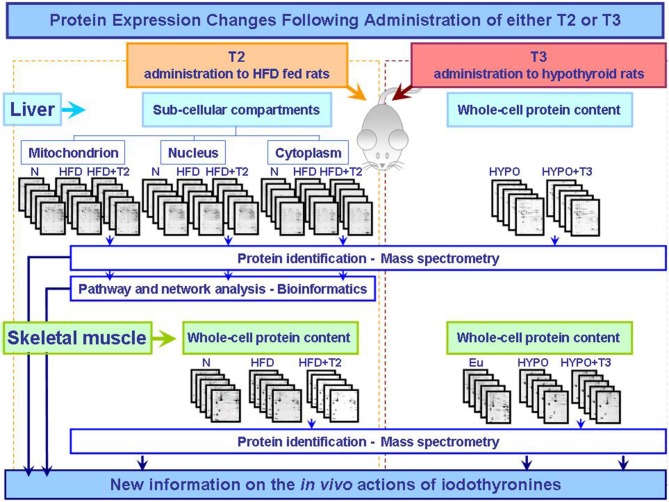
In vertebrates and, specifically, in mammals, energy homeostasis is achieved by the integration of metabolic and neuroendocrine signals linked to one another in an intricate network hierarchically responding to the tight modulating action of hormones among which thyroid hormones (THs) play a central role. At the cellular level, 3,5,3'-triiodo-L-thyronine (T3) acts mainly by binding to specific nuclear receptors (TRs) but actually it is becoming more and more evident that some T3- actions are independent of TRs and that other iodothyronines, such as 3,5-diiodo-L-thyronine (T2), affect energy metabolism and adiposity. In the postgenomic era, clinical and basic biological researches are increasingly benefiting from the recently developed new omics approaches including, among the others, proteomics. Considering the recognized value of proteins as excellent targets in physiology, the functional and simultaneous analysis of the expression level and the cellular localization of multiple proteins can actually be considered fundamental in the understanding of complex mechanisms such as those involved in thyroid control of metabolism. Here, we will discuss new leads (i.e., target proteins and metabolic pathways) emerging in applying proteomics to the actions of T3 and T2 in conditions of altered energy metabolism in animal tissues having a central role in the control of energy balance.
在脊椎动物,特别是哺乳动物中,能量稳态是通过代谢和神经内分泌信号的整合来实现的,这些信号在一个复杂的网络中相互关联,对激素的严格调节作用进行分级响应,其中甲状腺激素(THs)起着核心作用。在细胞水平上,3,5,3'-三碘-L-甲状腺原氨酸(T3)主要通过与特定的核受体(TRs)结合发挥作用,但实际上越来越明显的是,一些T3的作用独立于TRs,并且其他碘甲状腺原氨酸,如3,5-二碘-L-甲状腺原氨酸(T2),也会影响能量代谢和肥胖。在后基因组时代,临床和基础生物学研究越来越受益于最近开发的新组学方法,其中包括蛋白质组学。考虑到蛋白质作为生理学中优秀靶点的公认价值,对多种蛋白质的表达水平和细胞定位进行功能和同步分析,实际上对于理解诸如甲状腺控制代谢所涉及的复杂机制至关重要。在此,我们将讨论在将蛋白质组学应用于T3和T2在动物组织能量代谢改变条件下的作用时出现的新线索(即靶蛋白和代谢途径),这些动物组织在能量平衡控制中起核心作用。