Van Wilgenburg Ellen, Torres Candice W, Tsutsui Neil D
Department of Environmental Science, Policy and Management, University of California Berkeley, CA, USA ; Department of Zoology, University of Melbourne Melbourne, Vic., Australia.
Department of Environmental Science, Policy and Management, University of California Berkeley, CA, USA.
Evol Appl. 2010 Mar;3(2):136-43. doi: 10.1111/j.1752-4571.2009.00114.x.
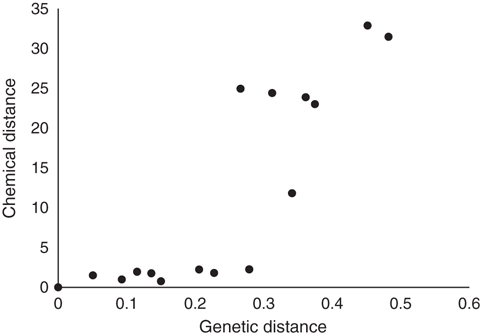
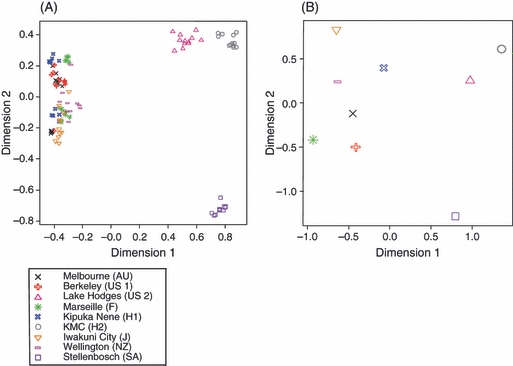
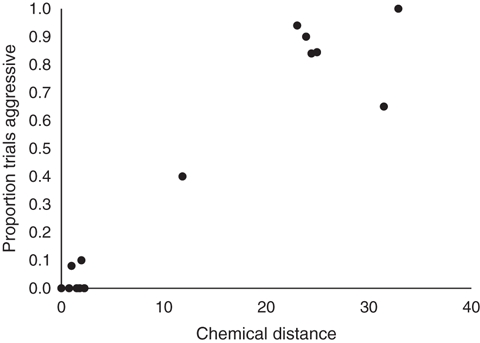
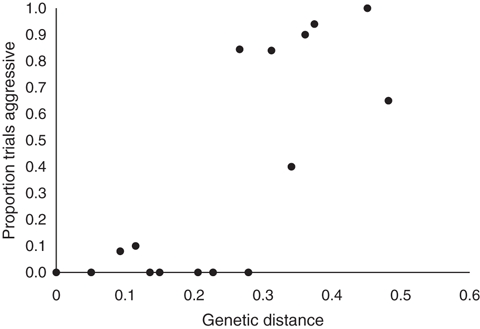
Ants are among the most damaging invasive species, and their success frequently arises from the widespread cooperation displayed by introduced populations, often across hundreds of kilometers. Previous studies of the invasive Argentine ant (Linepithema humile) have shown that introduced populations on different continents each contain a single, vast supercolony and, occasionally, smaller secondary colonies. Here, we perform inter-continental behavioral analyses among supercolonies in North America, Europe, Asia, Hawaii, New Zealand and Australia and show that these far-flung supercolonies also recognize and accept each other as if members of a single, globally distributed supercolony. Furthermore, populations also possess similar genetic and chemical profiles. However, these ants do show aggression toward ants from South Africa and the smaller secondary colonies that occur in Hawaii and California. Thus, the largest and most dominant introduced populations are likely descended from the same ancestral colony and, despite having been established more than 100 years ago, have diverged very little. This apparent evolutionary stasis is surprising because, in other species, some of the most rapid rates of evolutionary change have occurred in introduced populations. Given the spatial extent of the Argentine ant society we report here, there can be little doubt that this intercontinental supercolony represents the most populous known animal society.
蚂蚁是最具破坏力的入侵物种之一,它们的成功常常源于引入种群所展现出的广泛合作,这种合作往往跨越数百公里。此前对入侵性阿根廷蚁(Linepithema humile)的研究表明,不同大陆上的引入种群各自都包含一个单一的、庞大的超级蚁群,偶尔还会有较小的次级蚁群。在此,我们对北美、欧洲、亚洲、夏威夷、新西兰和澳大利亚的超级蚁群进行了洲际行为分析,结果显示这些分布广泛的超级蚁群也能相互识别并接纳,就好像它们是一个全球分布的超级蚁群的成员一样。此外,不同种群在基因和化学特征方面也很相似。然而,这些蚂蚁确实会对来自南非的蚂蚁以及夏威夷和加利福尼亚出现的较小次级蚁群表现出攻击性。因此,最大且最具主导性的引入种群可能都源自同一个祖先蚁群,尽管它们在100多年前就已建立,但分化却非常小。这种明显的进化停滞令人惊讶,因为在其他物种中,一些最快速的进化变化发生在引入种群中。鉴于我们在此报告的阿根廷蚁社会的空间范围,毫无疑问,这个洲际超级蚁群代表了已知的人口最多的动物社会。