Suhr Elissa L, O'Dowd Dennis J, McKechnie Stephen W, Mackay Duncan A
Australian Centre for Biodiversity, School of Biological Sciences, Monash University Clayton, Vic., Australia ; Centre of Environmental Stress and Adaptation Research, School of Biological Sciences, Monash University Clayton, Vic., Australia.
Australian Centre for Biodiversity, School of Biological Sciences, Monash University Clayton, Vic., Australia.
Evol Appl. 2011 May;4(3):471-84. doi: 10.1111/j.1752-4571.2010.00161.x. Epub 2010 Dec 6.
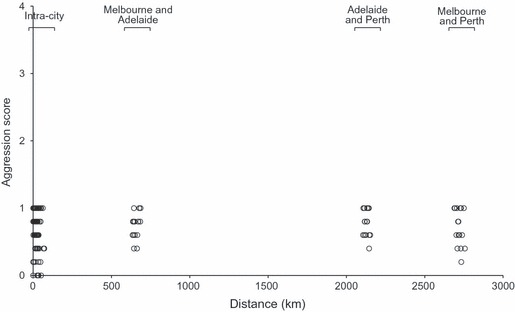
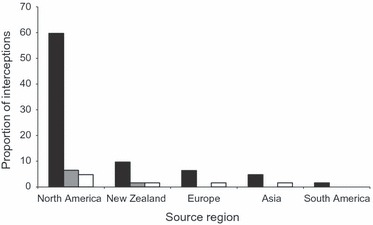
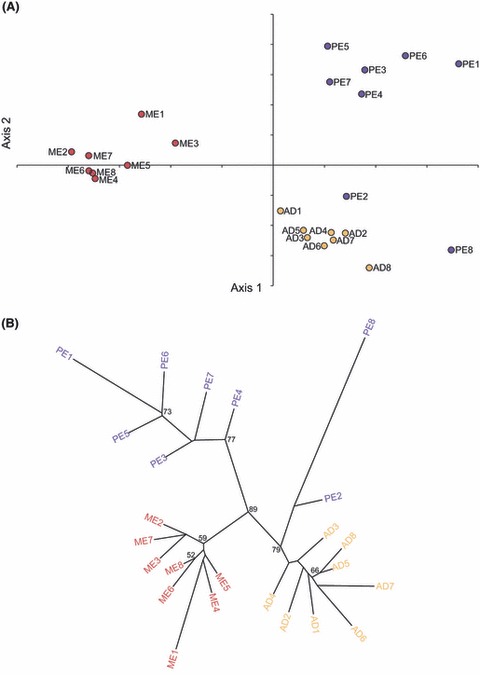
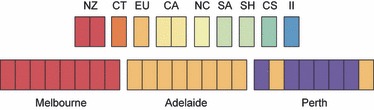
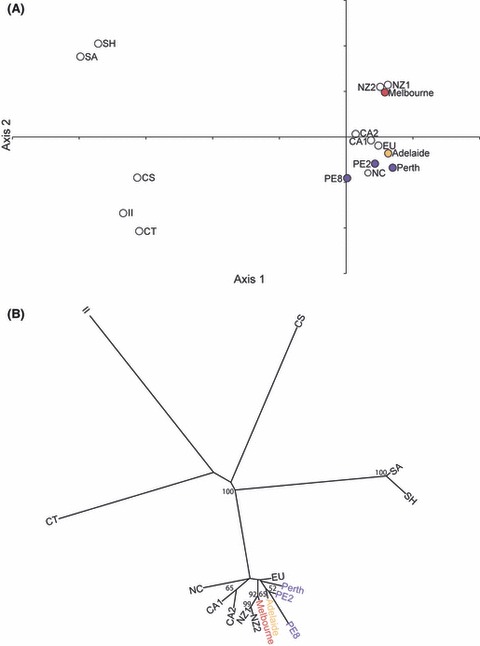
Biological invasions have significant ecological, evolutionary and economic consequences. Ants are exemplary invaders and their invasion success is frequently attributed to a shift in social structure between native and introduced populations. Here, we use a multidisciplinary approach to determine the social structure, origin and expansion of the invasive Argentine ant, Linepithema humile, in Australia by linking behavioural and genetic studies with indicators of dispersal pathways and propagule pressure. Behavioural assays revealed a complete absence of aggression within and between three cities - Melbourne, Adelaide and Perth - spanning 2700 km across Australia. Microsatellite analyses showed intracity genetic homogeneity and limited but significant intercity genetic differentiation. Exceptions were two Perth nests that likely represent independent translocations from Adelaide. These patterns suggest efficient local gene flow with more limited jump dispersal via transport corridors between cities. Microsatellite analyses of L. humile from potential source regions, combined with data from port interceptions, trade pathways and the timeline of spread within Australia, implicate the main European supercolony as the source of L. humile in Melbourne. Such an introduction probably then redistributed across Australia and spread to New Zealand to form an expansive Australasian supercolony.
生物入侵具有重大的生态、进化和经济后果。蚂蚁是典型的入侵物种,它们的入侵成功往往归因于本地种群和引入种群之间社会结构的转变。在这里,我们采用多学科方法,通过将行为和遗传研究与扩散途径和繁殖体压力指标相结合,来确定入侵性阿根廷蚁(Linepithema humile)在澳大利亚的社会结构、起源和扩张情况。行为分析表明,在澳大利亚境内横跨2700公里的三个城市——墨尔本、阿德莱德和珀斯——内部以及它们之间完全不存在攻击性。微卫星分析显示,城市内部基因具有同质性,城市间基因存在有限但显著的分化。例外情况是珀斯的两个蚁巢,它们可能代表从阿德莱德独立迁移而来的种群。这些模式表明,当地基因流动高效,而通过城市间运输走廊的跳跃扩散则较为有限。对潜在源地区域的阿根廷蚁进行微卫星分析,并结合港口截获数据、贸易途径以及在澳大利亚境内的传播时间线,表明欧洲的主要超级蚁群是墨尔本阿根廷蚁的来源。这样的引入可能随后在澳大利亚各地重新分布,并扩散到新西兰,形成一个庞大的澳大拉西亚超级蚁群。