Lajbner Zdeněk, Linhart Otomar, Kotlík Petr
Laboratory of Fish Genetics, Department of Vertebrate Evolutionary Biology and Genetics, Institute of Animal Physiology and Genetics, Academy of Sciences of the Czech Republic Liběchov, Czech Republic ; Department of Zoology, Faculty of Science, Charles University Prague, Czech Republic.
University of South Bohemia, České Budějovice, Faculty of Fisheries and Protection of Waters, Research Institute of Fish Culture and Hydrobiology at Vodňany Czech Republic.
Evol Appl. 2011 Jul;4(4):545-61. doi: 10.1111/j.1752-4571.2010.00174.x. Epub 2011 Jan 5.
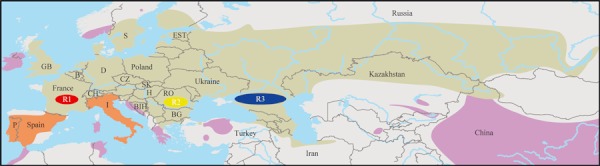
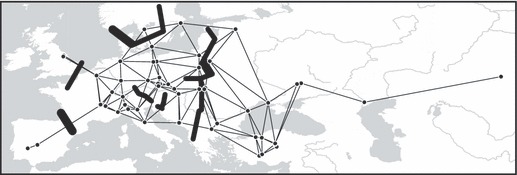
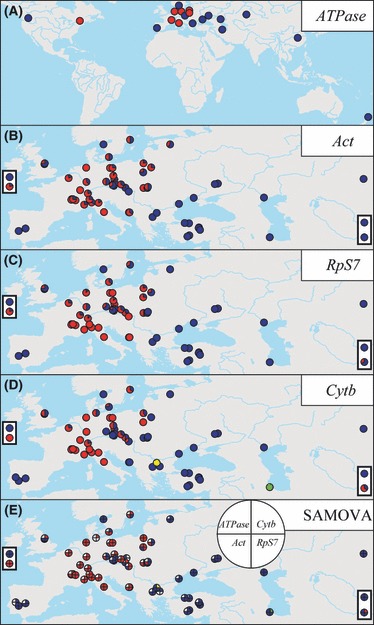
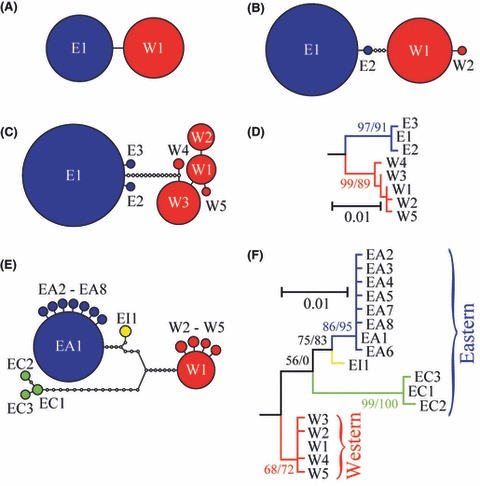
Human-aided dispersal can result in phylogeographic patterns that do not reflect natural historical processes, particularly in species prone to intentional translocations by humans. Here, we use a multiple-gene sequencing approach to assess the effects of human-aided dispersal on phylogeography of the tench Tinca tinca, a widespread Eurasian freshwater fish with a long history in aquaculture. Spatial genetic analysis applied to sequence data from four unlinked loci and 67 geographic localities (38-382 gene copies per locus) defined two groups of populations that were little structured geographically but were significantly differentiated from each other, and it identified locations of major genetic breaks, which were concordant across genes and were driven by distributions of two phylogroups. This pattern most reasonably reflects isolation in two major glacial refugia and subsequent range expansions, with the Eastern and Western phylogroups remaining largely allopatric throughout the tench range. However, this phylogeographic variation was also present in all 17 cultured breeds studied, and some populations at the western edge of the native range contained the Eastern phylogroup. Thus, natural processes have played an important role in structuring tench populations, but human-aided dispersal has also contributed significantly, with the admixed genetic composition of cultured breeds most likely contributing to the introgression.
人类辅助扩散可能导致系统发育地理格局无法反映自然历史过程,尤其是对于那些容易被人类有意迁移的物种。在此,我们采用多基因测序方法,评估人类辅助扩散对丁鱥(Tinca tinca)系统发育地理学的影响,丁鱥是一种广泛分布于欧亚大陆的淡水鱼,在水产养殖方面有着悠久历史。对来自四个不连锁基因座和67个地理位点(每个基因座38 - 382个基因拷贝)的序列数据进行空间遗传分析,确定了两组种群,它们在地理上结构松散,但彼此间存在显著分化,并识别出主要遗传间断的位置,这些位置在各基因间是一致的,且由两个系统发育类群的分布驱动。这种格局最合理地反映了在两个主要冰川避难所中的隔离以及随后的范围扩张,在丁鱥分布范围内,东部和西部系统发育类群在很大程度上保持异域分布。然而,在所有研究的17个养殖品种中也存在这种系统发育地理变异,并且在原生分布范围西边缘的一些种群包含东部系统发育类群。因此,自然过程在丁鱥种群结构形成中发挥了重要作用,但人类辅助扩散也有显著贡献,养殖品种的混合遗传组成很可能导致了基因渗入。