Kardasevic Mediha, Kardasevic Amel
Cantonal Hospital Bihac, Bihac, Bosnia and Herzegovina.
Med Arch. 2014 Aug;68(4):282-4. doi: 10.5455/medarh.2014.68.282-284. Epub 2014 Jul 31.
Heart murmurs can be functional (innocent) and pathological (organic). Although it is not considered a major sign of heart disease, it may be a sign of a serious heart defect. In most cases the noise is initiation for cardiac treatment. Is it possible to differentiate on the basis of auscultation innocent from pathological heart murmur? In this article we present the results of ultrasonography of newborns with positive auscultation finding of the heart in the neonatal and early infancy period.
To determine the role of murmurs in the heart detected by routine clinical examination in the neonatal period and early infancy, and to establish the legitimacy of cardiology consultation and ultrasound of the heart.
A retrospective review of medical records in the period from January 1 to December 31, 2011 at the Maternity ward of Cantonal Hospital in Bihac 1899 children was born. In 32 neonates was registered a heart murmur, in the period from birth up to 6 weeks of life. All children with positive auscultation finding of the heart were examined echocardiography by ultrasound ALOCA 2000, multifrequency probe from 3.5 to 5 MHz, and used M-mode, 2-D, continuous, pulsed and color Doppler.
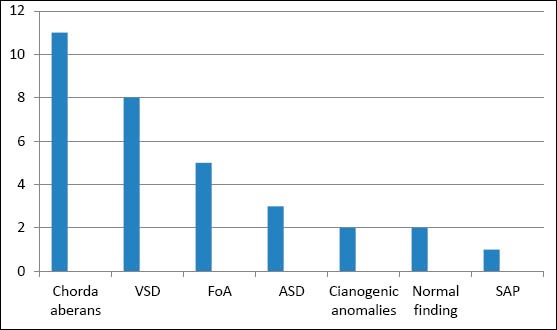
Of the 32 examined children regular echocardiographic findings had two children (6.25%), aberrant bunch of left ventricle 11 (34.37%), patent foramen ovale 5 (15.62%), atrial septal defect 3 children (9.37%), ventricular septal defect 8 children (25%), cyanogen anomaly 2 children (6.25%), stenosis of the pulmonary artery 1 child (3.12%). We see that 14 children (43.75%) had a structural abnormality of the heart that requires further treatment and monitoring.
Echocardiography is necessary to set up or refute the diagnosis of structural heart defect in children with positive auscultation finding in the neonatal period.
心脏杂音可分为功能性(无害性)和病理性(器质性)。尽管它不被视为心脏病的主要体征,但可能是严重心脏缺陷的迹象。在大多数情况下,这种杂音是心脏治疗的起始原因。是否有可能通过听诊区分无害性心脏杂音和病理性心脏杂音?在本文中,我们展示了在新生儿期和婴儿早期心脏听诊结果呈阳性的新生儿的超声检查结果。
确定新生儿期和婴儿早期常规临床检查发现的心脏杂音的作用,并确定心脏科会诊和心脏超声检查的合理性。
回顾性分析2011年1月1日至12月31日期间比哈奇1899年州立医院产科病房出生的1899名儿童的病历。在出生至6周龄期间,有32名新生儿被记录有心脏杂音。所有心脏听诊结果呈阳性的儿童均使用ALOCA 2000超声心动图仪进行超声心动图检查,使用3.5至5MHz的多频探头,并采用M型、二维、连续、脉冲和彩色多普勒技术。
在32名接受检查的儿童中,超声心动图检查结果正常的有2名儿童(6.25%),左心室异常束11名(34.37%),卵圆孔未闭5名(15.62%),房间隔缺损3名儿童(9.37%),室间隔缺损8名儿童(25%),发绀异常2名儿童(6.25%),肺动脉狭窄1名儿童(3.12%)。我们发现14名儿童(43.75%)存在需要进一步治疗和监测的心脏结构异常。
对于新生儿期心脏听诊结果呈阳性的儿童,超声心动图检查对于确立或排除结构性心脏缺陷的诊断是必要的。