Kim Yeo-Kyeoung, Lee Seung-Shin, Jeong Sung-Hoon, Ahn Jae-Sook, Yang Deok-Hwan, Lee Je-Jung, Shin Myung-Geun, Kim Hyeoung-Joon
Department of Hematology-Oncology, Hematology Clinics, Chonnam National University Hwasun Hospital, Gwangju, Korea.
Department of Laboratory Medicine, Chonnam National University Medical School, Gwangju, Korea.
Chonnam Med J. 2014 Dec;50(3):102-11. doi: 10.4068/cmj.2014.50.3.102. Epub 2014 Dec 17.
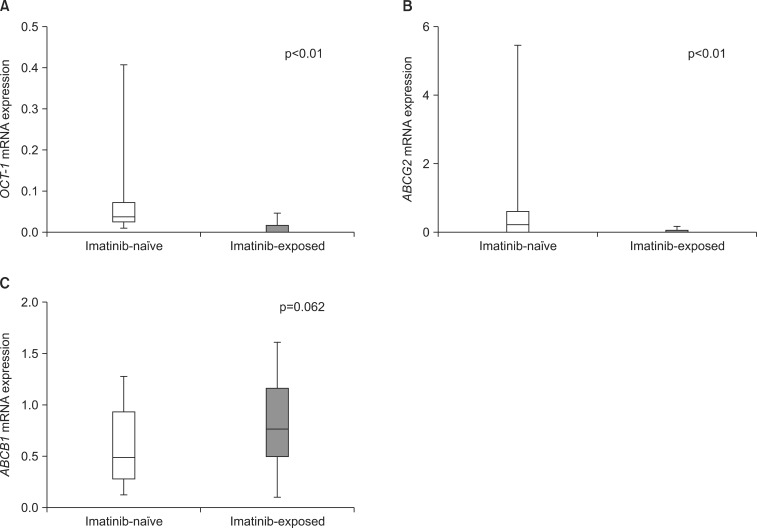
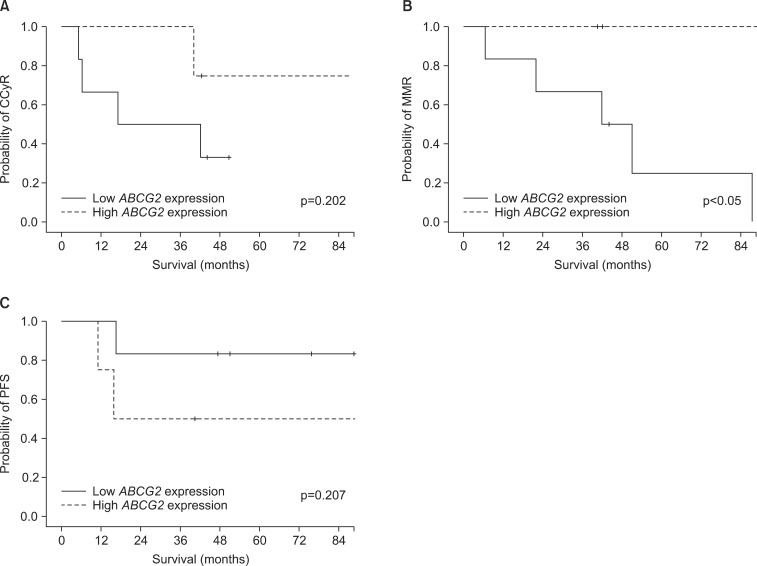
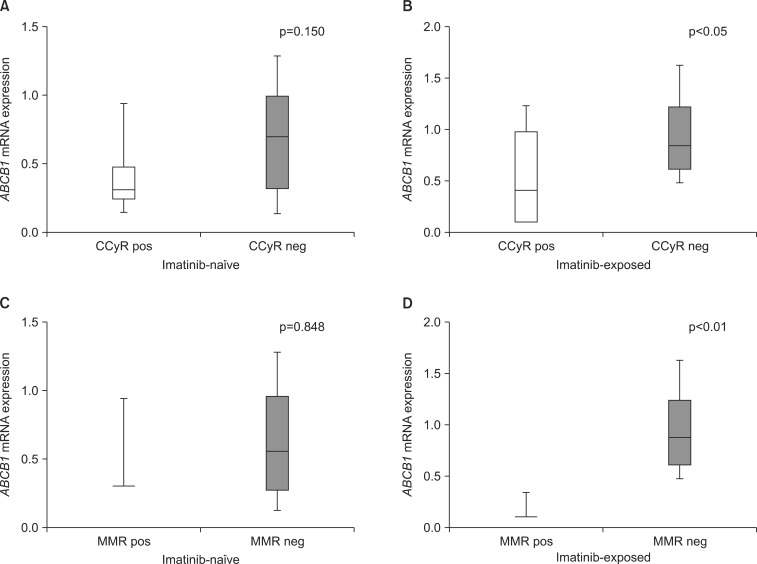
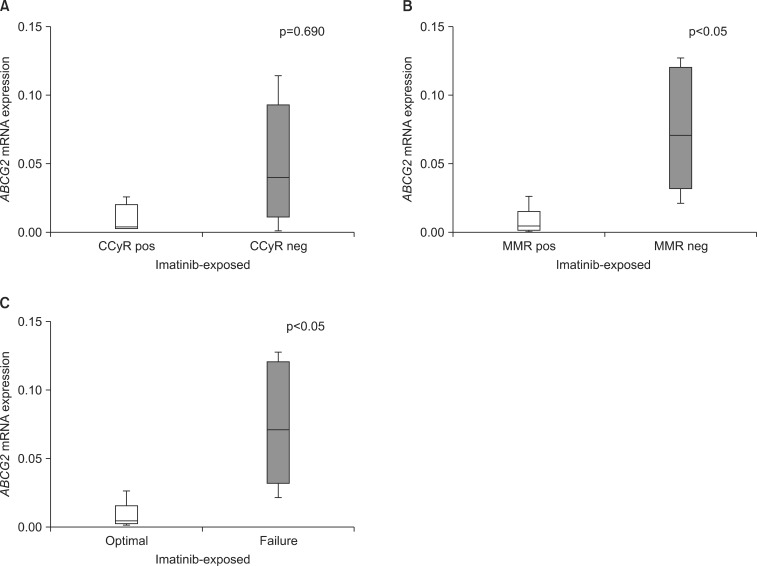
This study explored drug transporter expression levels and their impact on clinical response to imatinib and second-generation tyrosine kinase inhibitors (TKIs) in imatinib- resistant chronic myeloid leukemia (CML). Imatinib-resistant chronic phase CML patients treated with dasatinib (n=10) and nilotinib (n=12) were enrolled. The mRNA expression of the OCT-1, ABCG2, and ABCB1 genes was quantified by using paired bone marrow samples obtained before administering imatinib and at the point of detecting imatinib resistance (just before starting second-generation TKIs). The expression levels of OCT-1 and ABCG2 were lower in follow-up than in imatinib-naïve samples. ABCB1 revealed highly variable expression levels before and after imatinib treatment. In addition, median ABCB1 expression in follow-up samples was lower in patients achieving complete cytogenetic response or major molecular response during imatinib treatment than in failed patients. Higher ABCG2 expression in imatinib-exposed samples showed a negative impact on optimal response to dasatinib. Patients with higher ABCG2 expression in imatinib-exposed samples also had shorter progression- free survival with dasatinib treatment. However, no significant correlation was found between these drug transporter expression levels in imatinib-naïve or imatinib- exposed samples and responses to nilotinib. In imatinib-resistant CML, OCT-1 and ABCG2 mRNA expression decreased after imatinib treatment. Patients with higher ABCG2 expression in imatinib-exposed samples showed poor treatment outcome with dasatinib. On the other hand, a higher expression level of ABCB1 in imatinib-exposed samples did not affect second-generation TKI responses but was correlated with poor imatinib responses.
本研究探讨了药物转运体的表达水平及其对伊马替尼耐药的慢性髓性白血病(CML)患者对伊马替尼及第二代酪氨酸激酶抑制剂(TKIs)临床反应的影响。纳入了接受达沙替尼(n = 10)和尼洛替尼(n = 12)治疗的伊马替尼耐药慢性期CML患者。通过使用在给予伊马替尼之前以及检测到伊马替尼耐药时(即将开始第二代TKIs治疗之前)获取的配对骨髓样本,对OCT-1、ABCG2和ABCB1基因的mRNA表达进行定量分析。随访时OCT-1和ABCG2的表达水平低于未接受过伊马替尼治疗的样本。ABCB1在伊马替尼治疗前后的表达水平变化很大。此外,在伊马替尼治疗期间实现完全细胞遗传学缓解或主要分子反应的患者,其随访样本中的ABCB1中位表达水平低于治疗失败的患者。伊马替尼暴露样本中较高的ABCG2表达对达沙替尼的最佳反应有负面影响。伊马替尼暴露样本中ABCG2表达较高的患者接受达沙替尼治疗时的无进展生存期也较短。然而,在未接受过伊马替尼治疗或已接受伊马替尼治疗的样本中,这些药物转运体的表达水平与对尼洛替尼的反应之间未发现显著相关性。在伊马替尼耐药的CML中,伊马替尼治疗后OCT-1和ABCG2 mRNA表达下降。伊马替尼暴露样本中ABCG2表达较高的患者接受达沙替尼治疗的效果较差。另一方面,伊马替尼暴露样本中较高的ABCB1表达水平不影响对第二代TKIs的反应,但与伊马替尼反应不佳相关。