1] Division of Respiratory Medicine, School of Medicine, University of Nottingham, Nottingham, UK [2] Medical Research Institute of New Zealand, Wellington, New Zealand.
1] Medical Research Institute of New Zealand, Wellington, New Zealand [2] Capital & Coast District Health Board, Wellington, New Zealand.
NPJ Prim Care Respir Med. 2015 Jan 8;25:14099. doi: 10.1038/npjpcrm.2014.99.
Patterns of inhaled β2-agonist therapy use during severe asthma exacerbations before hospital attendance are poorly understood.
To assess β2-agonist use prior to hospital attendance.
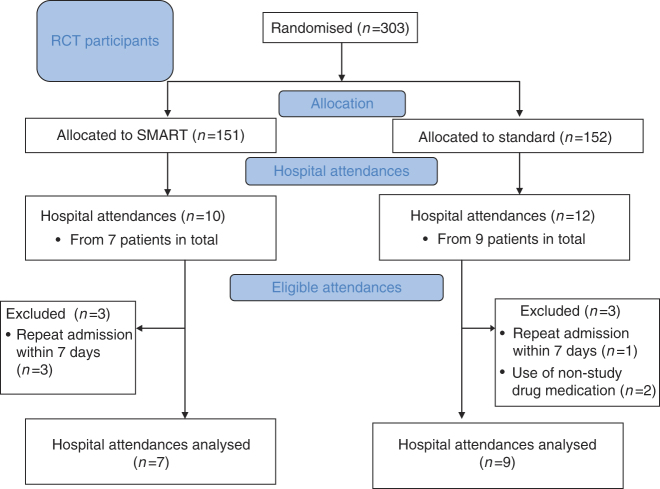
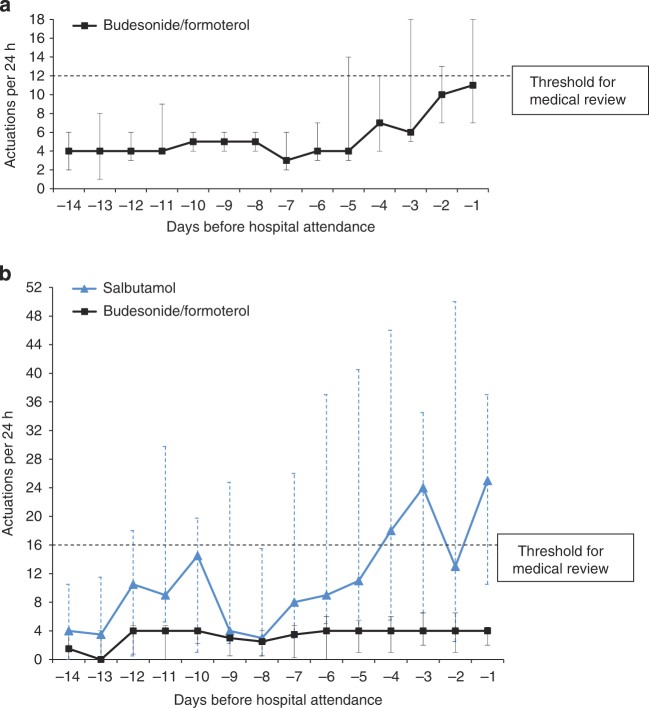
We undertook an exploratory post hoc analysis of data from a 6-month clinical trial of 303 patients randomised to combination budesonide/formoterol inhaler according to a Single combination inhaler as Maintenance And Reliever Therapy regimen ('SMART') or fixed-dose budesonide/formoterol with salbutamol as reliever ('Standard'). Patterns of β2-agonist use for 14 days before hospital attendance with a severe asthma exacerbation were determined by electronic monitoring of inhaler use.
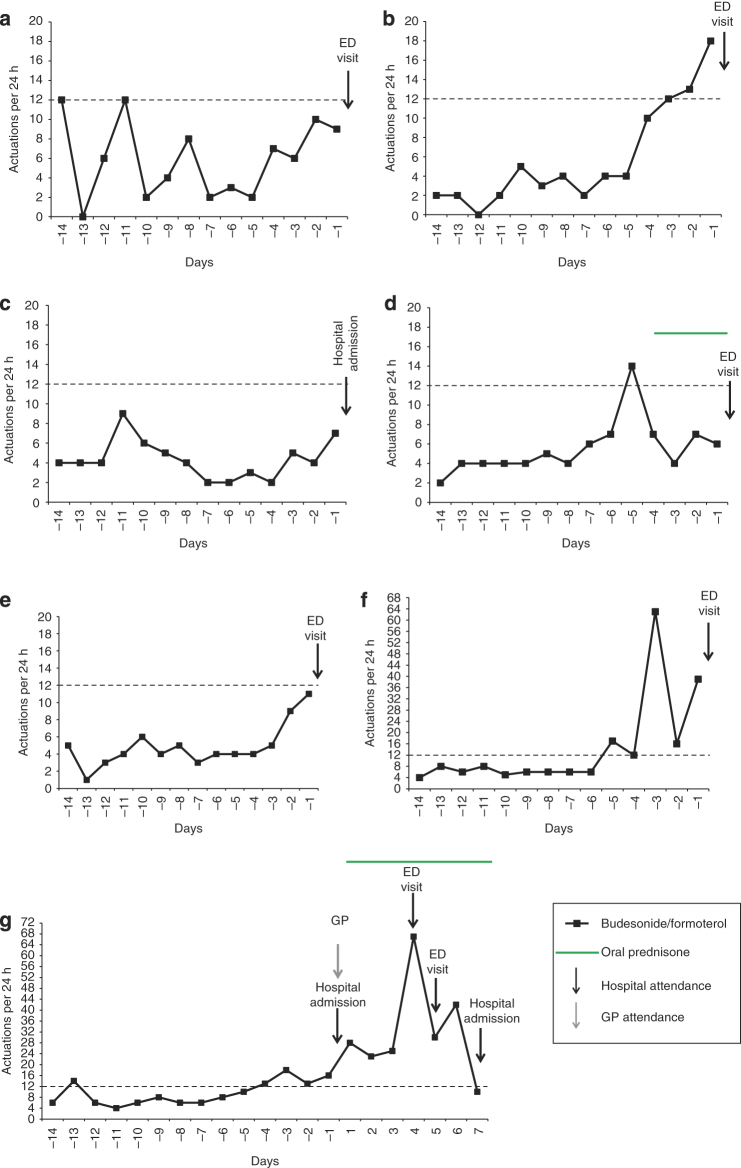
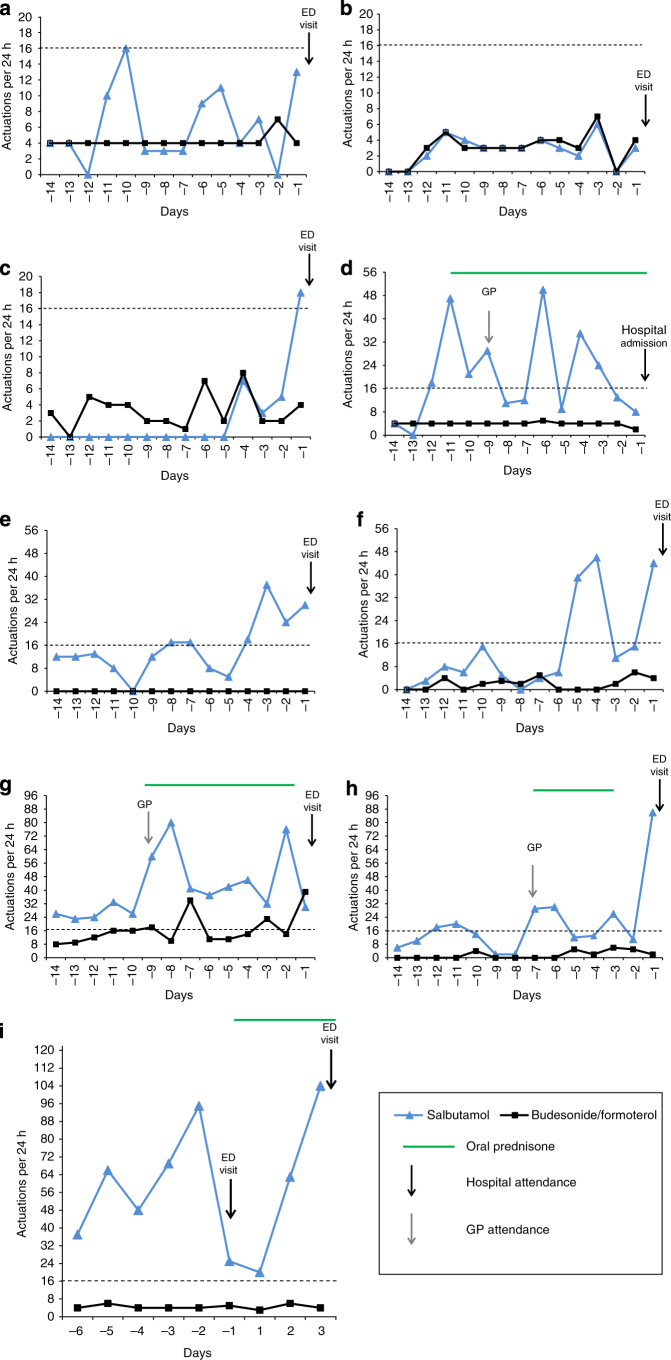
There were 22 hospital attendances in 16 patients during the study. Seven and nine hospital attendances were eligible for analysis in the SMART and Standard groups, respectively. In both regimens, β2-agonist use increased before hospital attendance, with a median (range) maximum daily number of actuations of 14 (9 to 63) budesonide/formoterol in SMART and 46 (6 to 95) salbutamol in Standard with 4 (0 to 10) budesonide/formoterol actuations on the day of maximal salbutamol use. There was delay in obtaining medical review despite high β2-agonist use, in 9/16 patients. Different patterns of use were observed, including repeated days of no inhaled corticosteroid despite marked salbutamol use, which occurred in 3/9 patients in the Standard group.
Delay in obtaining medical review in association with high β2-agonist use is common in patients before hospital presentation with severe exacerbations of asthma. The SMART regimen reduced nonadherence with inhaled corticosteroid therapy during severe exacerbations.
在前往医院就诊之前,严重哮喘恶化期间吸入β2-激动剂治疗的模式了解甚少。
评估在前往医院就诊之前β2-激动剂的使用情况。
我们对一项为期 6 个月的临床试验中 303 名患者的数据进行了探索性事后分析,这些患者根据单联合吸入器作为维持和缓解治疗方案(“SMART”)或固定剂量布地奈德/福莫特罗与沙丁胺醇作为缓解剂(“标准”)随机分配至布地奈德/福莫特罗吸入器治疗。通过电子监测吸入器的使用情况,确定在因严重哮喘恶化而住院就诊前 14 天内β2-激动剂的使用模式。
在研究期间,16 名患者中有 22 人住院就诊。SMART 和标准组分别有 7 次和 9 次住院就诊符合分析条件。在这两种方案中,β2-激动剂的使用在住院就诊前增加,SMART 组中最大日使用量中位数(范围)为 14(9 至 63)次布地奈德/福莫特罗,标准组中为 46(6 至 95)次沙丁胺醇,在最大沙丁胺醇使用日,布地奈德/福莫特罗的使用量为 4(0 至 10)次。尽管β2-激动剂使用量较高,但有 9/16 名患者未能及时获得医疗审查。观察到不同的使用模式,包括尽管大量使用沙丁胺醇,但仍有 3/9 名标准组患者出现连续几天未使用吸入性皮质类固醇的情况。
在因严重哮喘恶化而住院就诊前,β2-激动剂使用量高的患者常出现获得医疗审查的延迟。SMART 方案减少了在严重哮喘恶化期间吸入皮质激素治疗的不依从性。