Fayle Tom M, Edwards David P, Foster William A, Yusah Kalsum M, Turner Edgar C
Faculty of Science, University of South Bohemia, Branišovská 31, 370 05, České Budějovice, Czech Republic,
Oecologia. 2015 Jun;178(2):441-50. doi: 10.1007/s00442-014-3208-z. Epub 2015 Jan 10.
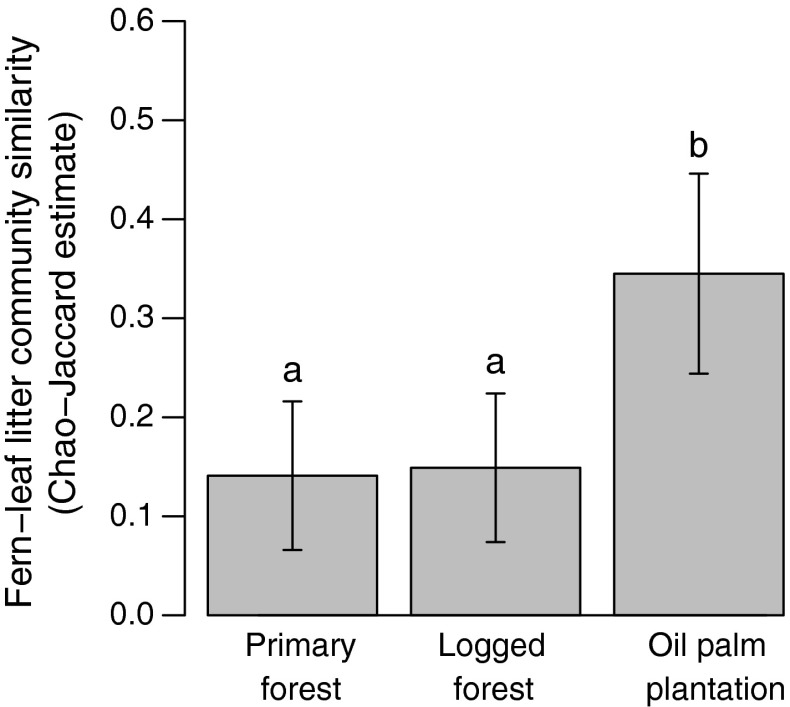
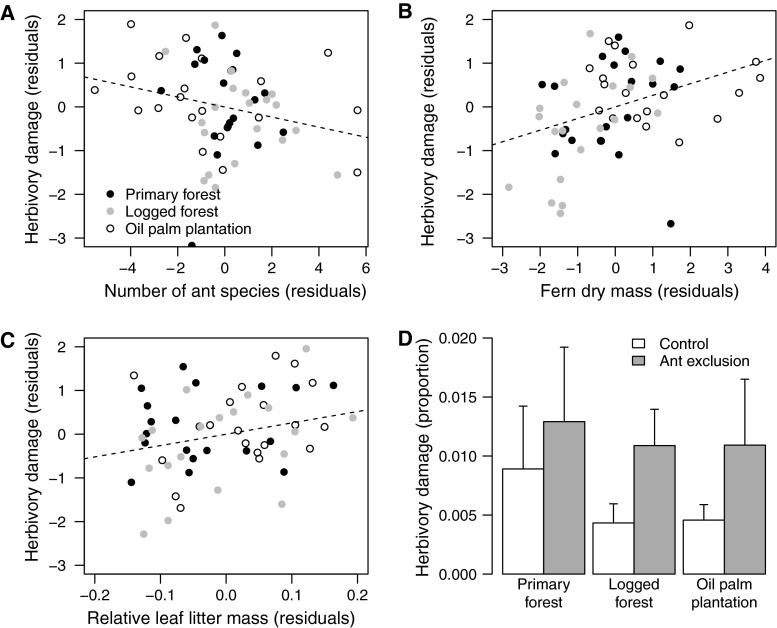
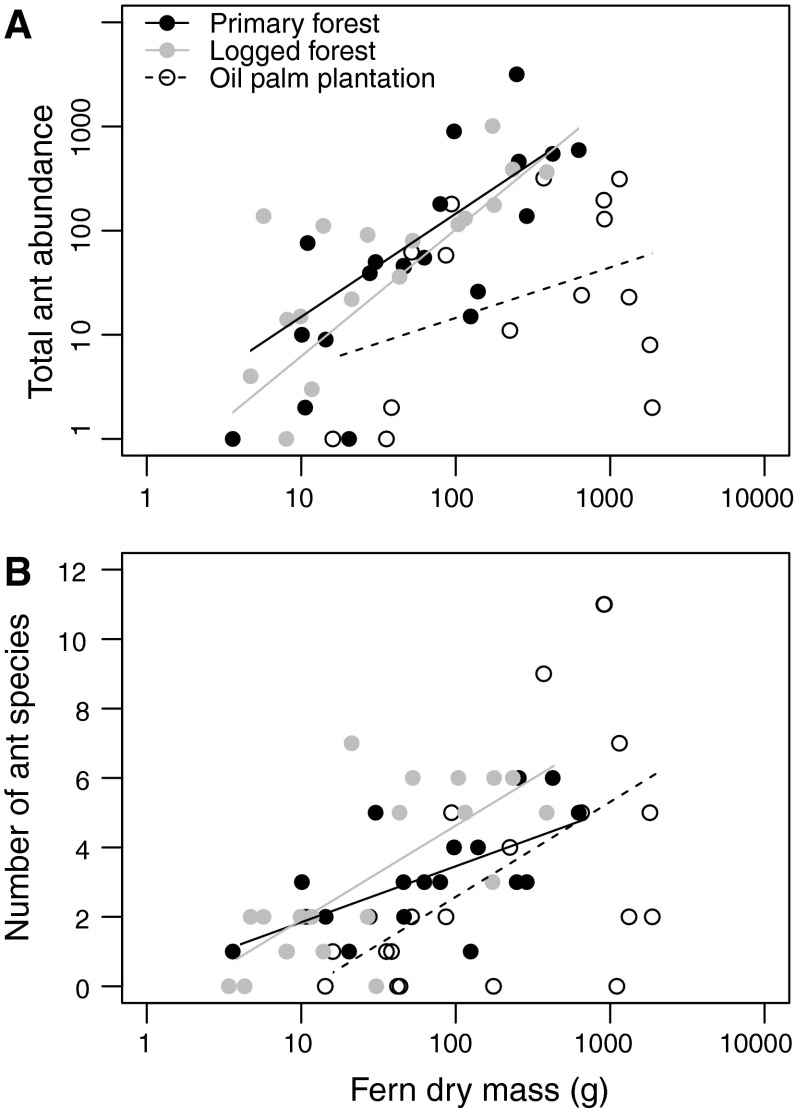
Anthropogenic disturbance and the spread of non-native species disrupt natural communities, but also create novel interactions between species. By-product mutualisms, in which benefits accrue as side effects of partner behaviour or morphology, are often non-specific and hence may persist in novel ecosystems. We tested this hypothesis for a two-way by-product mutualism between epiphytic ferns and their ant inhabitants in the Bornean rain forest, in which ants gain housing in root-masses while ferns gain protection from herbivores. Specifically, we assessed how the specificity (overlap between fern and ground-dwelling ants) and the benefits of this interaction are altered by selective logging and conversion to an oil palm plantation habitat. We found that despite the high turnover of ant species, ant protection against herbivores persisted in modified habitats. However, in ferns growing in the oil palm plantation, ant occupancy, abundance and species richness declined, potentially due to the harsher microclimate. The specificity of the fern-ant interactions was also lower in the oil palm plantation habitat than in the forest habitats. We found no correlations between colony size and fern size in modified habitats, and hence no evidence for partner fidelity feedbacks, in which ants are incentivised to protect fern hosts. Per species, non-native ant species in the oil palm plantation habitat (18 % of occurrences) were as important as native ones in terms of fern protection and contributed to an increase in ant abundance and species richness with fern size. We conclude that this by-product mutualism persists in logged forest and oil palm plantation habitats, with no detectable shift in partner benefits. Such persistence of generalist interactions in novel ecosystems may be important for driving ecosystem functioning.
人为干扰和外来物种的扩散破坏了自然群落,但也创造了物种之间新的相互作用。副产品共生关系中,益处作为伙伴行为或形态的副作用而产生,通常是非特异性的,因此可能在新生态系统中持续存在。我们针对婆罗洲雨林中附生蕨类植物与其蚂蚁栖息者之间的双向副产品共生关系检验了这一假设,在这种关系中,蚂蚁在根团中获得住所,而蕨类植物则免受食草动物的侵害。具体而言,我们评估了这种相互作用的特异性(蕨类植物与地面栖息蚂蚁之间的重叠)和益处如何因选择性采伐以及转变为油棕种植园栖息地而改变。我们发现,尽管蚂蚁物种更替频繁,但在改良栖息地中,蚂蚁对食草动物的保护作用依然存在。然而,在油棕种植园中生长的蕨类植物,蚂蚁的占据率、数量和物种丰富度有所下降,这可能是由于更恶劣的小气候所致。在油棕种植园栖息地中,蕨类植物与蚂蚁相互作用的特异性也低于森林栖息地。我们在改良栖息地中未发现蚁群大小与蕨类植物大小之间的相关性,因此也没有证据表明存在伙伴忠诚反馈,即蚂蚁受到激励去保护蕨类植物宿主。就每个物种而言,油棕种植园栖息地中的非本地蚂蚁物种(占出现次数的18%)在保护蕨类植物方面与本地蚂蚁物种同样重要,并且随着蕨类植物大小的增加,其数量和物种丰富度也有所增加。我们得出结论,这种副产品共生关系在采伐后的森林和油棕种植园栖息地中持续存在,伙伴益处没有可检测到的变化。这种在新生态系统中普遍存在的相互作用的持续性对于推动生态系统功能可能很重要。