Koike Haruki, Akiyama Kazuo, Saito Toyokazu, Sobue Gen
Department of Neurology, Nagoya University Graduate School of Medicine, Nagoya, 466-8550, Japan.
J Neurol. 2015 Mar;262(3):752-9. doi: 10.1007/s00415-014-7618-y. Epub 2015 Jan 11.
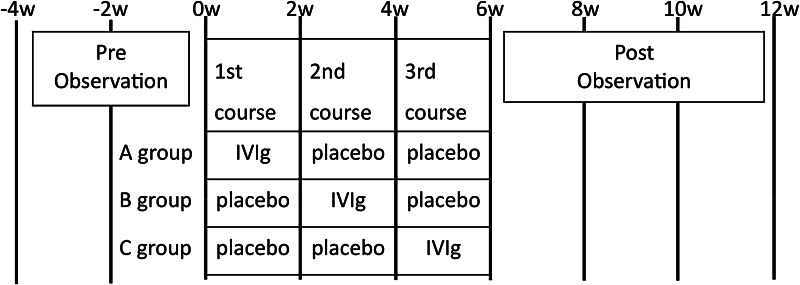
Eosinophilic granulomatosis with polyangiitis (EGPA), previously called Churg-Strauss syndrome, frequently affects the peripheral nervous system. We conducted a multicenter, double-blind, three-arm treatment period, randomized, pre-post trial to assess the efficacy of intravenous immunoglobulin (IVIg) administration for residual peripheral neuropathy in patients with EGPA that is in remission, indicated by laboratory indices. Twenty-three patients were randomly assigned into three groups, in which the timing of IVIg and placebo administration was different. Each group received one course of intervention and two courses of placebo at 2-week intervals. Treatment effects were assessed every 2 weeks for 8 weeks. The primary outcome measure, the amount of change in the manual muscle testing sum score 2 weeks after IVIg administration, significantly increased (p = 0.002). The results over time suggested that this effect continued until the last assessment was done 8 weeks later. The number of muscles with manual muscle testing scores of three or less (p = 0.004) and the neuropathic pain scores represented by the visual analogue scale (p = 0.005) also improved significantly 2 weeks after IVIg administration. This study indicates that IVIg treatment for EGPA patients with residual peripheral neuropathy should be considered even when laboratory indices suggest remission of the disease.
嗜酸性肉芽肿性多血管炎(EGPA),以前称为变应性肉芽肿性血管炎,常累及周围神经系统。我们进行了一项多中心、双盲、三臂治疗期、随机、前后对照试验,以评估静脉注射免疫球蛋白(IVIg)对实验室指标提示病情缓解的EGPA患者残留周围神经病变的疗效。23名患者被随机分为三组,IVIg和安慰剂的给药时间不同。每组接受一个疗程的干预和两个疗程的安慰剂,间隔2周。每2周评估一次治疗效果,共8周。主要结局指标,即IVIg给药后2周手动肌力测试总分的变化量显著增加(p = 0.002)。随着时间推移的结果表明,这种效果一直持续到8周后的最后一次评估。IVIg给药后2周,手动肌力测试评分小于或等于3分的肌肉数量(p = 0.004)以及视觉模拟量表表示的神经病理性疼痛评分(p = 0.005)也显著改善。这项研究表明,即使实验室指标提示疾病缓解,对于有残留周围神经病变的EGPA患者也应考虑IVIg治疗。