Deguine Jacques, Barton Gregory M
Division of Immunology & Pathogenesis, Department of Molecular and Cell Biology, University of California at Berkeley Berkeley, CA 94720-3200 USA.
F1000Prime Rep. 2014 Nov 4;6:97. doi: 10.12703/P6-97. eCollection 2014.
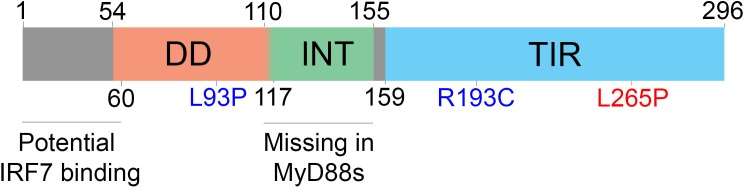
MyD88 is the canonical adaptor for inflammatory signaling pathways downstream of members of the Toll-like receptor (TLR) and interleukin-1 (IL-1) receptor families. MyD88 links IL-1 receptor (IL-1R) or TLR family members to IL-1R-associated kinase (IRAK) family kinases via homotypic protein-protein interaction. Activation of IRAK family kinases leads to a variety of functional outputs, including the activation of nuclear factor-kappa B (NFκB), mitogen-activated protein kinases, and activator protein 1, making MyD88 a central node of inflammatory pathways. As more details of MyD88-dependent signaling have been elucidated, it has become clear that the functions of this critical signaling component can be influenced by multiple interaction partners in distinct subcellular compartments. In this review, we will focus on recent developments in the understanding of the assembly of MyD88 signaling complexes and the mechanisms leading to the diversification of MyD88-based signaling.
髓样分化因子88(MyD88)是Toll样受体(TLR)家族和白细胞介素-1(IL-1)受体家族成员下游炎症信号通路的典型衔接蛋白。MyD88通过同型蛋白质-蛋白质相互作用,将IL-1受体(IL-1R)或TLR家族成员与IL-1受体相关激酶(IRAK)家族激酶联系起来。IRAK家族激酶的激活会导致多种功能输出,包括核因子-κB(NFκB)、丝裂原活化蛋白激酶和活化蛋白1的激活,使MyD88成为炎症信号通路的中心节点。随着MyD88依赖性信号传导更多细节的阐明,很明显,这一关键信号成分的功能可受到不同亚细胞区室中多个相互作用伙伴的影响。在本综述中,我们将重点关注对MyD88信号复合物组装以及导致基于MyD88的信号多样化机制理解的最新进展。