Winther Thilde Nordmann, Jacobsen Kari Stougaard, Mirza Aashiq Hussain, Heiberg Ida Louise, Bang-Berthelsen Claus Heiner, Pociot Flemming, Hogh Birthe
Department of Paediatrics, Hvidovre Hospital, University of Copenhagen, Kettegaard Allé 30, 2650 Hvidovre, Denmark ; Department of Paediatrics and Center for Non-Coding RNA in Technology and Health, Herlev Hospital, University of Copenhagen, Arkaden, 2730 Herlev, Denmark.
Department of Paediatrics and Center for Non-Coding RNA in Technology and Health, Herlev Hospital, University of Copenhagen, Arkaden, 2730 Herlev, Denmark.
Int J Hepatol. 2014;2014:791045. doi: 10.1155/2014/791045. Epub 2014 Dec 17.
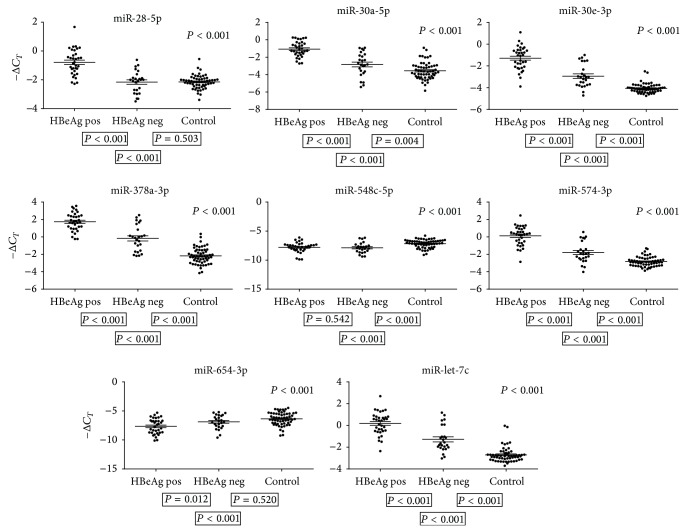
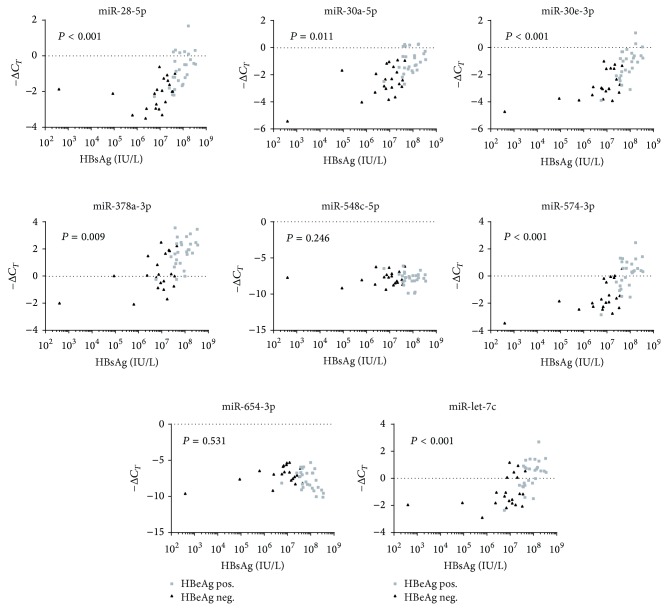
Background and Aim. Hepatitis B e antigen positive (HBeAg-positive) children are at high risk of severe complications such as hepatocellular carcinoma and cirrhosis. Liver damage is caused by the host immune response to infected hepatocytes, and we hypothesise that specific microRNAs play a role in this complex interaction between virus and host. The study aimed to identify microRNAs with aberrant plasma expressions in HBeAg-positive children and with liver-specific target genes. Methods. By revisiting our previous screen of microRNA plasma levels in HBeAg-positive and HBeAg-negative children with chronic hepatitis B (CHB) and in healthy controls, candidate microRNAs with aberrant plasma expressions in HBeAg-positive children were identified. MicroRNAs targeting liver-specific genes were selected based on bioinformatics analysis and validated by qRT-PCR using plasma samples from 34 HBeAg-positive, 26 HBeAg-negative, and 60 healthy control children. Results. Thirteen microRNAs showed aberrant plasma expressions in HBeAg-positive children and targeted liver-specific genes. In particular, three microRNAs were upregulated and one was downregulated in HBeAg-positive children compared to HBeAg-negative and healthy control children, which showed equal levels. Conclusion. The identified microRNAs might impact the progression of CHB in children. Functional studies are warranted, however, to elucidate the microRNAs' role in the immunopathogenesis of childhood CHB.
背景与目的。乙肝e抗原阳性(HBeAg阳性)儿童面临肝细胞癌和肝硬化等严重并发症的高风险。肝损伤由宿主对受感染肝细胞的免疫反应引起,我们推测特定的微小RNA在病毒与宿主之间的这种复杂相互作用中发挥作用。本研究旨在鉴定在HBeAg阳性儿童中血浆表达异常且具有肝脏特异性靶基因的微小RNA。方法。通过回顾我们之前对慢性乙型肝炎(CHB)HBeAg阳性和HBeAg阴性儿童以及健康对照者血浆中微小RNA水平的筛查,鉴定出在HBeAg阳性儿童中血浆表达异常的候选微小RNA。基于生物信息学分析选择靶向肝脏特异性基因的微小RNA,并使用来自34名HBeAg阳性、26名HBeAg阴性和60名健康对照儿童的血浆样本通过qRT-PCR进行验证。结果。13种微小RNA在HBeAg阳性儿童中显示出血浆表达异常且靶向肝脏特异性基因。特别是,与HBeAg阴性和健康对照儿童相比,3种微小RNA在HBeAg阳性儿童中上调,1种下调,而HBeAg阴性和健康对照儿童的水平相当。结论。所鉴定的微小RNA可能影响儿童CHB的进展。然而,有必要进行功能研究以阐明微小RNA在儿童CHB免疫发病机制中的作用。