Nunn Adam C, Nouraei S Ali R, George P Jeremy, Sandhu Guri S, Nouraei S A Reza
Department of Trauma & Orthopaedics, Ipswich Hospital, Heath Road, Ipswich IP4 5PD, UK.
The Neutral Corner Ltd, Clavering House, Clavering Place, Newcastle upon Tyne, NE1 3NG, UK.
Case Rep Otolaryngol. 2014;2014:325048. doi: 10.1155/2014/325048. Epub 2014 Dec 18.
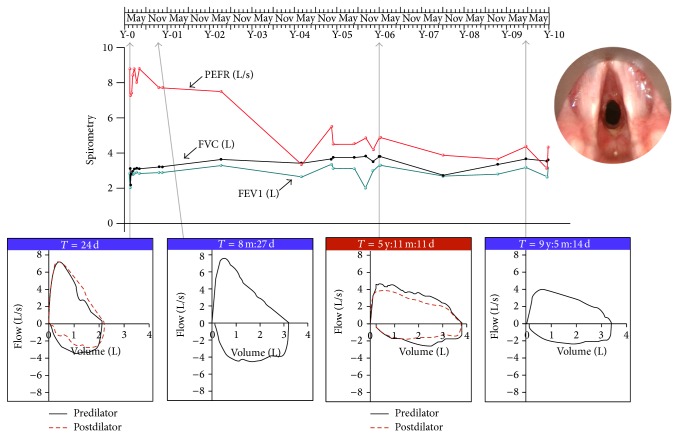
Laryngotracheal stenosis (LTS) is a rare condition that occurs most commonly as a result of instrumentation of the airway but may also occur as a result of inflammatory conditions or idiopathically. Here, we present the case of a patient who developed LTS as a complication of granulomatosis with polyangiitis (GPA), which was misdiagnosed as asthma for 6 years. After an admission with respiratory symptoms that worsened to the extent that she required intubation, a previously well 14-year-old girl was diagnosed with GPA. Following immunosuppressive therapy, she made a good recovery and was discharged after 22 days. Over subsequent years, she developed dyspnoea and "wheeze" and a diagnosis of asthma was made. When she became pregnant, she was admitted to hospital with worsening respiratory symptoms, whereupon her "wheeze" was correctly identified as "stridor," and subsequent investigations revealed a significant subglottic stenosis. The delay in diagnosis precluded the use of minimally invasive therapies, with the result that intermittent laser resection and open laryngotracheal reconstructive surgery were the only available treatment options. There were numerous points at which the correct diagnosis might have been made, either by proper interpretation of flow-volume loops or by calculation of the Empey or Expiratory Disproportion Indices from spirometry data.
喉气管狭窄(LTS)是一种罕见疾病,最常见的病因是气道插管,也可能由炎症性疾病或特发性因素引起。在此,我们报告一例因肉芽肿性多血管炎(GPA)并发LTS的患者,该患者被误诊为哮喘长达6年。一名此前健康的14岁女孩因呼吸道症状加重入院,最终需要插管治疗,入院后被诊断为GPA。经过免疫抑制治疗,她恢复良好,22天后出院。在随后的几年里,她出现呼吸困难和“喘息”症状,被诊断为哮喘。怀孕后,她因呼吸道症状恶化再次入院,此时她的“喘息”被正确诊断为“喘鸣”,随后的检查发现存在严重的声门下狭窄。诊断延误导致无法采用微创治疗,因此间歇性激光切除和开放性喉气管重建手术成为仅有的治疗选择。在多个时间点上,通过正确解读流量-容积环或根据肺功能测定数据计算恩佩指数或呼气比例失调指数,都有可能做出正确诊断。