Gismervik K, Aspholm M, Rørvik L M, Bruheim T, Andersen A, Skaar I
Norwegian Veterinary Institute, Trondheim/Oslo, Norway.
J Appl Microbiol. 2015 Apr;118(4):809-16. doi: 10.1111/jam.12750. Epub 2015 Feb 8.
Listeriosis is a frequent silage-associated disease in ruminants. The slugs Arion vulgaris are invaders in gardens, vegetable crops and meadows for silage production. Field and laboratory studies were conducted to clarify whether slugs could host Listeria monocytogenes and thereby constitute a threat to animal feed safety.
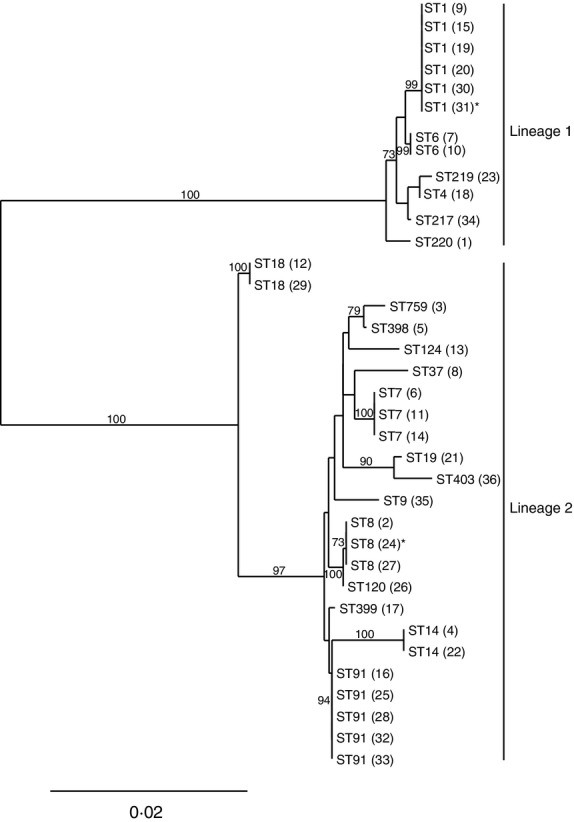
Selective culture of L. monocytogenes from 79 pooled slug samples (710 slugs) resulted in 43% positive, 16% with mean L. monocytogenes values of 405 CFU g(-1) slug tissues. Of 62 individual slugs cultured, 11% also tested positive from surface/mucus. Multilocus sequence typing analysis of 36 isolates from different slug pools identified 20 sequence types belonging to L. monocytogenes lineages I and II. Slugs fed ≅4·0 × 10(5) CFUL. monocytogenes, excreted viable L. monocytogenes in faeces for up to 22 days. Excretion of L. monocytogenes decreased with time, although there were indications of a short enrichment period during the first 24 h.
Arion vulgaris may act as a vector for L. monocytogenes.
Highly slug-contaminated grass silage may pose a potential threat to animal feed safety.
李斯特菌病是反刍动物中一种常见的与青贮饲料相关的疾病。普通蛞蝓是花园、蔬菜作物和用于青贮饲料生产的草地中的入侵者。开展了田间和实验室研究,以阐明蛞蝓是否可能携带单核细胞增生李斯特菌,从而对动物饲料安全构成威胁。
从79个混合蛞蝓样本(710只蛞蝓)中对单核细胞增生李斯特菌进行选择性培养,结果显示43%呈阳性,16%的单核细胞增生李斯特菌平均含量为每克蛞蝓组织405 CFU。在培养的62只个体蛞蝓中,11%的体表/黏液检测也呈阳性。对来自不同蛞蝓样本池的36株分离株进行多位点序列分型分析,确定了属于单核细胞增生李斯特菌I和II系的20种序列类型。蛞蝓摄入约4.0×10⁵CFU的单核细胞增生李斯特菌后,粪便中可排出存活的单核细胞增生李斯特菌长达22天。尽管在最初24小时有短期富集期的迹象,但单核细胞增生李斯特菌的排泄量随时间减少。
普通蛞蝓可能是单核细胞增生李斯特菌的传播媒介。
受蛞蝓高度污染的青贮牧草可能对动物饲料安全构成潜在威胁。