Kawasaki Yota, Ishigami Sumiya, Arigami Takaaki, Uenosono Yoshikazu, Yanagita Shigehiro, Uchikado Yasuto, Kita Yoshiaki, Nishizono Yuka, Okumura Hiroshi, Nakajo Akihiro, Kijima Yuko, Maemura Kosei, Natsugoe Shoji
Department of Digestive Surgery, Breast and Thyroid surgery Graduate School of Medical Sciences, Kagoshima University, Sakuragaoka 8-35-1, Kagoshima, 890-8520, Japan.
BMC Cancer. 2015 Jan 15;15:5. doi: 10.1186/s12885-015-1008-4.
The transcription factor nuclear factor (erythroid-2)-related factor 2 (Nrf2) was originally identified as a critical regulator of intracellular anti-oxidants and of phase II detoxification enzymes through its transcriptional up-regulation of many anti-oxidant response element (ARE)-containing genes. Nrf2 protects not only normal cells but also cancer cells from cellular stress, and enhances cancer cell survival. Some studies have shown that Nrf2 expression in cancer patients has clinical significance. However, there has been no comprehensive analysis of the nuclear expression level of Nrf2 in gastrointestinal cancer cells. In this study we aimed to immunohistochemically evaluate the expression of Nrf2, and to assess its clinical significance in gastric cancer.
A total of 175 gastric cancer patients who received R0 gastrectomy with standard lymph node dissection were enrolled. We immunohistochemically evaluated Nrf2 expression in the paraffin-embedded surgically resected specimens of these 175 patients. Group differences were analyzed using the χ (2) test, Fisher's exact test, and the Mann-Whitney U test. Associations between Nrf2 expression and clinicopathological features, including clinical outcome, were assessed using univariate and multivariate analyses, and Kaplan-Meier curves with the log-rank test, respectively.
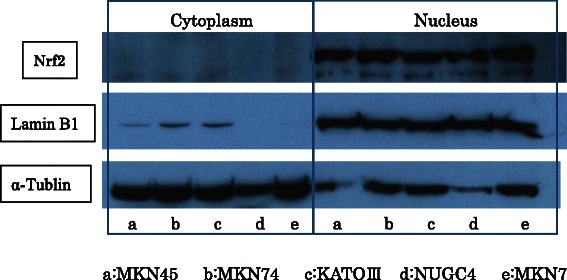
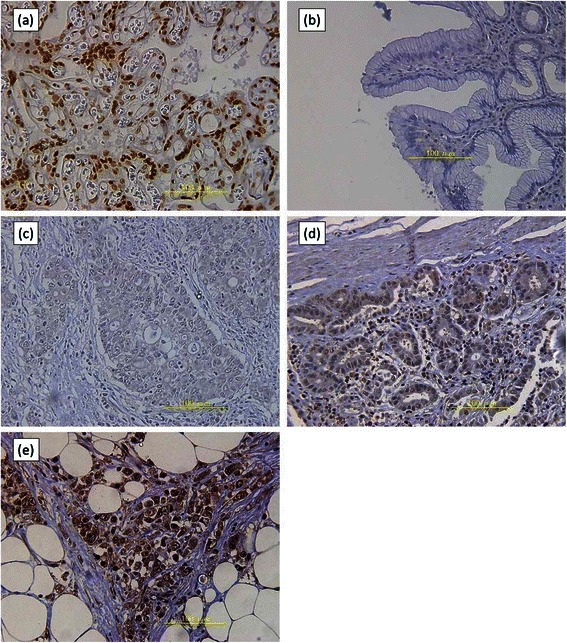
Nrf2 immunoreactivity was predominantly identified in the nucleus of gastric cancer cells. Nrf2 positivity was closely associated with tumor size, tumor depth, lymph node metastases, lymphovascular invasion, histology and stage (p < 0.05 for all). A log-rank test indicated that the overall survival of the Nrf2-positive group was significantly poorer than that of the Nrf2-negative group (p < 0.01). And, positive Nrf2 expression was significantly associated with resistance to 5FU-based adjuvant chemotherapy (p = 0.024).
Nrf2 expression was positively associated with aggressive tumor behavior in gastric cancer. This result suggests that Nrf2 expression in gastric cancer is a potential indicator of worse prognosis.
转录因子核因子(红系衍生2)相关因子2(Nrf2)最初被确定为细胞内抗氧化剂和Ⅱ相解毒酶的关键调节因子,它通过转录上调许多含抗氧化反应元件(ARE)的基因来发挥作用。Nrf2不仅能保护正常细胞,还能保护癌细胞免受细胞应激,并提高癌细胞的存活率。一些研究表明,Nrf2在癌症患者中的表达具有临床意义。然而,尚未对胃肠道癌细胞中Nrf2的核表达水平进行全面分析。在本研究中,我们旨在通过免疫组织化学方法评估Nrf2的表达,并评估其在胃癌中的临床意义。
共纳入175例行标准淋巴结清扫的R0胃切除术的胃癌患者。我们对这175例患者手术切除的石蜡包埋标本进行了Nrf2表达的免疫组织化学评估。采用χ²检验、Fisher精确检验和Mann-Whitney U检验分析组间差异。分别采用单因素和多因素分析以及带有对数秩检验的Kaplan-Meier曲线评估Nrf2表达与包括临床结局在内的临床病理特征之间的关联。
Nrf2免疫反应主要在胃癌细胞核中被检测到。Nrf2阳性与肿瘤大小、肿瘤深度、淋巴结转移、淋巴管浸润、组织学类型和分期密切相关(所有p均<0.05)。对数秩检验表明,Nrf2阳性组的总生存期明显低于Nrf2阴性组(p<0.01)。而且,Nrf2阳性表达与基于5FU的辅助化疗耐药显著相关(p=0.024)。
Nrf2表达与胃癌侵袭性肿瘤行为呈正相关。这一结果表明,胃癌中Nrf2表达是预后较差的一个潜在指标。