Cui Xu, Chopp Michael, Zacharek Alex, Karasinska Joanna M, Cui Yisheng, Ning Ruizhuo, Zhang Yi, Wang Yun, Chen Jieli
From the Department of Neurology, Henry Ford Hospital, Detroit, MI (X.C., M.C., A.Z., Y.C., R.N., Y.Z., J.C.); Department of Physics, Oakland University, Rochester, MI (M.C.); Neural Protection and Regeneration section, Center for Neuropsychiatric Research, National Institute on Drug Abuse, NIH, Baltimore, MD (Y.W.); and Department of Medical Genetics, Centre for Molecular Medicine and Therapeutics, University of British Columbia, Vancouver, British Columbia, Canada (J.M.K.).
Stroke. 2015 Mar;46(3):827-34. doi: 10.1161/STROKEAHA.114.007145. Epub 2015 Jan 15.
The ATP-binding cassette transporter A-1 (ABCA1) gene is a key target of the transcription factors liver X receptors. Liver X receptor activation has anti-inflammatory and neuroprotective effects in animal ischemic stroke models. Here, we tested the hypothesis that brain ABCA1 reduces blood-brain barrier (BBB) and white matter (WM) impairment in the ischemic brain after stroke.
Adult brain-specific ABCA1-deficient (ABCA1(-B/-B)) and floxed-control (ABCA1(fl/fl)) mice were subjected to permanent distal middle cerebral artery occlusion and were euthanized 7 days after distal middle cerebral artery occlusion. Functional outcome, infarct volume, BBB leakage, and WM damage were analyzed.
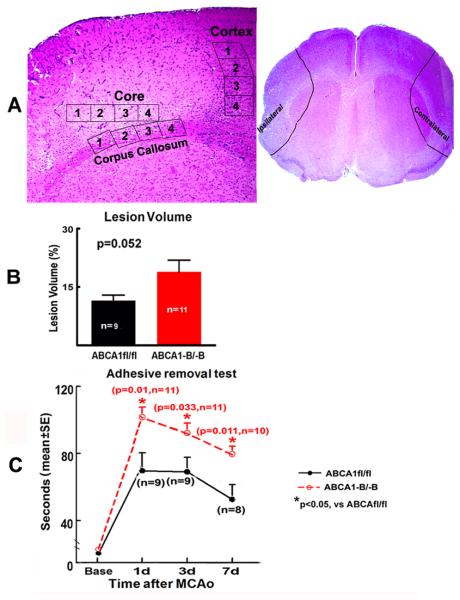
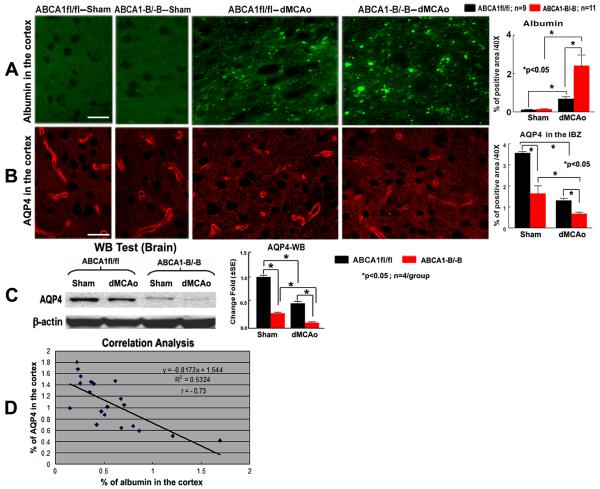
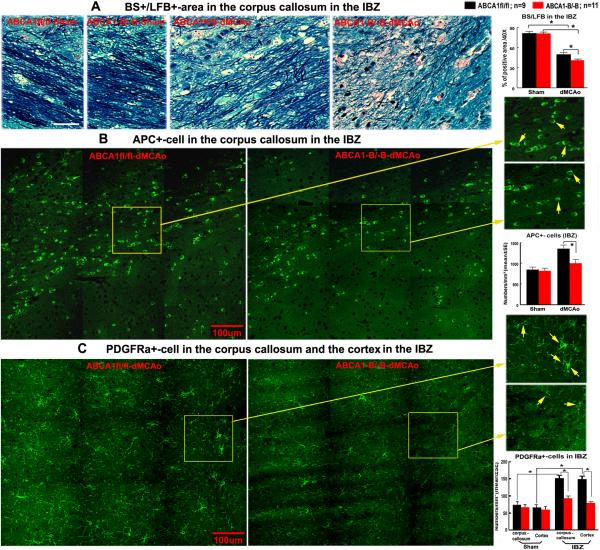
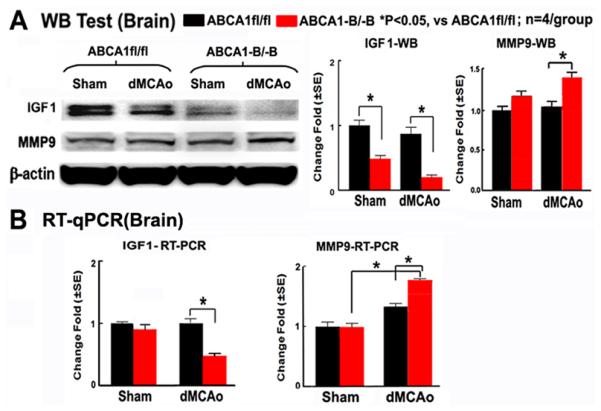
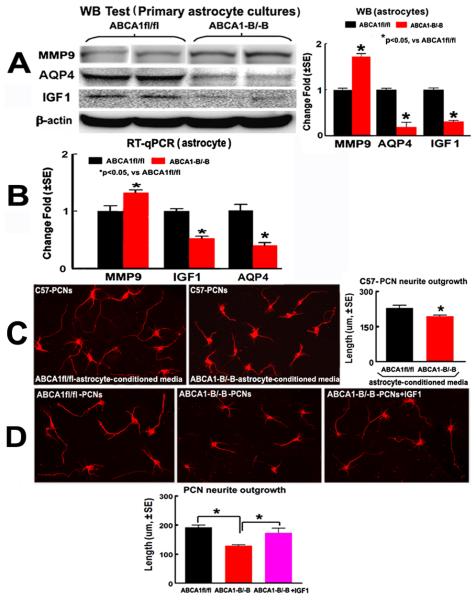
Compared with ABCA1(fl/fl) mice, ABCA1(-B/-B) mice showed marginally (P=0.052) increased lesion volume but significantly increased BBB leakage and WM damage in the ischemic brain and more severe neurological deficits. Brain ABCA1-deficient mice exhibited increased the level of matrix metalloproteinase-9 and reduced the level of insulin-like growth factor 1 in the ischemic brain. BBB leakage was inversely correlated (r=-0.073; P<0.05) with aquaporin-4 expression. Reduction of insulin-like growth factor 1 and aquaporin-4, but upregulation of matrix metalloproteinase-9 expression were also found in the primary astrocyte cultures derived from ABCA1(-B/-B) mice. Cultured primary cortical neurons derived from C57BL/6 wild-type mice with ABCA1(-B/-B) astrocyte-conditioned medium exhibited decreased neurite outgrowth compared with culture with ABCA1(fl/fl) astrocyte-conditioned medium. ABCA1(-B/-B) primary cortical neurons show significantly decreased neurite outgrowth, which was attenuated by insulin-like growth factor 1 treatment.
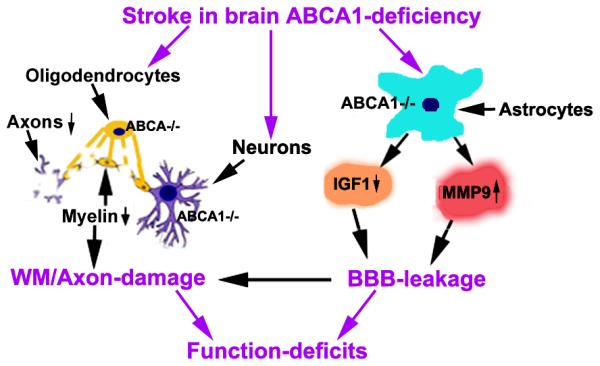
We demonstrate that brain ABCA1 deficiency increases BBB leakage, WM/axonal damage, and functional deficits after stroke. Concomitant reduction of insulin-like growth factor 1 and upregulation of matrix metalloproteinase-9 may contribute to brain ABCA1 deficiency-induced BBB and WM/axonal damage in the ischemic brain.
ATP结合盒转运蛋白A-1(ABCA1)基因是转录因子肝X受体的关键靶点。在动物缺血性中风模型中,肝X受体激活具有抗炎和神经保护作用。在此,我们验证了以下假说:脑内ABCA1可减轻中风后缺血性脑内血脑屏障(BBB)和白质(WM)的损伤。
对成年脑特异性ABCA1基因敲除(ABCA1(-B/-B))小鼠和对照(ABCA1(fl/fl))小鼠进行永久性大脑中动脉远端闭塞,并在大脑中动脉远端闭塞7天后实施安乐死。分析其功能转归、梗死体积、血脑屏障渗漏及白质损伤情况。
与ABCA1(fl/fl)小鼠相比,ABCA1(-B/-B)小鼠梗死体积略有增加(P=0.052),但缺血性脑内血脑屏障渗漏及白质损伤显著增加,神经功能缺损更严重。脑内ABCA1基因敲除小鼠缺血性脑内基质金属蛋白酶-9水平升高以及胰岛素样生长因子1水平降低。血脑屏障渗漏与水通道蛋白-4表达呈负相关(r=-0.073;P<0.05)。在源自ABCA1(-B/-B)小鼠的原代星形胶质细胞培养物中也发现胰岛素样生长因子1和水通道蛋白-4减少,但基质金属蛋白酶-9表达上调。与用ABCA1(fl/fl)星形胶质细胞条件培养基培养相比,用源自ABCA1(-B/-B)小鼠的星形胶质细胞条件培养基培养的C57BL/6野生型小鼠原代皮质神经元神经突生长减少。ABCA1(-B/-B)原代皮质神经元神经突生长显著减少,胰岛素样生长因子1治疗可使其减轻。
我们证明脑内ABCA1缺乏会增加中风后的血脑屏障渗漏、白质/轴突损伤及功能缺损。胰岛素样生长因子1水平降低和基质金属蛋白酶-9上调可能共同导致脑内ABCA1缺乏引起的缺血性脑内血脑屏障和白质/轴突损伤。