Xu Jingyao, Agyemang Stephanie, Qin Yunlong, Aysola Kartik, Giles Mercedes, Oprea Gabriela, O'Regan Ruth M, Partridge Edward E, Harris-Hooker Sandra, Rice Valarie Montgomery, Reddy E Shyam P, Rao Veena N
Cancer Biology Program, Department of OB/GYN, Georgia Cancer Center for Excellence, Grady Health System, Atlanta, GA 30303, USA.
Emory University School of Medicine, Atlanta, GA, USA.
Enliven Chall Cancer Detect Ther. 2014;1(1). doi: 10.18650/2376-046x.11004.
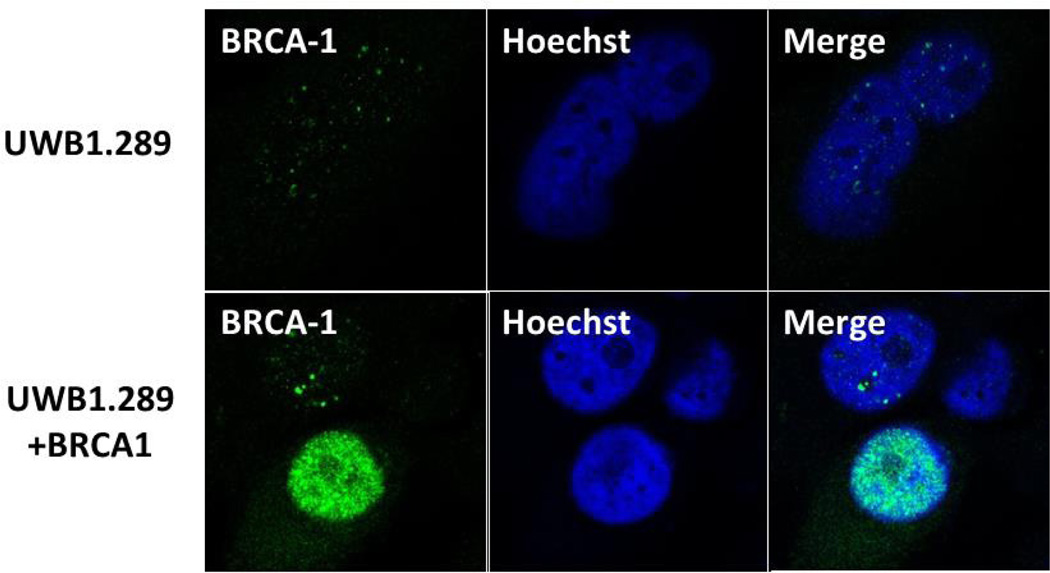
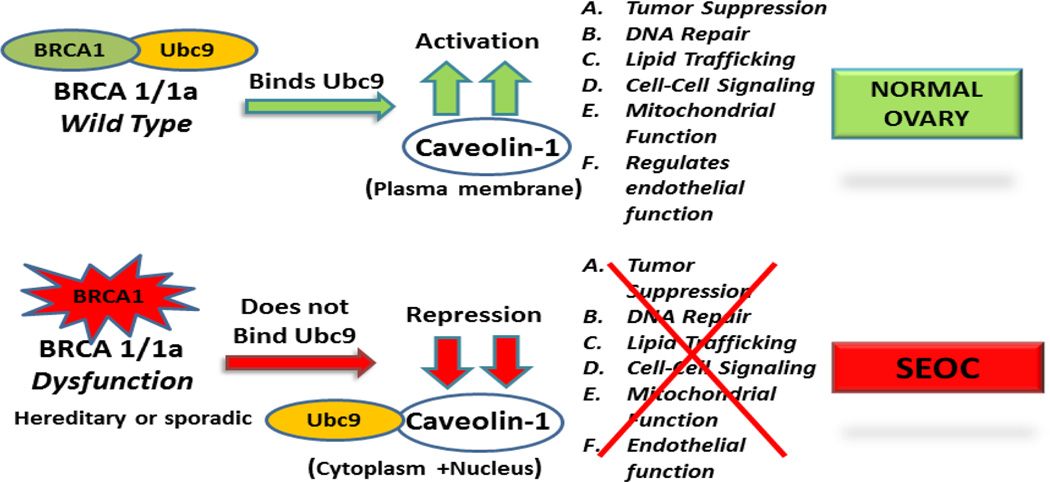
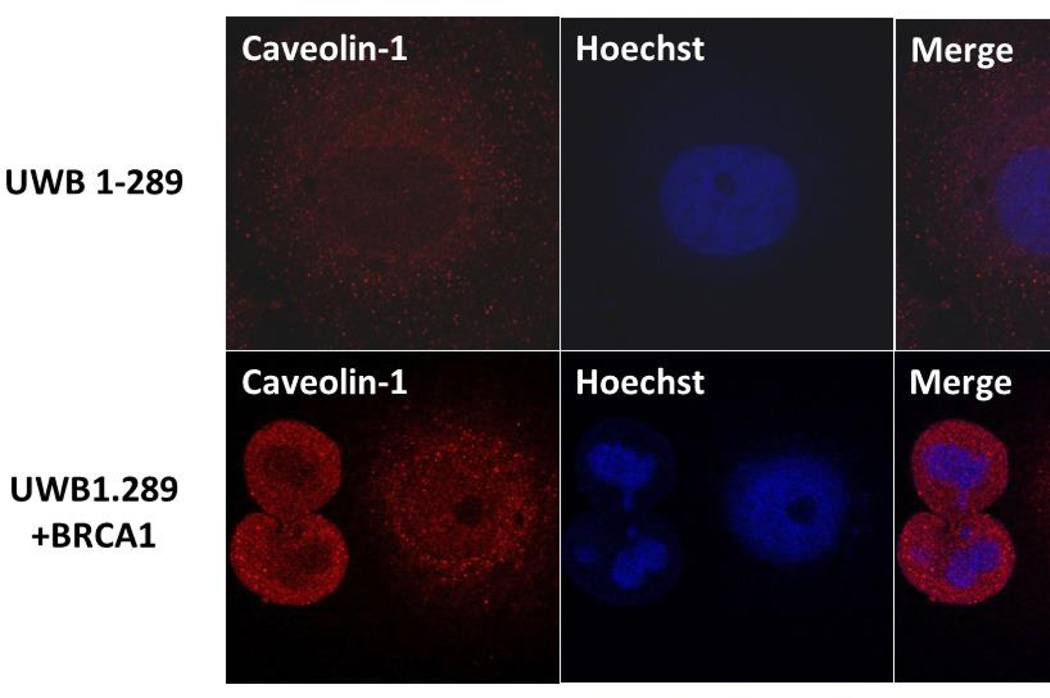
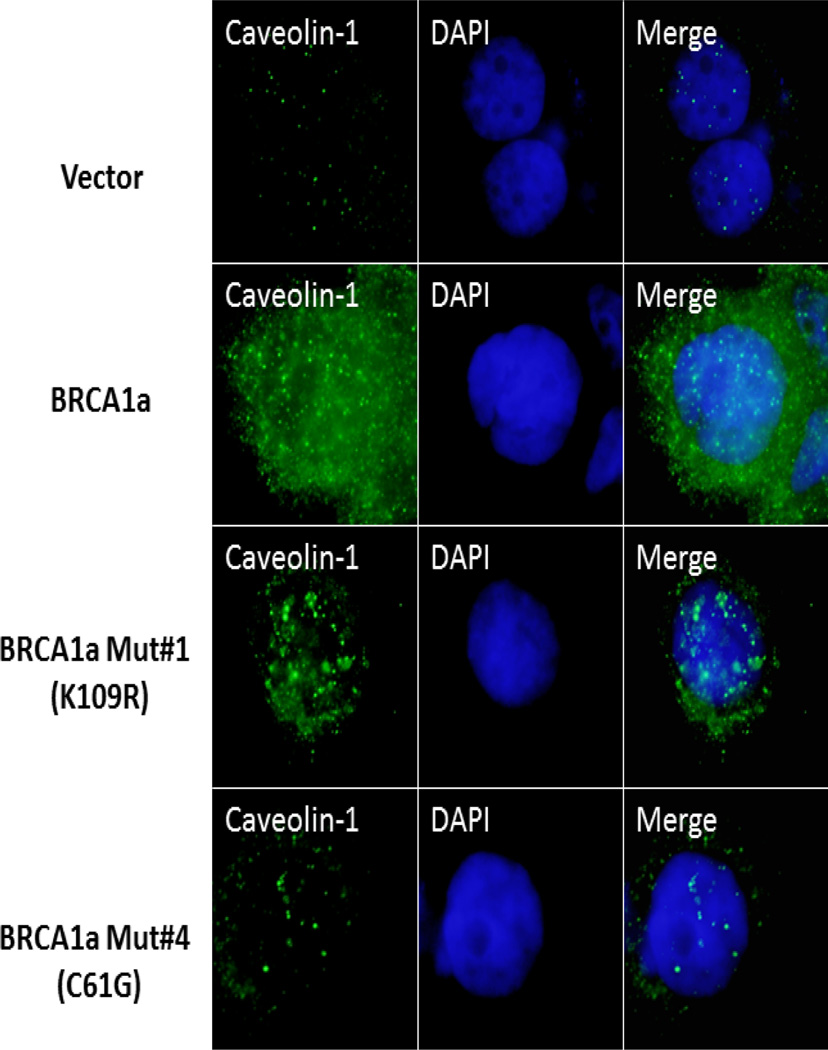
Ovarian cancer is the second most common gynecological cancer and the five-year survival rate is only about 40%. High-grade serous carcinoma is the pre-dominant histotype associated with hereditary ovarian cancer and women with inherited mutations in BRCA1 have a lifetime risk of 40-60%. BRCA1 and its isoform BRCA1a are multifunctional proteins that are the most evolutionary conserved of all the other splice variants. Our group has previously reported that BRCA1/1a proteins, unlike K109R and C61G mutants, suppress growth of ovarian cancer cells by tethering Ubc9. In this study we found wild type BRCA1/1a proteins to induce expression of caveolin-1, a tumor suppressor in BRCA1-mutant serous epithelial ovarian cancer (SEOC) cells by immunofluorescence analysis. The K109R and C61G disease associated mutant BRCA1 proteins that do not bind Ubc9 were not as efficient in up-regulation of caveolin-1 expression in SEOC cells. Additionally, immunofluorescence analysis showed BRCA1/1a proteins to induce redistribution of Caveolin-1 from cytoplasm and nucleus to the cell membrane. This is the first study demonstrating the physiological link between loss of Ubc9 binding, loss of growth suppression and loss of Caveolin-1 induction of disease-associated mutant BRCA1 proteins in SEOC cells. Decreased Caveolin-1 expression combined with elevated Ubc9 expression can in the future be used as an early biomarker for BRCA1 mutant SEOC.
卵巢癌是第二常见的妇科癌症,其五年生存率仅约为40%。高级别浆液性癌是与遗传性卵巢癌相关的主要组织学类型,携带BRCA1基因遗传突变的女性终生患病风险为40%-60%。BRCA1及其异构体BRCA1a是多功能蛋白,是所有其他剪接变体中进化上最保守的。我们团队此前曾报道,与K109R和C61G突变体不同,BRCA1/1a蛋白通过与Ubc9结合来抑制卵巢癌细胞的生长。在本研究中,我们通过免疫荧光分析发现野生型BRCA1/1a蛋白可诱导小窝蛋白-1的表达,小窝蛋白-1是BRCA1突变的浆液性上皮性卵巢癌(SEOC)细胞中的一种肿瘤抑制因子。不与Ubc9结合的K109R和C61G疾病相关突变型BRCA1蛋白在SEOC细胞中上调小窝蛋白-1表达方面效率较低。此外,免疫荧光分析显示BRCA1/1a蛋白可诱导小窝蛋白-1从细胞质和细胞核重新分布到细胞膜。这是第一项证明SEOC细胞中与疾病相关的突变型BRCA1蛋白失去Ubc9结合、失去生长抑制以及失去小窝蛋白-1诱导之间存在生理联系的研究。未来,小窝蛋白-1表达降低与Ubc9表达升高相结合可作为BRCA1突变型SEOC的早期生物标志物。