• 文献检索
  • 文档翻译
  • 深度研究
  • 学术资讯
  • Suppr Zotero 插件Zotero 插件
  • 邀请有礼
  • 套餐&价格
  • 历史记录
应用&插件
Suppr Zotero 插件Zotero 插件浏览器插件Mac 客户端Windows 客户端微信小程序
定价
高级版会员购买积分包购买API积分包
服务
文献检索文档翻译深度研究API 文档MCP 服务
关于我们
关于 Suppr公司介绍联系我们用户协议隐私条款
关注我们

Suppr 超能文献

核心技术专利:CN118964589B侵权必究
粤ICP备2023148730 号-1Suppr @ 2026

文献检索

告别复杂PubMed语法,用中文像聊天一样搜索,搜遍4000万医学文献。AI智能推荐,让科研检索更轻松。

立即免费搜索

文件翻译

保留排版,准确专业,支持PDF/Word/PPT等文件格式,支持 12+语言互译。

免费翻译文档

深度研究

AI帮你快速写综述,25分钟生成高质量综述,智能提取关键信息,辅助科研写作。

立即免费体验

非洲和亚洲机构分娩的驱动因素:利用人口与健康调查进行的区域分析

Drivers of facility deliveries in Africa and Asia: regional analyses using the demographic and health surveys.

作者信息

Diamond-Smith Nadia, Sudhinaraset May

机构信息

Global Health Group/Global Health Sciences, University of California, San Francisco, 550 16th Street, 3rd Floor, San Francisco, CA 94158, USA.

出版信息

Reprod Health. 2015 Jan 16;12:6. doi: 10.1186/1742-4755-12-6.

DOI:10.1186/1742-4755-12-6
PMID:25595063
原文链接:https://pmc.ncbi.nlm.nih.gov/articles/PMC4320522/
Abstract

BACKGROUND

In the past few decades many countries have worked to increase the number of women delivering in facilities, with the goal of improving maternal and neonatal health outcomes. The purpose of this study is to explore the current situation of facility deliveries in Africa and Asia to understand where and with whom women deliver. Furthermore, we aim to test potential drivers of facility delivery at the individual, household, and community-level.

METHODS

Demographic and Health Survey data collected since 2003 from 43 countries in Africa and Asia is explored to understand the patterns of where women are delivering. We look at patterns by region and wealth quintile and urban/rural status. We then run a series of multi-level models looking at relationships between individual, household and community-level factors and the odds of a woman delivering in a facility. We explore this for Asia and Africa separately. We also look at correlates of delivery with a trained provider, in a public facility, in a private facility, with a doctor and in a hospital.

RESULTS

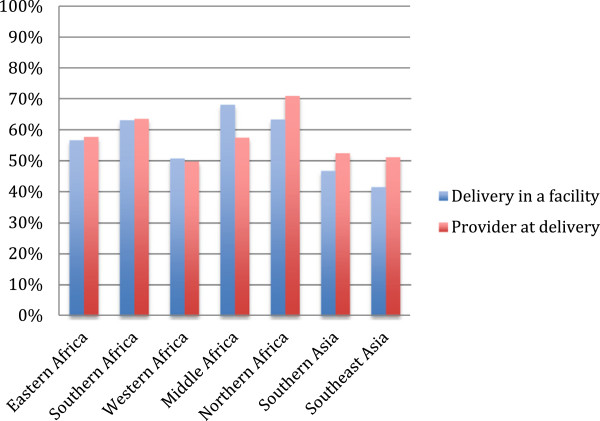
The majority of women deliver in a facility and with a provider; however, about 20% of deliveries are still with no one or a friend/relative or alone. Rates of facility delivery are lower in Asia overall, and a greater proportion of deliveries take place in private facilities in Asia compared to Africa. Most of the individual level factors that have been found in past studies to be associated with delivering in a facility hold true for the multi-country-level analyses, and small differences exist between Asia and Africa. Women who deliver in private facilities differ from women who deliver in public facilities or at home.

CONCLUSIONS

Most women in Africa and Asia are delivering in a facility, and drivers of facility delivery identified in smaller level or country specific studies hold true in multi-country national level data. More data and research is needed on other drivers, especially at the country-level and relating to the quality of care and maternal health complications.

摘要

背景

在过去几十年里,许多国家致力于增加在医疗机构分娩的妇女数量,目标是改善孕产妇和新生儿健康结局。本研究的目的是探讨非洲和亚洲医疗机构分娩的现状,以了解妇女在何处以及由谁接生。此外,我们旨在检验个体、家庭和社区层面上医疗机构分娩的潜在驱动因素。

方法

对自2003年以来从非洲和亚洲43个国家收集的人口与健康调查数据进行探究,以了解妇女的分娩地点模式。我们按地区、财富五分位数以及城乡状况查看模式。然后,我们运行一系列多层次模型,研究个体、家庭和社区层面因素与妇女在医疗机构分娩几率之间的关系。我们分别对亚洲和非洲进行此项探究。我们还研究了与受过培训的提供者、在公立医疗机构、在私立医疗机构、由医生接生以及在医院分娩的相关因素。

结果

大多数妇女在医疗机构由提供者接生;然而,约20%的分娩仍然是无人接生、由朋友/亲属接生或独自分娩。总体而言,亚洲的医疗机构分娩率较低,与非洲相比,亚洲在私立医疗机构分娩的比例更高。过去研究中发现的大多数与在医疗机构分娩相关的个体层面因素在多国层面分析中依然成立,亚洲和非洲之间存在细微差异。在私立医疗机构分娩的妇女与在公立医疗机构或家中分娩的妇女不同。

结论

非洲和亚洲的大多数妇女在医疗机构分娩,在较小层面或国家特定研究中确定的医疗机构分娩驱动因素在多国层面数据中依然成立。需要更多关于其他驱动因素的数据和研究,尤其是在国家层面以及与护理质量和孕产妇健康并发症相关的方面。

https://cdn.ncbi.nlm.nih.gov/pmc/blobs/403a/4320522/275066fa9e98/12978_2014_348_Fig5_HTML.jpg
https://cdn.ncbi.nlm.nih.gov/pmc/blobs/403a/4320522/08edf42237ac/12978_2014_348_Fig1_HTML.jpg
https://cdn.ncbi.nlm.nih.gov/pmc/blobs/403a/4320522/d118777fee4c/12978_2014_348_Fig2_HTML.jpg
https://cdn.ncbi.nlm.nih.gov/pmc/blobs/403a/4320522/81d763595fb8/12978_2014_348_Fig3_HTML.jpg
https://cdn.ncbi.nlm.nih.gov/pmc/blobs/403a/4320522/81b5af58df6e/12978_2014_348_Fig4_HTML.jpg
https://cdn.ncbi.nlm.nih.gov/pmc/blobs/403a/4320522/275066fa9e98/12978_2014_348_Fig5_HTML.jpg
https://cdn.ncbi.nlm.nih.gov/pmc/blobs/403a/4320522/08edf42237ac/12978_2014_348_Fig1_HTML.jpg
https://cdn.ncbi.nlm.nih.gov/pmc/blobs/403a/4320522/d118777fee4c/12978_2014_348_Fig2_HTML.jpg
https://cdn.ncbi.nlm.nih.gov/pmc/blobs/403a/4320522/81d763595fb8/12978_2014_348_Fig3_HTML.jpg
https://cdn.ncbi.nlm.nih.gov/pmc/blobs/403a/4320522/81b5af58df6e/12978_2014_348_Fig4_HTML.jpg
https://cdn.ncbi.nlm.nih.gov/pmc/blobs/403a/4320522/275066fa9e98/12978_2014_348_Fig5_HTML.jpg

相似文献

1
Drivers of facility deliveries in Africa and Asia: regional analyses using the demographic and health surveys.非洲和亚洲机构分娩的驱动因素:利用人口与健康调查进行的区域分析
Reprod Health. 2015 Jan 16;12:6. doi: 10.1186/1742-4755-12-6.
2
Factors influencing place of delivery for women in Kenya: an analysis of the Kenya demographic and health survey, 2008/2009.影响肯尼亚妇女分娩地点的因素:肯尼亚人口与健康调查 2008/2009 年分析。
BMC Pregnancy Childbirth. 2013 Feb 17;13:40. doi: 10.1186/1471-2393-13-40.
3
Should I stay or should I go?: consistency and switching of delivery locations among new mothers in 39 Sub-Saharan African and South/Southeast Asian countries.我该留下还是离开?:39 个撒哈拉以南非洲和南亚/东南亚国家新妈妈的分娩地点的一致性和转换。
Health Policy Plan. 2017 Nov 1;32(9):1294-1308. doi: 10.1093/heapol/czx087.
4
Health facility or home delivery? Factors influencing the choice of delivery place among mothers living in rural communities of Eritrea.医疗机构分娩还是在家分娩?影响厄立特里亚农村社区母亲分娩地点选择的因素。
J Health Popul Nutr. 2018 Oct 22;37(1):22. doi: 10.1186/s41043-018-0153-1.
5
Time trends in facility-based and private-sector childbirth care: analysis of Demographic and Health Surveys from 25 sub-Saharan African countries from 2000 to 2016.机构和私营部门的儿童分娩护理的时间趋势:2000 年至 2016 年来自 25 个撒哈拉以南非洲国家的人口与健康调查分析。
J Glob Health. 2019 Dec;9(2):020406. doi: 10.7189/jogh.09.020406.
6
Where women go to deliver: understanding the changing landscape of childbirth in Africa and Asia.妇女分娩的去处:了解非洲和亚洲分娩状况的变化。
Health Policy Plan. 2017 Oct 1;32(8):1146-1152. doi: 10.1093/heapol/czx060.
7
Factors associated with non-utilisation of health service for childbirth in Timor-Leste: evidence from the 2009-2010 Demographic and Health Survey.东帝汶分娩时未利用卫生服务的相关因素:来自2009 - 2010年人口与健康调查的证据。
BMC Int Health Hum Rights. 2014 May 5;14:14. doi: 10.1186/1472-698X-14-14.
8
What impact does contact with the prenatal care system have on women's use of facility delivery? Evidence from low-income countries.接触产前保健系统对妇女选择设施分娩有何影响?来自低收入国家的证据。
Soc Sci Med. 2012 Jun;74(12):1882-90. doi: 10.1016/j.socscimed.2012.02.008. Epub 2012 Mar 17.
9
Where do the rural poor deliver when high coverage of health facility delivery is achieved? Findings from a community and hospital survey in Tanzania.在实现了较高的医疗机构分娩覆盖率的情况下,农村贫困人口在哪里分娩?坦桑尼亚一项社区与医院调查的结果。
PLoS One. 2014 Dec 2;9(12):e113995. doi: 10.1371/journal.pone.0113995. eCollection 2014.
10
Prevalence of institutional delivery and its correlates amongst women of reproductive age in Mozambique: a cross-sectional analysis.莫桑比克育龄妇女的机构分娩率及其相关因素:一项横断面分析。
Reprod Health. 2020 Apr 16;17(1):49. doi: 10.1186/s12978-020-0905-4.

引用本文的文献

1
Exploring Cesarean Section Delivery Patterns in South India: A Bayesian Multilevel and Geospatial analysis of Population-Based Cross-Sectional Data.探索印度南部的剖宫产分娩模式:基于人群的横断面数据的贝叶斯多层次和地理空间分析。
BMC Public Health. 2024 Sep 16;24(1):2514. doi: 10.1186/s12889-024-19984-8.
2
Disparities in Elective and Emergency Caesarean Section Rates Among Public and Private Hospitals in the Districts of Andhra Pradesh, India.印度安得拉邦各地区公立和私立医院择期及急诊剖宫产率的差异
Cureus. 2024 Feb 16;16(2):e54320. doi: 10.7759/cureus.54320. eCollection 2024 Feb.
3
Delays in accessing high-quality care for newborns in East Africa: An analysis of survey data in Malawi, Mozambique, and Tanzania.

本文引用的文献

1
Factors associated with the timing of antenatal care seeking in Bangladesh.孟加拉国产前检查就诊时间的相关因素。
Asia Pac J Public Health. 2015 Mar;27(2):NP1467-80. doi: 10.1177/1010539513485786. Epub 2013 Oct 4.
2
Drivers and deterrents of facility delivery in sub-Saharan Africa: a systematic review.撒哈拉以南非洲地区医疗机构分娩的影响因素及阻碍因素:系统综述。
Reprod Health. 2013 Aug 20;10:40. doi: 10.1186/1742-4755-10-40.
3
Migration and access to maternal healthcare: determinants of adequate antenatal care and institutional delivery among socio-economically disadvantaged migrants in Delhi, India.
东非新生儿获得高质量医疗服务的延误:对马拉维、莫桑比克和坦桑尼亚调查数据的分析。
J Glob Health. 2024 Feb 9;14:04022. doi: 10.7189/jogh.14.04022.
4
To what extent is antenatal care in public health facilities associated with delivery in public health facilities? Findings from a cross-section of women who had facility deliveries in Nigeria.在多大程度上,在公共卫生机构进行的产前护理与在公共卫生机构进行的分娩有关?来自尼日利亚在机构分娩的妇女的横断面研究结果。
BMC Public Health. 2023 May 4;23(1):820. doi: 10.1186/s12889-023-15688-7.
5
Risk factors of caesarean deliveries in urban-rural areas of Bangladesh.孟加拉国城乡地区剖宫产的风险因素。
Front Reprod Health. 2023 Feb 15;5:1101400. doi: 10.3389/frph.2023.1101400. eCollection 2023.
6
Factors influencing health facility delivery among women of reproductive age in Lilongwe District, Malawi: a cross-section study.马拉维利隆圭地区育龄妇女选择医疗保健机构分娩的影响因素:一项横断面研究。
Pan Afr Med J. 2022 Nov 29;43:160. doi: 10.11604/pamj.2022.43.160.6921. eCollection 2022.
7
Examining socioeconomic status disparities in facility-based childbirth in Kenya: role of perceived need, accessibility, and quality of care.考察肯尼亚医疗机构分娩中社会经济地位差异:感知需求、可及性和护理质量的作用。
BMC Pregnancy Childbirth. 2022 Nov 2;22(1):804. doi: 10.1186/s12884-022-05111-1.
8
A national assessment of elective cesarean sections in Bangladesh and the need for health literacy and accessibility.孟加拉国选择性剖宫产术的全国评估及对健康素养和可及性的需求。
Sci Rep. 2021 Aug 19;11(1):16854. doi: 10.1038/s41598-021-96337-0.
9
Determinants, reasons for choice and willingness to recommend birthing facility among mothers in public and private health facilities in Ebonyi, Nigeria.尼日利亚埃邦伊州公立和私立医疗机构产妇选择分娩机构的决定因素、选择原因和推荐意愿。
Pan Afr Med J. 2021 Mar 19;38:289. doi: 10.11604/pamj.2021.38.289.24437. eCollection 2021.
10
Spatial variability in factors influencing maternal health service use in Jimma Zone, Ethiopia: a geographically-weighted regression analysis.埃塞俄比亚吉马地区影响孕产妇保健服务利用因素的空间变异性:地理加权回归分析
BMC Health Serv Res. 2021 May 12;21(1):454. doi: 10.1186/s12913-021-06379-3.
移民和获得产妇保健服务:印度德里社会经济弱势群体移民获得充分产前护理和住院分娩的决定因素。
Trop Med Int Health. 2013 Oct;18(10):1202-10. doi: 10.1111/tmi.12166. Epub 2013 Aug 6.
4
Determinants of institutional delivery among women in Bangladesh.孟加拉国女性机构分娩的决定因素。
Asia Pac J Public Health. 2015 Mar;27(2):NP1372-88. doi: 10.1177/1010539513486178. Epub 2013 May 10.
5
Preference for institutional delivery and caesarean sections in Bangladesh.孟加拉国对机构分娩和剖腹产的偏好。
J Health Popul Nutr. 2013 Mar;31(1):96-109. doi: 10.3329/jhpn.v31i1.14754.
6
Inequity in maternal health care service utilization in Gujarat: analyses of district-level health survey data.古吉拉特邦产妇保健服务利用中的不平等:基于地区级健康调查数据的分析。
Glob Health Action. 2013 Mar 6;6:1-9. doi: 10.3402/gha.v6i0.19652.
7
Does utilization of antenatal care result in an institutional delivery? Findings of a record-based study in urban Chandigarh.产前护理的利用是否会导致住院分娩?昌迪加尔市基于记录的研究结果。
J Trop Pediatr. 2013 Jun;59(3):220-2. doi: 10.1093/tropej/fms068. Epub 2012 Dec 12.
8
What influences the decision to undergo institutional delivery by skilled birth attendants? A cohort study in rural Andhra Pradesh, India.是什么影响了由熟练接生员进行机构分娩的决策?印度安得拉邦农村地区的一项队列研究。
Rural Remote Health. 2012;12:2311. Epub 2012 Nov 9.
9
Effect of maternal education on choice of location for delivery among Indian women.母亲教育程度对印度女性分娩地点选择的影响。
Natl Med J India. 2011 Nov-Dec;24(6):328-34.
10
What impact does contact with the prenatal care system have on women's use of facility delivery? Evidence from low-income countries.接触产前保健系统对妇女选择设施分娩有何影响?来自低收入国家的证据。
Soc Sci Med. 2012 Jun;74(12):1882-90. doi: 10.1016/j.socscimed.2012.02.008. Epub 2012 Mar 17.