Kurji Jaameeta, Thickstun Charles, Bulcha Gebeyehu, Taljaard Monica, Li Ziqi, Kulkarni Manisha A
School of Epidemiology and Public Health, University of Ottawa, 600 Peter Morand Crescent, Ottawa, Ontario, K1G 5Z3, Canada.
Jimma Zone Health Office, Jimma town, Jimma Zone, Oromia Region, Ethiopia.
BMC Health Serv Res. 2021 May 12;21(1):454. doi: 10.1186/s12913-021-06379-3.
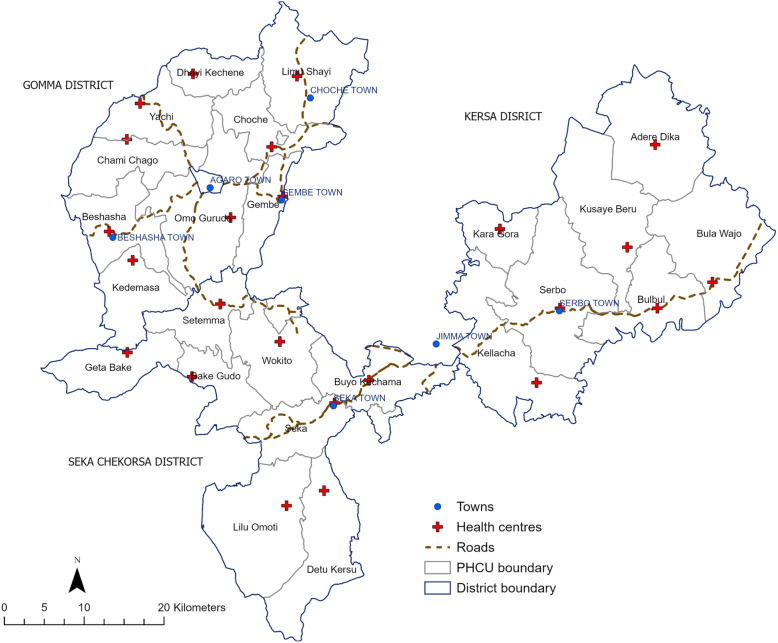
Persisting within-country disparities in maternal health service access are significant barriers to attaining the Sustainable Development Goals aimed at reducing inequalities and ensuring good health for all. Sub-national decision-makers mandated to deliver health services play a central role in advancing equity but require appropriate evidence to craft effective responses. We use spatial analyses to identify locally-relevant barriers to access using sub-national data from rural areas in Jimma Zone, Ethiopia.
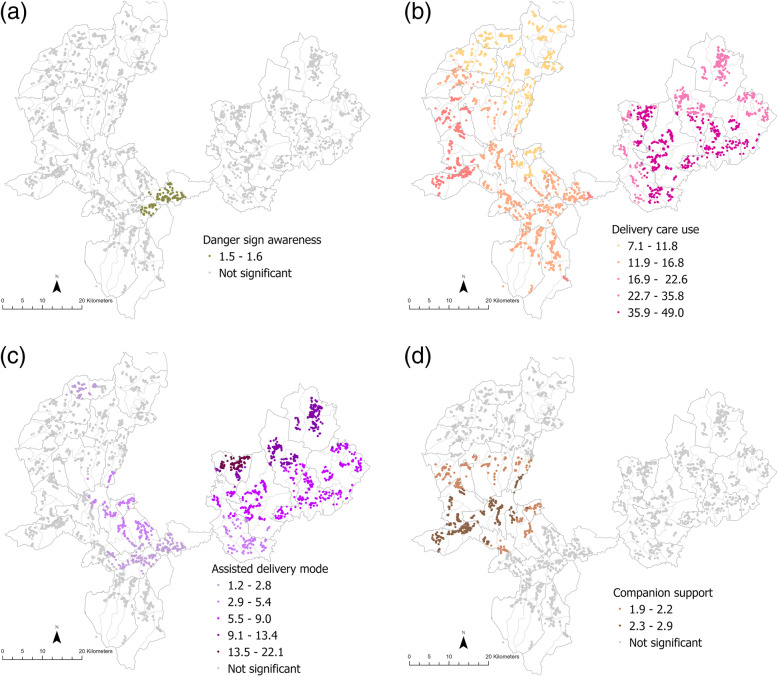
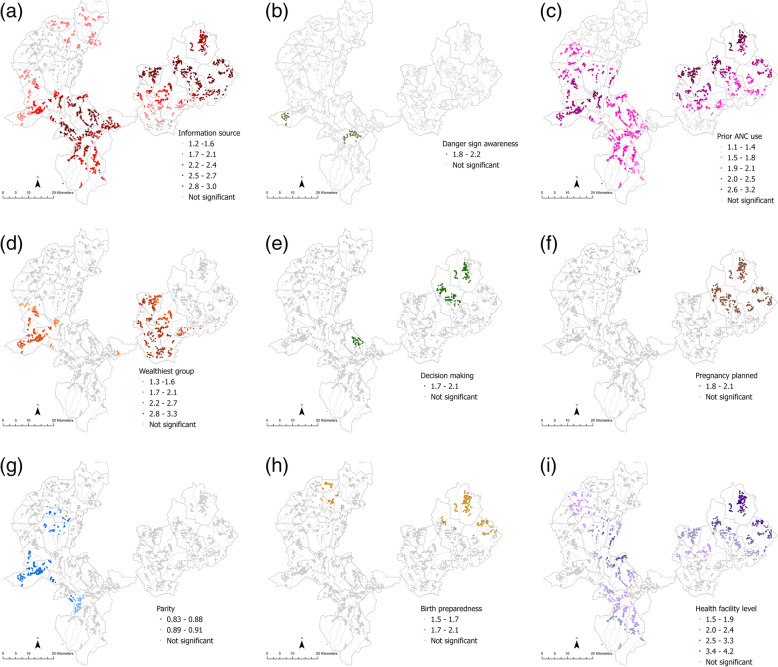
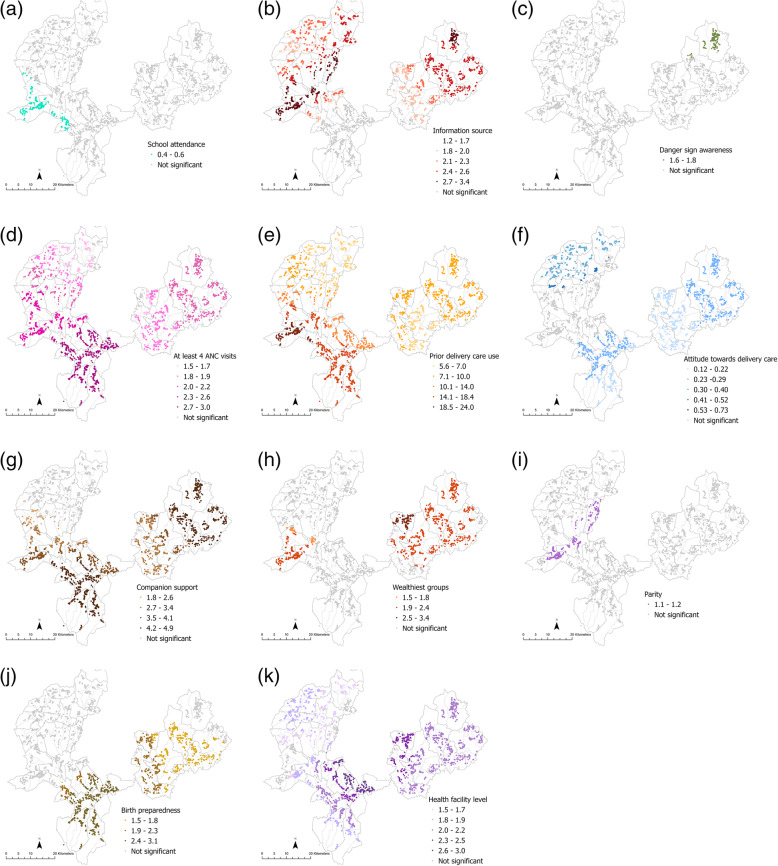
Cross-sectional data from 3727 households, in three districts, collected at baseline in a cluster randomized controlled trial were analysed using geographically-weighted regressions. These models help to quantify associations within women's proximal contexts by generating local parameter estimates. Data subsets, representing an empirically-identified scale for neighbourhood, were used. Local associations between outcomes (antenatal, delivery, and postnatal care use) and potential explanatory factors at individual-level (ex: health information source), interpersonal-level (ex: companion support availability) and health service-levels (ex: nearby health facility type) were modelled. Statistically significant local odds ratios were mapped to demonstrate how relevance and magnitude of associations between various explanatory factors and service outcomes change depending on locality.
Significant spatial variability in relationships between all services and their explanatory factors (p < 0.001) was detected, apart from the association between delivery care and women's decision-making involvement (p = 0.124). Local models helped to pinpoint factors, such as danger sign awareness, that were relevant for some localities but not others. Among factors with more widespread influence, such as that of prior service use, variation in estimate magnitudes between localities was uncovered. Prominence of factors also differed between services; companion support, for example, had wider influence for delivery than postnatal care. No significant local associations with postnatal care use were detected for some factors, including wealth and decision involvement, at the selected neighbourhood scale.
Spatial variability in service use associations means that the relative importance of explanatory factors changes with locality. These differences have important implications for the design of equity-oriented and responsive health systems. Reductions in within-country disparities are also unlikely if uniform solutions are applied to heterogeneous contexts. Multi-scale models, accommodating factor-specific neighbourhood scaling, may help to improve estimated local associations.
国内孕产妇保健服务可及性方面持续存在的差异是实现旨在减少不平等和确保全民健康的可持续发展目标的重大障碍。负责提供卫生服务的地方一级决策者在促进公平方面发挥着核心作用,但需要适当的证据来制定有效的应对措施。我们利用空间分析方法,借助埃塞俄比亚吉马地区农村地区的地方数据,确定与当地相关的可及性障碍。
在一项整群随机对照试验的基线阶段收集的来自三个区3727户家庭的横断面数据,采用地理加权回归进行分析。这些模型通过生成局部参数估计值,有助于量化女性周边环境中的关联。使用了代表经实证确定的邻里规模的数据子集。对结果(产前、分娩和产后护理利用情况)与个体层面(如健康信息来源)、人际层面(如同伴支持的可获得性)和卫生服务层面(如附近卫生设施类型)的潜在解释因素之间的局部关联进行建模。将具有统计学意义的局部优势比进行映射,以展示各种解释因素与服务结果之间关联的相关性和强度如何因地点而异。
除了分娩护理与女性决策参与之间的关联(p = 0.124)外,所有服务与其解释因素之间均检测到显著的空间变异性(p < 0.001)。局部模型有助于找出一些因素,如危险信号意识,这些因素在某些地方相关而在其他地方不相关。在具有更广泛影响的因素中,如先前服务的使用情况,发现不同地方的估计强度存在差异。不同服务之间因素的突出程度也有所不同;例如,同伴支持对分娩的影响比对产后护理的影响更广泛。在选定的邻里规模下,包括财富和决策参与在内的一些因素与产后护理利用情况未检测到显著的局部关联。
服务利用关联的空间变异性意味着解释因素的相对重要性因地点而异。这些差异对以公平为导向且反应灵敏的卫生系统设计具有重要意义。如果将统一的解决方案应用于异质性环境,国内差异也不太可能缩小。适应特定因素邻里规模的多尺度模型可能有助于改善局部关联的估计。