Department of Epidemiology and Health Statistics, School of Public Health, Shandong University, PO Box 100, Jinan, 250012, China.
Department of Neurology, Xuan Wu Hospital, Capital Medical University, Beijing, China.
BMC Public Health. 2015 Jan 17;15:7. doi: 10.1186/s12889-014-1334-5.
Obesity is a major independent risk factor for chronic diseases such as hypertension and coronary diseases, it might not be only related to the amount of body fat but its distribution. The single body mass index (BMI), waist circumference (WC), waist to hip ratio (WHR) or waist to stature ratio (WSR) provides limited information on fat distribution, and the debate about which one is the best remained. On the other hand, the current classification of body shape is qualitative rather than quantitative, and only crudely measure fat distribution. Therefore, a synthetical index is highly desirable to quantify body shape.
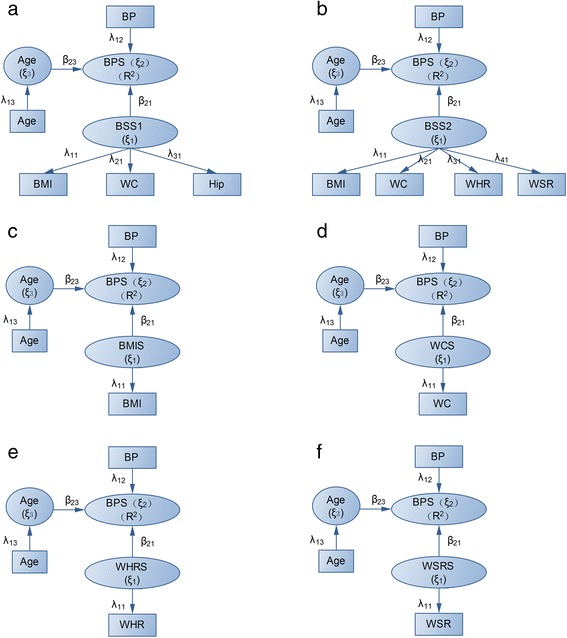
Based on the China Health and Nutrition Survey (CHNS) data, using Lohmäller PLSPM algorithm, six Partial Least Squares Path Models (PLSPMs) between the different obesity measurements and hypertension as well as two synthetical body shape scores (BSS1 by BMI/WC/Hip circumference, BSS2 by BMI/WC/WHR/WSR) were created. Simulation and real data analysis were conducted to assess their performance.
Statistical simulation showed the proposed model was stable and powerful. Totally 15,172 (6,939 male and 8,233 female) participants aged from 18 to 87 years old were included. It indicated that age, height, weight, WC, WHR, WSR, SBP, DBP, the prevalence of hypertension and obesity were significantly sex-different. BMI, WC, WHR, WSR, Hip, BSS1 and BSS2 between hypertension and normotensive group are significantly different (p < 0.05). PLSPM method illustrated the biggest path coefficients (95% confidence interval, CI) were 0.220(0.196, 0.244) for male and 0.205(0.182, 0.228) for female in model of BSS1. The area under receiver-operating characteristic curve (AUC(95% CI)) of BSS1(0.839(0.831,0.847)) was significantly larger than that of BSS2(0.834(0.825,0.842)) as well as the four single indices for female, and similar trend can be found for male.
BSS1 was an excellent measurement for quantifying body shape and detecting the association between body shape and hypertension.
肥胖是高血压和冠心病等慢性病的一个主要独立危险因素,它不仅与体脂肪量有关,还与脂肪分布有关。单一的身体质量指数(BMI)、腰围(WC)、腰臀比(WHR)或腰高比(WSR)提供的脂肪分布信息有限,关于哪种方法最好的争论仍在继续。另一方面,目前的体型分类是定性的,而不是定量的,只能粗略地测量脂肪分布。因此,非常需要一个综合指数来量化体型。
基于中国健康与营养调查(CHNS)数据,使用 Lohmäller PLSPM 算法,建立了 6 种不同肥胖测量方法与高血压之间的偏最小二乘路径模型(PLSPM)以及 2 种综合体型评分(BSS1 由 BMI/WC/臀围组成,BSS2 由 BMI/WC/WHR/WSR 组成)。通过模拟和真实数据分析来评估它们的性能。
统计模拟表明,所提出的模型是稳定和强大的。共纳入了 15172 名(男性 6939 名,女性 8233 名)年龄在 18 至 87 岁之间的参与者。结果表明,年龄、身高、体重、WC、WHR、WSR、SBP、DBP、高血压患病率和肥胖在性别上有显著差异。高血压组和正常血压组的 BMI、WC、WHR、WSR、臀围、BSS1 和 BSS2 有显著差异(p<0.05)。PLSPM 方法表明,男性模型中 BSS1 的最大路径系数(95%置信区间,CI)为 0.220(0.196,0.244),女性为 0.205(0.182,0.228)。BSS1 的受试者工作特征曲线下面积(AUC(95%CI))(0.839(0.831,0.847))显著大于 BSS2(0.834(0.825,0.842))以及女性的四个单一指标,男性也存在类似趋势。
BSS1 是一种用于量化体型和检测体型与高血压之间关联的优秀方法。