Zhang Wei, Lukacsovich David, Young Juan I, Gomez Lissette, Schmidt Michael A, Martin Eden R, Kunkle Brian W, Chen X Steven, O'Shea Deirdre M, Galvin James E, Wang Lily
Division of Biostatistics, Department of Public Health Sciences, University of Miami, Miller School of Medicine, Miami, FL, 33136, USA.
Dr. John T Macdonald Foundation Department of Human Genetics, University of Miami, Miller School of Medicine, Miami, FL, 33136, USA.
Alzheimers Res Ther. 2025 Apr 22;17(1):88. doi: 10.1186/s13195-025-01733-7.
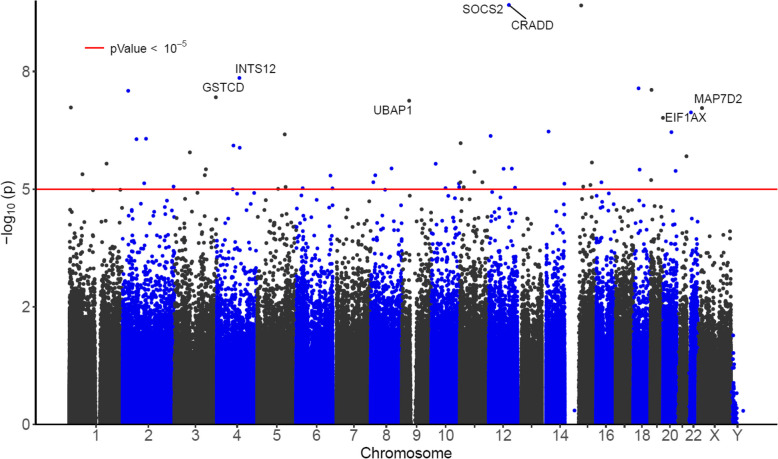
Cognitive resilience (CR) contributes to the variability in risk for developing and progressing in Alzheimer's disease (AD) among individuals. Beyond genetics, recent studies highlight the critical role of lifestyle factors in enhancing CR and delaying cognitive decline. DNA methylation (DNAm), an epigenetic mechanism influenced by both genetic and environmental factors, including CR-related lifestyle factors, offers a promising pathway for understanding the biology of CR. We studied DNAm changes associated with the Resilience Index (RI), a composite measure of lifestyle factors, using blood samples from the Healthy Brain Initiative (HBI) cohort. After corrections for multiple comparisons, our analysis identified 19 CpGs and 24 differentially methylated regions significantly associated with the RI, adjusting for covariates age, sex, APOE ε4, and immune cell composition. The RI-associated methylation changes are significantly enriched in pathways related to lipid metabolism, synaptic plasticity, and neuroinflammation, and highlight the connection between cardiovascular health and cognitive function. By identifying RI-associated DNAm, our study provided an alternative approach to discovering future targets and treatment strategies for AD, complementary to the traditional approach of identifying disease-associated variants directly. Furthermore, we developed a Methylation-based Resilience Score (MRS) that successfully predicted future cognitive decline in an external dataset from the Alzheimer's Disease Neuroimaging Initiative (ADNI), even after accounting for age, sex, APOE ε4, years of education, baseline diagnosis, and baseline MMSE score. Our findings are particularly relevant for a better understanding of epigenetic architecture underlying cognitive resilience. Importantly, the significant association between baseline MRS and future cognitive decline demonstrated that DNAm could be a predictive marker for AD, laying the foundation for future studies on personalized AD prevention.
认知弹性(CR)导致个体患阿尔茨海默病(AD)以及病情发展风险的差异。除了遗传因素外,最近的研究强调了生活方式因素在增强CR和延缓认知衰退方面的关键作用。DNA甲基化(DNAm)是一种受遗传和环境因素(包括与CR相关的生活方式因素)影响的表观遗传机制,为理解CR的生物学机制提供了一条有前景的途径。我们使用健康大脑计划(HBI)队列的血液样本,研究了与生活方式因素综合指标弹性指数(RI)相关的DNAm变化。在进行多重比较校正后,我们的分析确定了19个CpG位点和24个差异甲基化区域与RI显著相关,并对年龄、性别、APOE ε4和免疫细胞组成等协变量进行了调整。与RI相关的甲基化变化在与脂质代谢、突触可塑性和神经炎症相关的通路中显著富集,并突出了心血管健康与认知功能之间的联系。通过识别与RI相关的DNAm,我们的研究提供了一种发现AD未来靶点和治疗策略的替代方法,这是对直接识别疾病相关变异的传统方法的补充。此外,我们开发了一种基于甲基化的弹性评分(MRS),该评分在来自阿尔茨海默病神经影像学计划(ADNI)的外部数据集中成功预测了未来的认知衰退,即使在考虑了年龄、性别、APOE ε4、受教育年限、基线诊断和基线MMSE评分之后也是如此。我们的发现对于更好地理解认知弹性背后的表观遗传结构尤为重要。重要的是,基线MRS与未来认知衰退之间的显著关联表明DNAm可能是AD的预测标志物,为未来个性化AD预防研究奠定了基础。