Central Virginia Health Network, Richmond, VA, United States.
JMIR Med Inform. 2014 Aug 15;2(2):e19. doi: 10.2196/medinform.3455.
Much attention has been given to the proposition that the exchange of health information as an act, and health information exchange (HIE), as an entity, are critical components of a framework for health care change, yet little has been studied to understand the value proposition of implementing HIE with a statewide HIE. Such an organization facilitates the exchange of health information across disparate systems, thus following patients as they move across different care settings and encounters, whether or not they share an organizational affiliation. A sociotechnical systems approach and an interorganizational systems framework were used to examine implementation of a health system electronic medical record (EMR) system onto a statewide HIE, under a cooperative agreement with the Office of the National Coordinator for Health Information Technology, and its collaborating organizations.
The objective of the study was to focus on the implementation of a health system onto a statewide HIE; provide insight into the technical, organizational, and governance aspects of a large private health system and the Virginia statewide HIE (organizations with the shared goal of exchanging health information); and to understand the organizational motivations and value propositions apparent during HIE implementation.
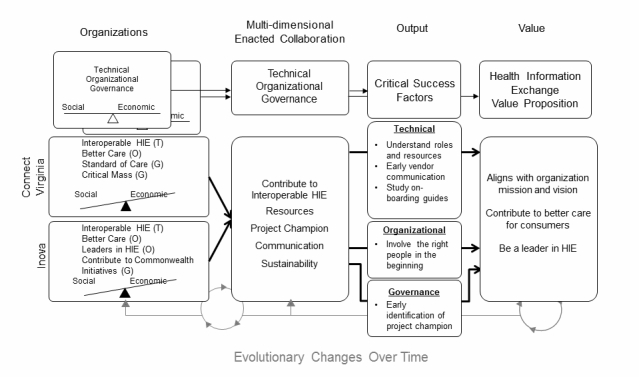
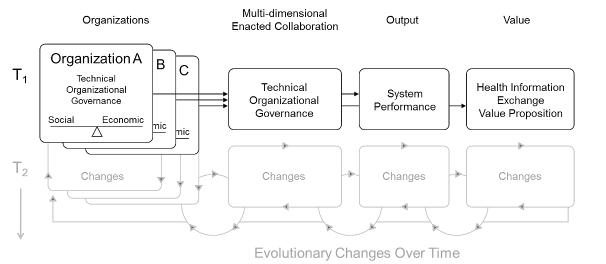
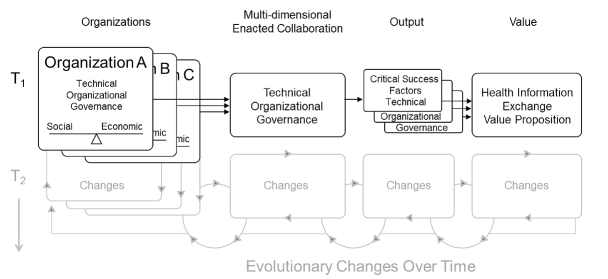
We used a formative evaluation methodology to investigate the first implementation of a health system onto the statewide HIE. Qualitative methods (direct observation, 36 hours), informal information gathering, semistructured interviews (N=12), and document analysis were used to gather data between August 12, 2012 and June 24, 2013. Derived from sociotechnical concepts, a Blended Value Collaboration Enactment Framework guided the data gathering and analysis to understand organizational stakeholders' perspectives across technical, organizational, and governance dimensions.
Several challenges, successes, and lessons learned during the implementation of a health system to the statewide HIE were found. The most significant perceived success was accomplishing the implementation, although many interviewees also underscored the value of a project champion with decision-making power. In terms of lessons learned, social reasons were found to be very significant motivators for early implementation, frequently outweighing economic motivations. It was clear that understanding the guides early in the project would have mitigated some of the challenges that emerged, and early communication with the electronic health record vendor so that they have a solid understanding of the undertaking was critical. An HIE implementations evaluation framework was found to be useful for assessing challenges, motivations, value propositions for participating, and success factors to consider for future implementations.
This case study illuminates five critical success factors for implementation of a health system onto a statewide HIE. This study also reveals that organizations have varied motivations and value proposition perceptions for engaging in the exchange of health information, few of which, at the early stages, are economically driven.

人们高度关注健康信息交流作为一种行为和健康信息交流(HIE)作为实体,是医疗保健变革框架的关键组成部分,但几乎没有研究来理解通过全州范围的 HIE 实施 HIE 的价值主张。这样的组织促进了不同系统之间的健康信息交换,从而随着患者在不同的护理环境和遭遇中移动,无论他们是否有组织隶属关系,都能跟踪他们的健康信息。本研究采用社会技术系统方法和组织间系统框架,根据与国家卫生信息技术协调办公室(ONC)及其合作组织的合作协议,研究了在全州范围内的 HIE 上实施医疗系统电子病历(EMR)系统的情况。
本研究的目的是专注于在全州范围内的 HIE 上实施医疗系统;深入了解一个大型私立医疗系统和弗吉尼亚州全州范围的 HIE(具有交换健康信息共同目标的组织)的技术、组织和治理方面;并了解 HIE 实施过程中明显的组织动机和价值主张。
我们使用形成性评估方法来研究医疗系统在全州范围内的 HIE 上的首次实施。定性方法(直接观察,36 小时)、非正式信息收集、半结构化访谈(N=12)和文档分析用于在 2012 年 8 月 12 日至 2013 年 6 月 24 日之间收集数据。从社会技术概念中得出的混合价值协作实施框架指导了数据收集和分析,以了解组织利益相关者在技术、组织和治理方面的观点。
在将医疗系统实施到全州范围的 HIE 过程中发现了一些挑战、成功和经验教训。最显著的成功是完成了实施,尽管许多受访者还强调了具有决策权的项目负责人的价值。就经验教训而言,发现社会原因是早期实施的非常重要的动机,经常超过经济动机。显然,在项目早期了解指南将减轻一些出现的挑战,并且与电子健康记录供应商进行早期沟通以便他们对项目有一个清晰的了解是至关重要的。发现健康信息交换实施评估框架对于评估挑战、参与的动机和价值主张以及考虑未来实施的成功因素非常有用。
本案例研究阐明了将医疗系统实施到全州范围的 HIE 中需要的五个关键成功因素。本研究还表明,组织参与健康信息交换的动机和价值主张存在差异,很少有组织在早期阶段是出于经济驱动。