Vanderbilt Implementation Sciences Laboratory, Department of Biomedical Informatics, Vanderbilt University School of Medicine, Nashville, TN, United States.
JMIR Med Inform. 2013 Oct 29;1(1):e3. doi: 10.2196/medinform.2510.
The fragmented nature of health care delivery in the United States leads to fragmented health information and impedes patient care continuity and safety. Technologies to support interorganizational health information exchange (HIE) are becoming more available. Understanding how HIE technology changes health care delivery and affects people and organizations is crucial to long-term successful implementation.
Our study investigated the impacts of HIE technology on organizations, health care providers, and patients through a new, context-aware perspective, the Regional Health Information Ecology.
We conducted more than 180 hours of direct observation, informal interviews during observation, and 9 formal semi-structured interviews. Data collection focused on workflow and information flow among health care team members and patients and on health care provider use of HIE technology.
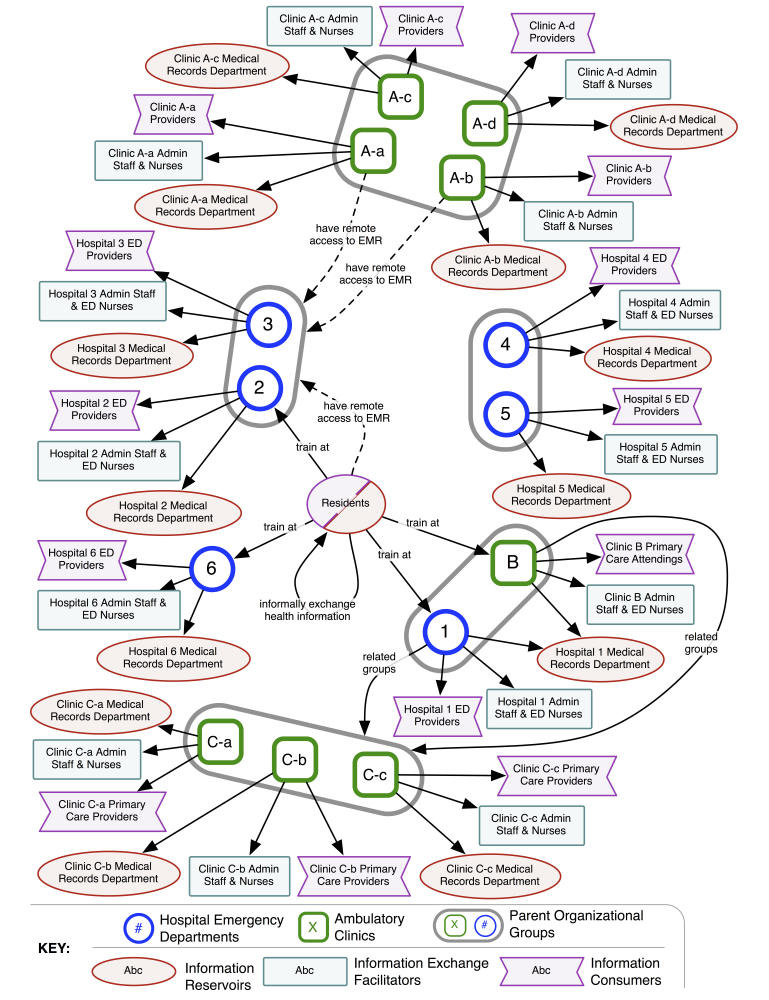
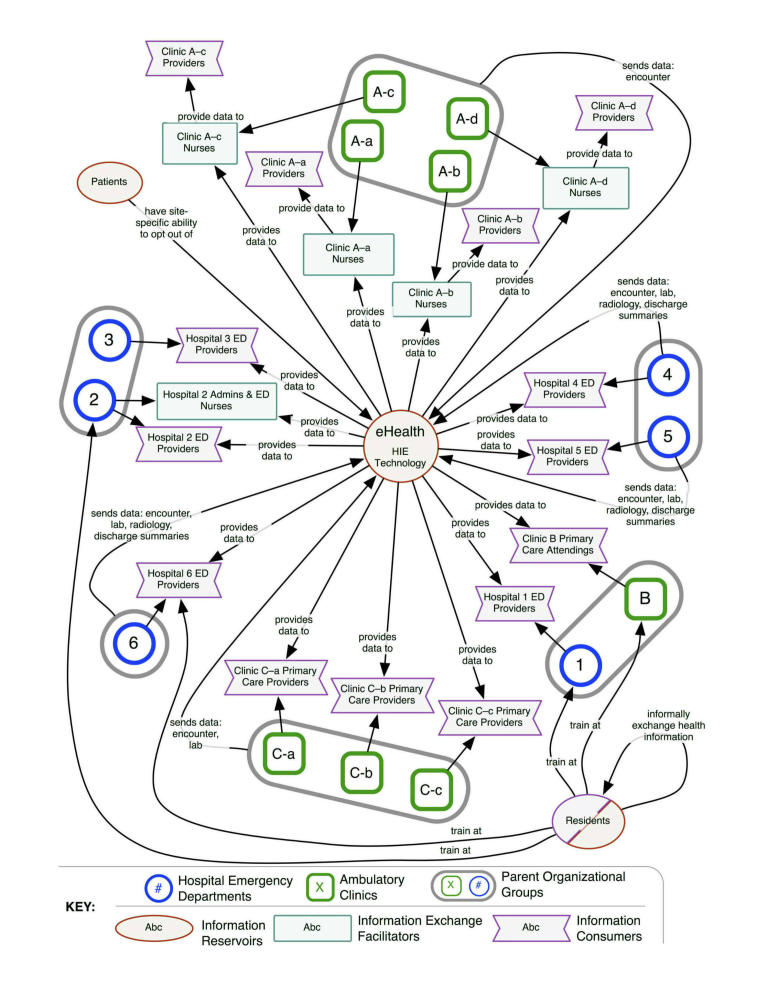
We structured the data analysis around five primary information ecology components: system, locality, diversity, keystone species, and coevolution. Our study identified three main roles, or keystone species, involved in HIE: information consumers, information exchange facilitators, and information repositories. The HIE technology impacted patient care by allowing providers direct access to health information, reducing time to obtain health information, and increasing provider awareness of patient interactions with the health care system. Developing the infrastructure needed to support HIE technology also improved connections among information technology support groups at different health care organizations. Despite the potential of this type of technology to improve continuity of patient care, HIE technology adoption by health care providers was limited.
To successfully build a HIE network, organizations had to shift perspectives from an ownership view of health data to a continuity of care perspective. To successfully integrate external health information into clinical work practices, health care providers had to move toward understanding potential contributions of external health information. Our study provides a foundation for future context-aware development and implementation of HIE technology. Integrating concepts from the Regional Health Information Ecology into design and implementation may lead to wider diffusion and adoption of HIE technology into clinical work.
美国医疗服务提供的碎片化导致了医疗信息的碎片化,阻碍了患者护理的连续性和安全性。支持组织间医疗信息交换(HIE)的技术变得越来越普及。了解 HIE 技术如何改变医疗服务提供方式,以及如何影响人和组织,对于长期成功实施至关重要。
通过一种新的、基于情境感知的视角——区域卫生信息生态系统,我们研究了 HIE 技术对组织、医疗保健提供者和患者的影响。
我们进行了超过 180 小时的直接观察、观察期间的非正式访谈以及 9 次正式的半结构化访谈。数据收集侧重于医疗保健团队成员和患者之间的工作流程和信息流,以及医疗保健提供者对 HIE 技术的使用。
我们围绕五个主要的信息生态系统组件组织数据分析:系统、位置、多样性、关键物种和共同进化。我们的研究确定了三个主要角色,或 HIE 中的关键物种,包括信息消费者、信息交换促进者和信息存储库。HIE 技术通过允许提供者直接访问健康信息、减少获取健康信息的时间以及提高提供者对患者与医疗保健系统交互的认识,从而影响患者护理。开发支持 HIE 技术所需的基础设施也改善了不同医疗保健组织之间信息技术支持小组之间的联系。尽管这种类型的技术有可能改善患者护理的连续性,但医疗保健提供者对 HIE 技术的采用受到限制。
为了成功建立 HIE 网络,组织必须从对健康数据的所有权视角转变为对患者护理连续性的视角。为了成功将外部健康信息整合到临床工作实践中,医疗保健提供者必须开始理解外部健康信息的潜在贡献。我们的研究为未来基于情境感知的 HIE 技术开发和实施提供了基础。将区域卫生信息生态系统的概念纳入设计和实施中可能会导致更广泛地扩散和采用 HIE 技术到临床工作中。