Cruz Sónia, Cartaxana Paulo, Newcomer Rebecca, Dionísio Gisela, Calado Ricardo, Serôdio João, Pelletreau Karen N, Rumpho Mary E
Departamento de Biologia &CESAM - Centro de Estudos do Ambiente e do Mar, Universidade de Aveiro, Campus de Santiago, 3810-193 Aveiro, Portugal.
MARE - Centro de Ciências do Mar e do Ambiente, Faculdade de Ciências da Universidade de Lisboa, 1749-016 Lisboa, Portugal.
Sci Rep. 2015 Jan 20;5:7904. doi: 10.1038/srep07904.
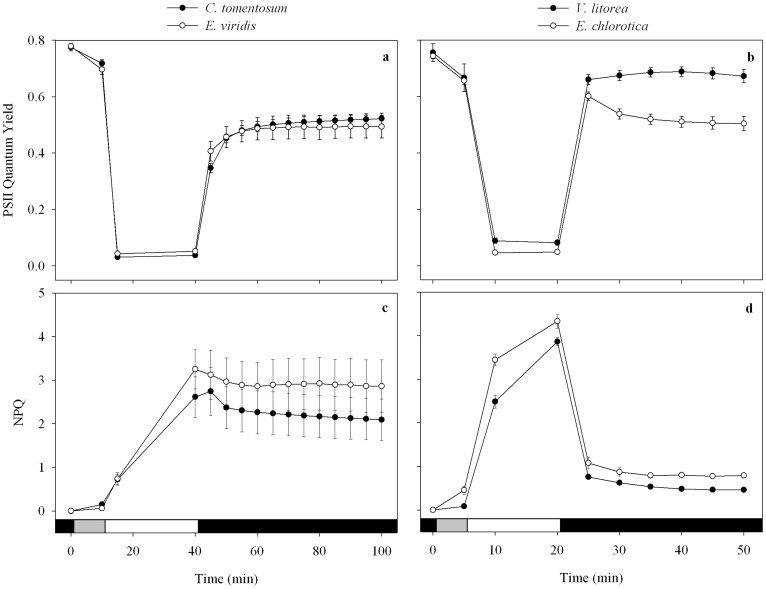
Some sea slugs are capable of retaining functional sequestered chloroplasts (kleptoplasts) for variable periods of time. The mechanisms supporting the maintenance of these organelles in animal hosts are still largely unknown. Non-photochemical quenching (NPQ) and the occurrence of a xanthophyll cycle were investigated in the sea slugs Elysia viridis and E. chlorotica using chlorophyll fluorescence measurements and pigment analysis. The photoprotective capacity of kleptoplasts was compared to that observed in their respective algal source, Codium tomentosum and Vaucheria litorea. A functional xanthophyll cycle and a rapidly reversible NPQ component were found in V. litorea and E. chlorotica but not in C. tomentosum and E. viridis. To our knowledge, this is the first report of the absence of a functional xanthophyll cycle in a green macroalgae. The absence of a functional xanthophyll cycle in C. tomentosum could contribute to the premature loss of photosynthetic activity and relatively short-term retention of kleptoplasts in E. viridis. On the contrary, E. chlorotica displays one of the longest functional examples of kleptoplasty known so far. We speculate that different efficiencies of photoprotection and repair mechanisms of algal food sources play a role in the longevity of photosynthetic activity in kleptoplasts retained by sea slugs.
一些海蛞蝓能够在不同时间段内保留功能性的隔离叶绿体(盗食质体)。支持这些细胞器在动物宿主体内维持的机制在很大程度上仍不为人知。利用叶绿素荧光测量和色素分析,对绿叶海天牛和绿叶海蛞蝓体内的非光化学猝灭(NPQ)和叶黄素循环的发生情况进行了研究。将盗食质体的光保护能力与其各自的藻类来源,即绒毛藻和利特瑞藻中观察到的情况进行了比较。在利特瑞藻和绿叶海蛞蝓中发现了功能性的叶黄素循环和快速可逆的NPQ成分,但在绒毛藻和绿叶海天牛中未发现。据我们所知,这是首次报道绿色大型藻类中不存在功能性叶黄素循环。绒毛藻中不存在功能性叶黄素循环可能导致光合活性过早丧失,以及绿叶海天牛体内盗食质体的保留时间相对较短。相反,绿叶海蛞蝓展示了迄今为止已知的盗食质体功能持续时间最长的例子之一。我们推测,藻类食物来源的光保护和修复机制的不同效率在海蛞蝓保留的盗食质体光合活性的寿命中发挥了作用。