Hayashi Kentaro, Tabata Sho, Piras Vincent, Tomita Masaru, Selvarajoo Kumar
Institute for Advanced Biosciences, Keio University , Tsuruoka , Japan ; Systems Biology Program, Graduate School of Media and Governance, Keio University , Fujisawa , Japan.
Front Immunol. 2015 Jan 5;5:659. doi: 10.3389/fimmu.2014.00659. eCollection 2014.
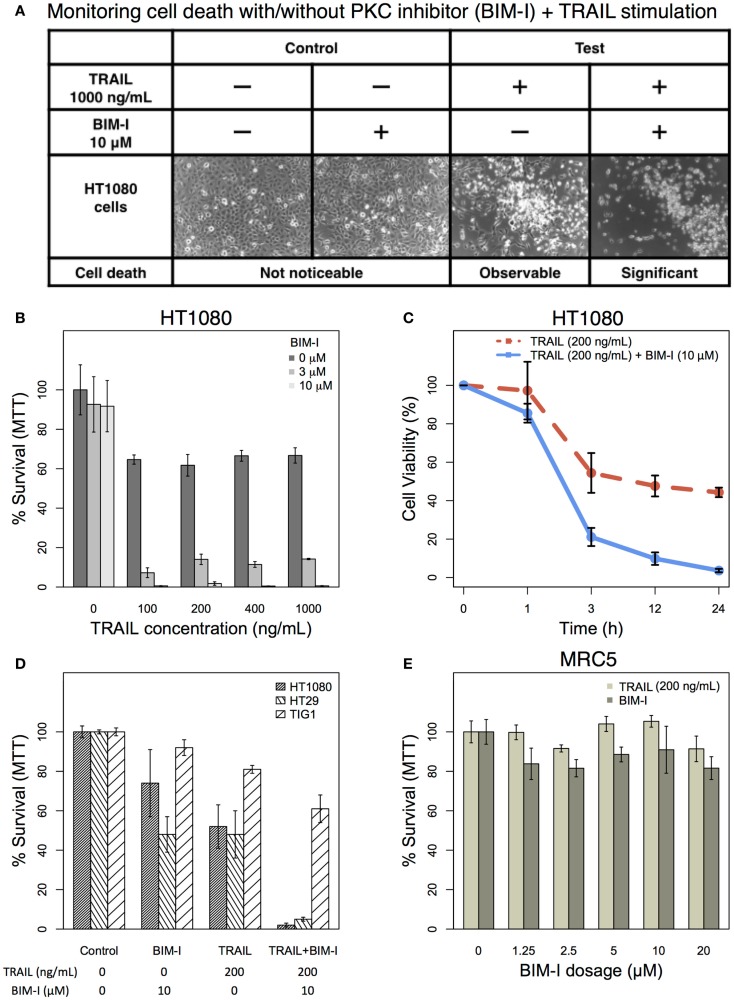
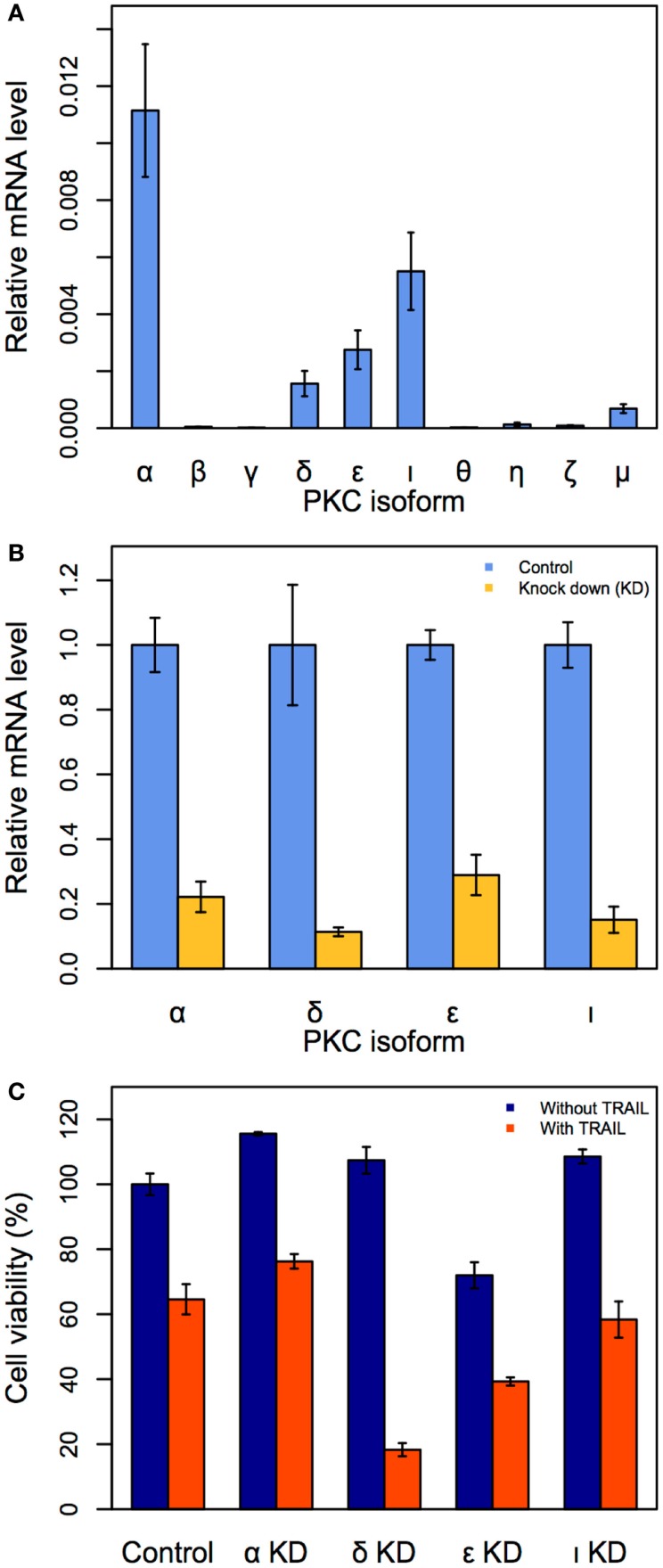
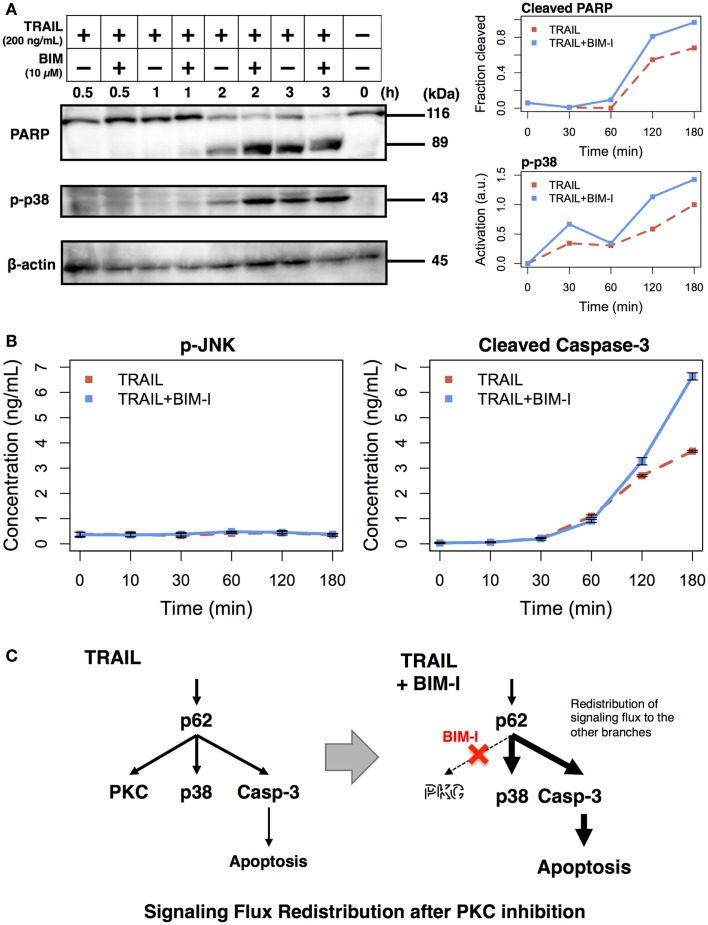
Cancer cells are highly variable and largely resistant to therapeutic intervention. Recently, the use of the tumor necrosis factor related apoptosis-inducing ligand (TRAIL) induced treatment is gaining momentum due to TRAIL's ability to specifically target cancers with limited effect on normal cells. Nevertheless, several malignant cancer types still remain non-sensitive to TRAIL. Previously, we developed a dynamic computational model, based on perturbation-response differential equations approach, and predicted protein kinase C (PKC) as the most effective target, with over 95% capacity to kill human fibrosarcoma (HT1080) in TRAIL stimulation (1). Here, to validate the model prediction, which has significant implications for cancer treatment, we conducted experiments on two TRAIL-resistant cancer cell lines (HT1080 and HT29). Using PKC inhibitor bisindolylmaleimide I, we demonstrated that cell viability is significantly impaired with over 95% death of both cancer types, in consistency with our previous model. Next, we measured caspase-3, Poly (ADP-ribose) polymerase (PARP), p38, and JNK activations in HT1080, and confirmed cell death occurs through apoptosis with significant increment in caspase-3 and PARP activations. Finally, to identify a crucial PKC isoform, from 10 known members, we analyzed each isoform mRNA expressions in HT1080 cells and shortlisted the highest 4 for further siRNA knock-down (KD) experiments. From these KDs, PKCδ produced the most cancer cell death in conjunction with TRAIL. Overall, our approach combining model predictions with experimental validation holds promise for systems biology based cancer therapy.
癌细胞具有高度变异性,并且对治疗干预大多具有抗性。近来,由于肿瘤坏死因子相关凋亡诱导配体(TRAIL)能够特异性靶向癌症细胞且对正常细胞影响有限,利用TRAIL诱导治疗的方法正越来越受到关注。然而,几种恶性癌症类型对TRAIL仍然不敏感。此前,我们基于微扰响应微分方程方法开发了一个动态计算模型,并预测蛋白激酶C(PKC)是最有效的靶点,在TRAIL刺激下对人纤维肉瘤(HT1080)的杀伤能力超过95%(1)。在此,为了验证对癌症治疗具有重要意义的模型预测,我们对两种TRAIL抗性癌细胞系(HT1080和HT29)进行了实验。使用PKC抑制剂双吲哚马来酰亚胺I,我们证明两种癌症类型细胞活力均显著受损,细胞死亡率超过95%,这与我们之前的模型一致。接下来,我们检测了HT1080细胞中半胱天冬酶 - 3、聚(ADP - 核糖)聚合酶(PARP)、p38和JNK的激活情况,并证实细胞死亡是通过凋亡发生的,半胱天冬酶 - 3和PARP的激活显著增加。最后,为了从10个已知成员中鉴定关键的PKC亚型,我们分析了HT1080细胞中各亚型的mRNA表达,并筛选出最高的4种进行进一步的小干扰RNA敲低(KD)实验。从这些KD实验中,PKCδ与TRAIL联合作用时导致的癌细胞死亡最多。总体而言,我们将模型预测与实验验证相结合的方法有望用于基于系统生物学的癌症治疗。