Cunningham John A, Hendershot Christian S, Rehm Jürgen
Department of Social and Epidemiological Research, Centre for Addiction and Mental Health, Toronto, Canada.
National Institute for Mental Health Research, Australian National University, Canberra, Australia.
BMC Public Health. 2015 Jan 21;15:21. doi: 10.1186/s12889-015-1347-8.
Problem drinking causes great harm to the person and to society. Most problem drinkers will never seek treatment. The current trial will test the efficacy of two Internet interventions for problem drinking - one minimal and the other extended - as an alternate means of providing help to those in need.
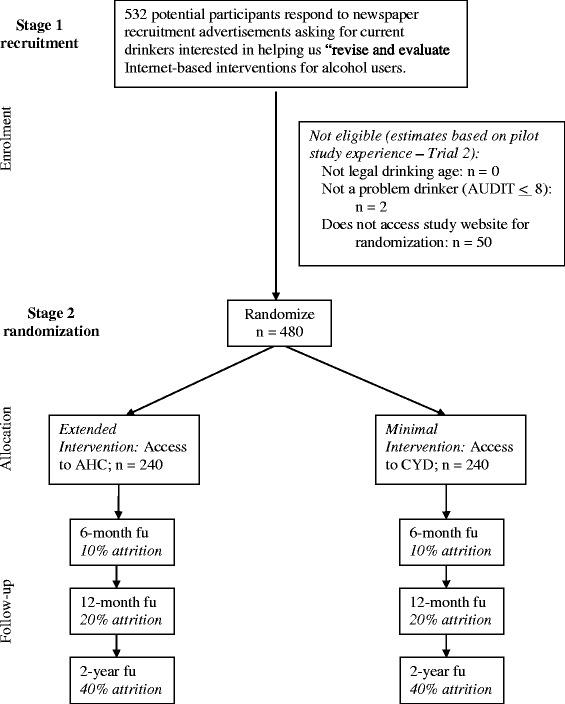
METHODS/DESIGN: A double blinded, four-wave panel design with random assignment to two experimental conditions will be used in this study. Participants will be recruited through a comprehensive recruitment strategy consisting of online and print advertisements asking for people who are 'interested in helping us develop and evaluate Internet-based interventions for problem drinkers.' Potential participants will be screened to select problem drinkers who have home access to the Internet. Participants will be sent to a password-protected Internet site and, upon signing in, will be randomized to be provided access to the minimal or extended Internet-based intervention. Six-month, twelve-month, and two-year drinking outcomes will be compared between experimental conditions. The primary hypothesis is that participants in the extended Internet intervention condition will display significantly improved drinking outcomes at twelve months compared to participants in the minimal intervention.
The findings of this trial will contribute to the growing literature on Internet interventions for problem drinkers. In addition, findings from this trial will contribute to the scarce literature available evaluating the long-term efficacy of brief interventions for alcohol problems.
Clinical Trials.gov # NCT01874509; First submitted June 17, 2013.
问题饮酒对个人和社会造成极大危害。大多数问题饮酒者从不寻求治疗。当前试验将测试两种针对问题饮酒的互联网干预措施的效果——一种是极简干预,另一种是扩展干预——作为向有需要的人提供帮助的替代方式。
方法/设计:本研究将采用双盲、四波面板设计,并随机分配到两种实验条件。参与者将通过全面的招募策略招募,包括在线和印刷广告,招募“有兴趣帮助我们开发和评估针对问题饮酒者的基于互联网的干预措施”的人。潜在参与者将经过筛选,以选择家中可上网的问题饮酒者。参与者将被发送到一个受密码保护的互联网网站,登录后将被随机分配,以获得极简或扩展的基于互联网的干预措施。将比较两种实验条件下六个月、十二个月和两年的饮酒结果。主要假设是,与接受极简干预的参与者相比,接受扩展互联网干预的参与者在十二个月时饮酒结果将有显著改善。
该试验的结果将为关于针对问题饮酒者的互联网干预措施的不断增加的文献做出贡献。此外,该试验的结果将为评估针对酒精问题的简短干预措施的长期效果的稀缺文献做出贡献。
ClinicalTrials.gov # NCT01874509;首次提交于2013年6月17日。