Huo Y, Liu S X, Song G Y, Ren L P, Wang C, Zhang D H
Internal Medicine Teaching and Research Room, Hebei Medical University, Shijiazhuang, Hebei, China.
Department of Obstetrics and Gynecology, Hebei General Hospital, China.
Braz J Med Biol Res. 2015 Mar;48(3):273-9. doi: 10.1590/1414-431X20143432. Epub 2015 Jan 20.
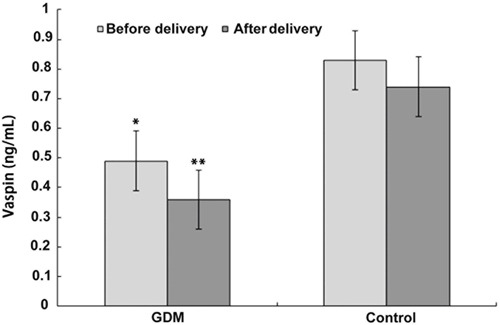
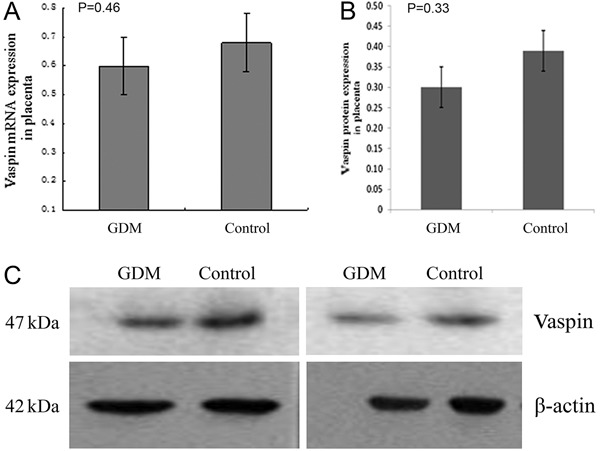
The present study aimed to investigate visceral adipose tissue-specific serpin (vaspin) concentrations in serum and term placentas and relate these values to insulin resistance and lipid parameters in women with gestational diabetes mellitus (GDM). A total of 30 GDM subjects and 27 age-matched pregnant women with normal glucose tolerance (NGT, control) were included. Serum glucose, glycated hemoglobin (HbA1c), lipid profile, insulin, and vaspin were measured at the end of pregnancy, and homeostasis model of assessment-insulin resistance (HOMA-IR) values were calculated. Vaspin mRNA and protein levels in placentas were measured by real-time fluorescence quantitative reverse transcription polymerase chain reaction (RT-qPCR) and Western blotting, respectively. Serum vaspin levels were significantly lower in the GDM group than in controls (0.49 ± 0.24 vs 0.83 ± 0.27 ng/mL, respectively; P<0.01). Three days after delivery, serum vaspin levels were significantly decreased in subjects with GDM (0.36 ± 0.13 vs 0.49 ± 0.24 ng/mL, P<0.01). However, in the GDM group, serum vaspin levels were not correlated with the parameters evaluated. In contrast, in the control group, serum vaspin levels were positively correlated with triglycerides (TG; r=0.45, P=0.02) and very low-density lipoprotein cholesterol (VLDL-C; r=0.42, P=0.03). Placental mRNA vaspin (0.60 ± 0.32 vs 0.68 ± 0.32, P=0.46) and protein (0.30 ± 0.08 vs 0.39 ± 0.26; P=0.33) levels in the GDM group did not differ significantly from those in the control group, but were negatively correlated with neonatal birth weight in the GDM group (r=-0.48, P=0.03; r=-0.88; P<0.01). Our findings indicated that vaspin may be an important adipokine involved in carbohydrate and lipid metabolism and may also play a role in fetal development.
本研究旨在调查血清和足月胎盘组织中内脏脂肪组织特异性丝氨酸蛋白酶抑制剂(vaspin)的浓度,并将这些值与妊娠期糖尿病(GDM)女性的胰岛素抵抗和血脂参数相关联。共纳入30例GDM患者和27例年龄匹配的糖耐量正常的孕妇(NGT,对照组)。在妊娠末期测量血清葡萄糖、糖化血红蛋白(HbA1c)、血脂谱、胰岛素和vaspin,并计算稳态模型评估胰岛素抵抗(HOMA-IR)值。分别通过实时荧光定量逆转录聚合酶链反应(RT-qPCR)和蛋白质印迹法测量胎盘组织中vaspin的mRNA和蛋白质水平。GDM组血清vaspin水平显著低于对照组(分别为0.49±0.24 vs 0.83±0.27 ng/mL;P<0.01)。分娩后3天,GDM患者血清vaspin水平显著降低(0.36±0.13 vs 0.49±0.24 ng/mL,P<0.01)。然而,在GDM组中,血清vaspin水平与所评估的参数无关。相反,在对照组中,血清vaspin水平与甘油三酯(TG;r=0.45,P=0.02)和极低密度脂蛋白胆固醇(VLDL-C;r=0.42,P=0.03)呈正相关。GDM组胎盘组织中vaspin的mRNA(0.60±0.32 vs 0.68±0.32,P=0.46)和蛋白质(0.30±0.08 vs 0.39±0.26;P=0.33)水平与对照组相比无显著差异,但与GDM组新生儿出生体重呈负相关(r=-0.48,P=0.03;r=-0.88;P<0.01)。我们的研究结果表明,vaspin可能是参与碳水化合物和脂质代谢的重要脂肪因子,也可能在胎儿发育中发挥作用。