Kwesiga Brendan, Zikusooka Charlotte M, Ataguba John E
HealthNet Consult, P.O. Box 35928, Kampala, Uganda.
Health Economics Unit, School of Public Health and Family Medicine, University of Cape Town, Observatory, Cape Town, 7925, South Africa.
BMC Health Serv Res. 2015 Jan 22;15:30. doi: 10.1186/s12913-015-0682-x.
Direct out-of-pocket payments for health care are recognised as limiting access to health care services and also endangering the welfare of households. In Uganda, such payments comprise a large portion of total health financing. This study assesses the catastrophic and impoverishing impact of paying for health care out-of-pocket in Uganda.
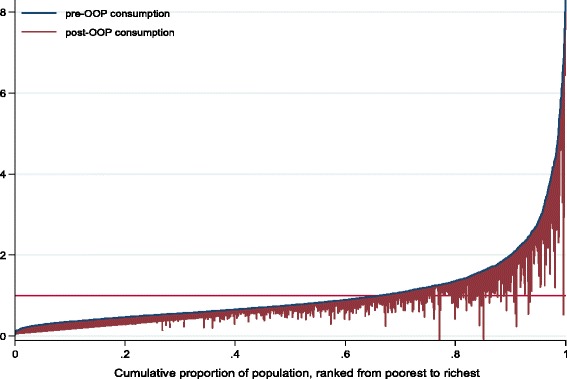
Using data from the Uganda National Household Surveys 2009/10, the catastrophic impact of out-of-pocket health care payments is defined using thresholds that vary with household income. The impoverishing effect of out-of-pocket health care payments is assessed using the Ugandan national poverty line and the World Bank poverty line ($1.25/day).
A high level and intensity of both financial catastrophe and impoverishment due to out-of-pocket payments are recorded. Using an initial threshold of 10% of household income, about 23% of Ugandan households face financial ruin. Based on both the $1.25/day and the Ugandan poverty lines, about 4% of the population are further impoverished by such payments. This represents a relative increase in poverty head count of 17.1% and 18.1% respectively.
The absence of financial protection in Uganda's health system calls for concerted action. Currently, out-of-pocket payments account for a large share of total health financing and there is no pooled prepayment system available. There is therefore a need to move towards mandatory prepayment. In this way, people could access the needed health services without any associated financial consequence.
医疗保健的直接自付费用被认为限制了人们获得医疗服务的机会,也危及家庭福利。在乌干达,此类支付占卫生总筹资的很大一部分。本研究评估了乌干达自付医疗费用的灾难性和致贫性影响。
利用2009/10年乌干达全国住户调查的数据,根据随家庭收入变化的阈值来定义自付医疗费用的灾难性影响。使用乌干达国家贫困线和世界银行贫困线(1.25美元/天)评估自付医疗费用的致贫效应。
记录到因自付费用导致的高额财务灾难和贫困程度。以家庭收入的10%作为初始阈值,约23%的乌干达家庭面临财务困境。根据1.25美元/天和乌干达贫困线,约4%的人口因这些支付而进一步陷入贫困。这分别代表贫困人口数相对增加了17.1%和18.1%。
乌干达卫生系统缺乏财务保护需要采取协调一致行动。目前,自付费用在卫生总筹资中占很大比例,且没有可用的统筹预付款制度。因此,有必要转向强制性预付款。这样,人们可以获得所需的医疗服务而不会产生任何相关财务后果。