Anderson Geoffrey A, Ilcisin Lenka, Kayima Peter, Abesiga Lenard, Portal Benitez Noralis, Ngonzi Joseph, Ronald Mayanja, Shrime Mark G
Department of Surgery, Massachusetts General Hospital, Boston, Massachusetts, United States of America.
Program in Global Surgery and Social Change, Department of Global Health and Social Medicine, Harvard Medical School, Boston, Massachusetts, United States of America.
PLoS One. 2017 Oct 31;12(10):e0187293. doi: 10.1371/journal.pone.0187293. eCollection 2017.
It is Ugandan governmental policy that all surgical care delivered at government hospitals in Uganda is to be provided to patients free of charge. In practice, however, frequent stock-outs and broken equipment require patients to pay for large portions of their care out of their own pocket. The purpose of this study was to determine the financial impact on patients who undergo surgery at a government hospital in Uganda.
Every surgical patient discharged from a surgical ward at a large regional referral hospital in rural southwestern Uganda over a 3-week period in April 2016 was asked to participate. Patients who agreed were surveyed to determine their baseline level of poverty and to assess the financial impact of the hospitalization. Rates of impoverishment and catastrophic expenditure were then calculated. An "impoverishing expense" is defined as one that pushes a household below published poverty thresholds. A "catastrophic expense" was incurred if the patient spent more than 10% of their average annual expenditures.
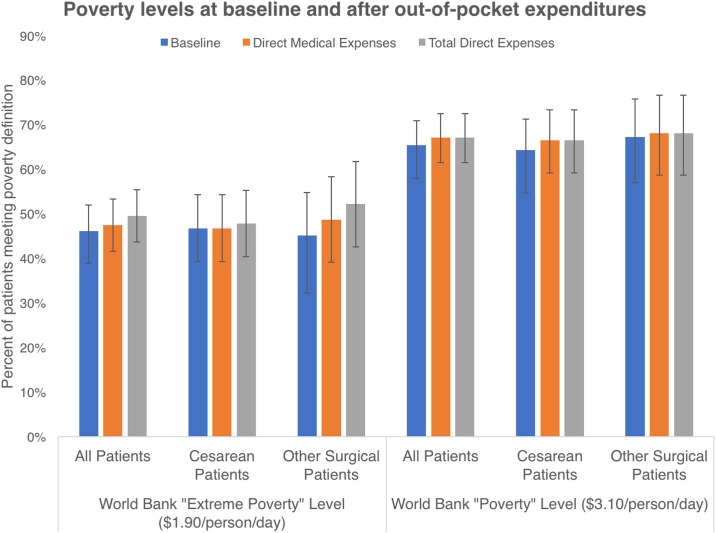
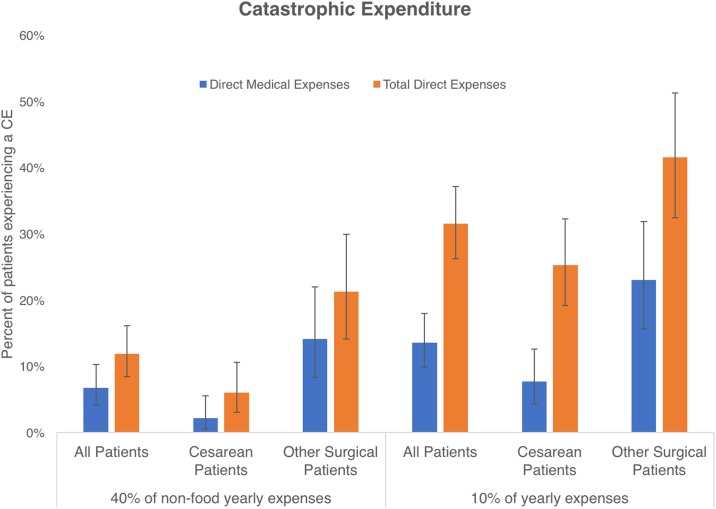
We interviewed 295 out of a possible 320 patients during the study period. 46% (CI 40-52%) of our patients met the World Bank's definition of extreme poverty ($1.90/person/day). After receiving surgical care an additional 10 patients faced extreme poverty, and 5 patients were newly impoverished by the World Bank's definition ($3.10/person/day). 31% of patients faced a catastrophic expenditure of more than 10% of their estimated total yearly expenses. 53% of the households in our study had to borrow money to pay for care, 21% had to sell possessions, and 17% lost a job as a result of the patient's hospitalization. Only 5% of our patients received some form of charity.
Despite the government's policy to provide "free care," undergoing an operation at a government hospital in Uganda can result in a severe economic burden to patients and their families. Alternative financing schemes to provide financial protection are critically needed.
乌干达政府政策规定,乌干达政府医院提供的所有外科护理服务应免费提供给患者。然而,在实际操作中,频繁的药品短缺和设备损坏要求患者自掏腰包支付大部分医疗费用。本研究的目的是确定在乌干达一家政府医院接受手术的患者所面临的经济影响。
2016年4月,在乌干达西南部农村地区一家大型区域转诊医院的外科病房出院的每一位手术患者都被邀请参与。同意参与的患者接受调查,以确定他们的基线贫困水平,并评估住院治疗的经济影响。然后计算贫困率和灾难性支出率。“贫困费用”定义为使家庭收入低于公布的贫困线的费用。如果患者花费超过其年均支出的10%,则产生“灾难性费用”。
在研究期间,我们在可能的320名患者中采访了295名。46%(置信区间40 - 52%)的患者符合世界银行对极端贫困的定义(每人每天1.90美元)。接受手术治疗后,又有10名患者面临极端贫困,5名患者根据世界银行的定义(每人每天3.10美元)新陷入贫困。31%的患者面临超过其估计年度总费用10%的灾难性支出。我们研究中的53%的家庭不得不借钱支付医疗费用,21%的家庭不得不出售财产,17%的家庭因患者住院而失去了工作。只有5%的患者接受了某种形式的慈善救助。
尽管政府有提供“免费医疗”的政策,但在乌干达政府医院接受手术仍可能给患者及其家庭带来沉重的经济负担。迫切需要替代性融资方案来提供经济保护。