Młyniec Katarzyna, Budziszewska Bogusława, Holst Birgitte, Ostachowicz Beata, Nowak Gabriel
Department of Biochemical Toxicology, Jagiellonian University Medical College, Medyczna 9, PL 30-688 Kraków, Poland (Dr. K. Młyniec, Prof. B. Budziszewska); Institute of Pharmacology, Polish Academy of Sciences, Smętna 12, PL 31-343 Kraków, Poland (Profs. B. Budziszewska, G. Nowak); Department of Neuroscience and Pharmacology University of Copenhagen, Blegdamsvej 3, DK-2200, Copenhagen, Denmark (Prof. B. Holst); Faculty of Physics and Applied Computer Science, AGH University of Science and Technology, Kraków, Poland (Dr. B. Ostachowicz); Department of Pharmacobiology, Jagiellonian University Medical College, Medyczna 9, PL 30-688 Kraków, Poland (Prof. G. Nowak).
Int J Neuropsychopharmacol. 2014 Oct 31;18(3):pyu002. doi: 10.1093/ijnp/pyu002.
Zinc may act as a neurotransmitter in the central nervous system by activation of the GPR39 metabotropic receptors.
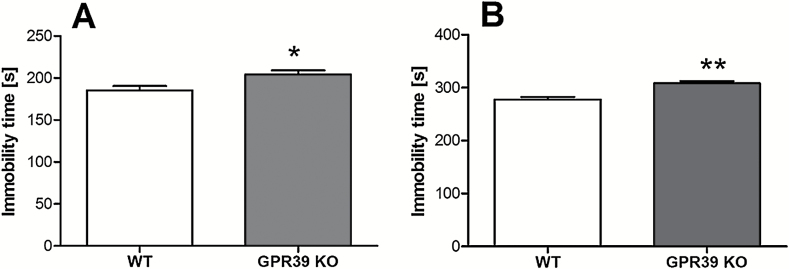
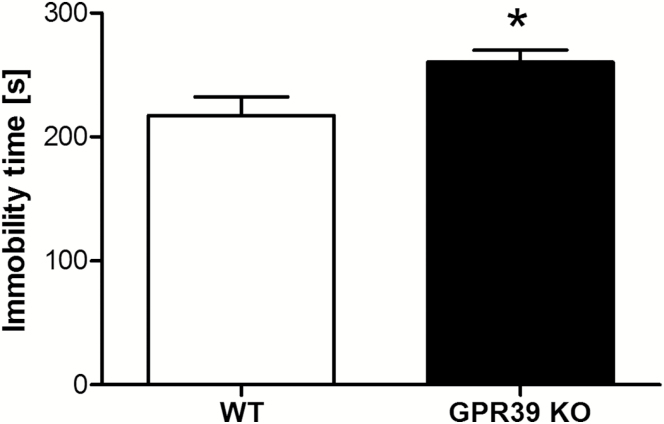
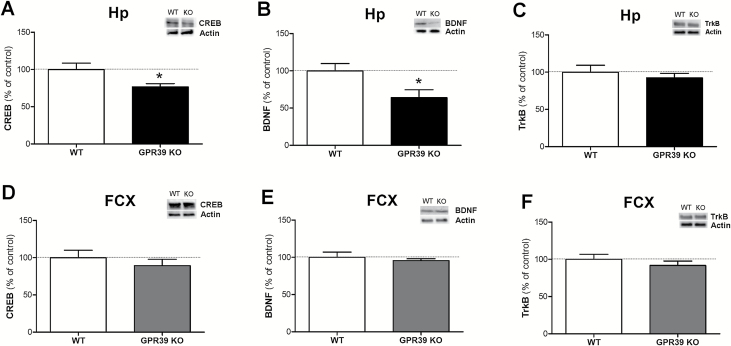
In the present study, we investigated whether GPR39 knockout would cause depressive-like and/or anxiety-like behavior, as measured by the forced swim test, tail suspension test, and light/dark test. We also investigated whether lack of GPR39 would change levels of cAMP response element-binding protein (CREB),brain-derived neurotrophic factor (BDNF) and tropomyosin related kinase B (TrkB) protein in the hippocampus and frontal cortex of GPR39 knockout mice subjected to the forced swim test, as measured by Western-blot analysis.
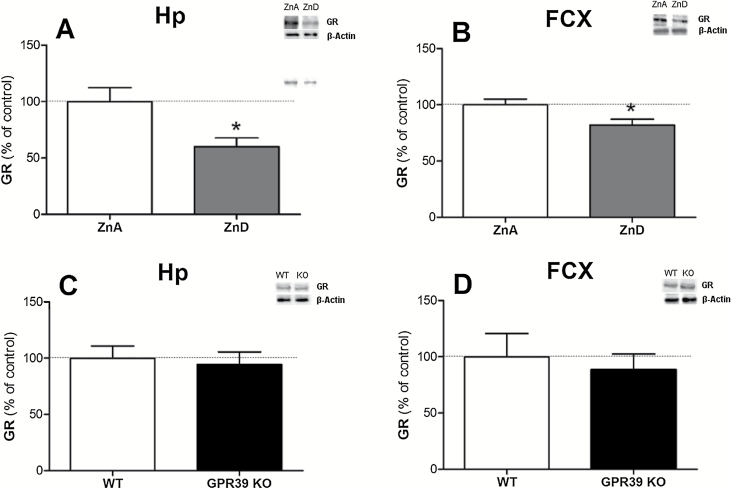
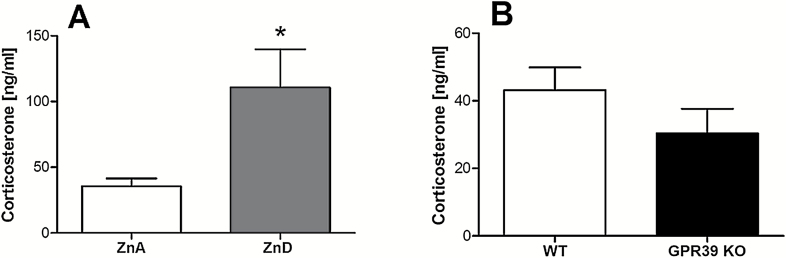
In this study, GPR39 knockout mice showed an increased immobility time in both the forced swim test and tail suspension test, indicating depressive-like behavior and displayed anxiety-like phenotype. GPR39 knockout mice had lower CREB and BDNF levels in the hippocampus, but not in the frontal cortex, which indicates region specificity for the impaired CREB/BDNF pathway (which is important in antidepressant response) in the absence of GPR39. There were no changes in TrkB protein in either structure. In the present study, we also investigated activity in the hypothalamus-pituitary-adrenal axis under both zinc- and GPR39-deficient conditions. Zinc-deficient mice had higher serum corticosterone levels and lower glucocorticoid receptor levels in the hippocampus and frontal cortex.
There were no changes in the GPR39 knockout mice in comparison with the wild-type control mice, which does not support a role of GPR39 in hypothalamus-pituitary-adrenal axis regulation. The results of this study indicate the involvement of the GPR39 Zn(2+)-sensing receptor in the pathophysiology of depression with component of anxiety.
锌可通过激活GPR39代谢型受体在中枢神经系统中充当神经递质。
在本研究中,我们通过强迫游泳试验、悬尾试验和明暗试验,研究了GPR39基因敲除是否会导致抑郁样和/或焦虑样行为。我们还通过蛋白质免疫印迹分析,研究了强迫游泳试验后的GPR39基因敲除小鼠海马体和前额叶皮质中,cAMP反应元件结合蛋白(CREB)、脑源性神经营养因子(BDNF)和原肌球蛋白相关激酶B(TrkB)蛋白水平是否因GPR39缺失而发生变化。
在本研究中,GPR39基因敲除小鼠在强迫游泳试验和悬尾试验中的不动时间均增加,表明有抑郁样行为,并表现出焦虑样表型。GPR39基因敲除小鼠海马体中的CREB和BDNF水平较低,但前额叶皮质中无此现象,这表明在缺乏GPR39的情况下,CREB/BDNF通路受损(这在抗抑郁反应中很重要)具有区域特异性。两种结构中的TrkB蛋白均无变化。在本研究中,我们还研究了锌缺乏和GPR39缺乏条件下下丘脑-垂体-肾上腺轴的活性。缺锌小鼠血清皮质酮水平较高,海马体和前额叶皮质中的糖皮质激素受体水平较低。
与野生型对照小鼠相比,GPR39基因敲除小鼠没有变化,这不支持GPR39在下丘脑-垂体-肾上腺轴调节中的作用。本研究结果表明,GPR39锌离子感应受体参与了伴有焦虑成分的抑郁症的病理生理过程。