Respiratory, Critical Care & Anaesthesia Section (Portex Unit), UCL, Institute of Child Health, London, UK.
MRC/CSO, Social and Public Health Sciences Unit, University of Glasgow, 4 Lilybank Gardens, Glasgow, UK.
NPJ Prim Care Respir Med. 2015 Jan 22;25:14112. doi: 10.1038/npjpcrm.2014.112.
Access to reliable birth data (birthweight (BW) and gestational age (GA)) is essential for the identification of individuals who are at subsequent health risk.
This study aimed to explore the feasibility of retrospectively collecting birth data for schoolchildren from parental questionnaires (PQ) and general practitioners (GPs) in primary care clinics, in inner city neighbourhoods with high density of ethnic minority and disadvantaged populations.
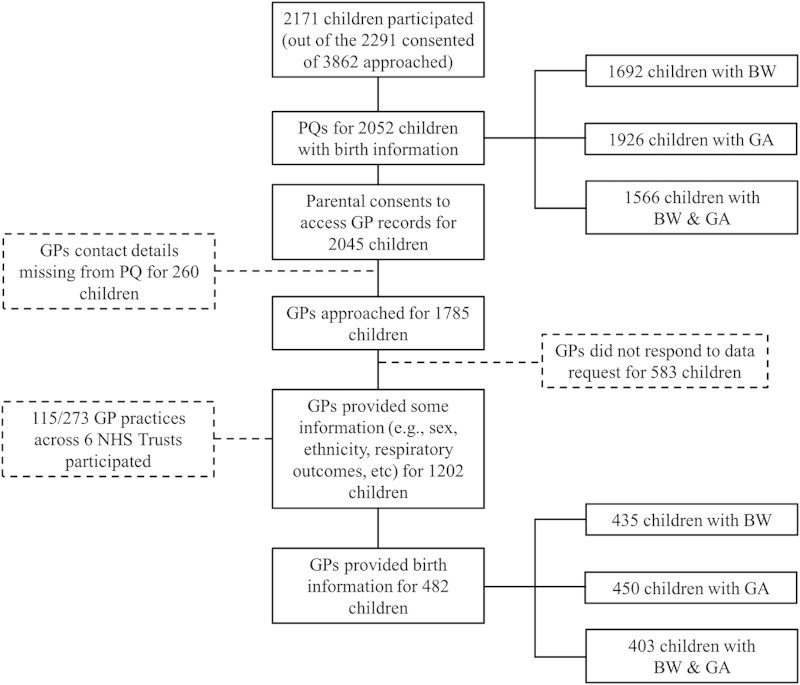
Attempts were made to obtain birth data from parents and GPs for 2,171 London primary schoolchildren (34% White, 29% Black African origin, 25% South Asians, 12% Other) as part of a larger study of respiratory health.
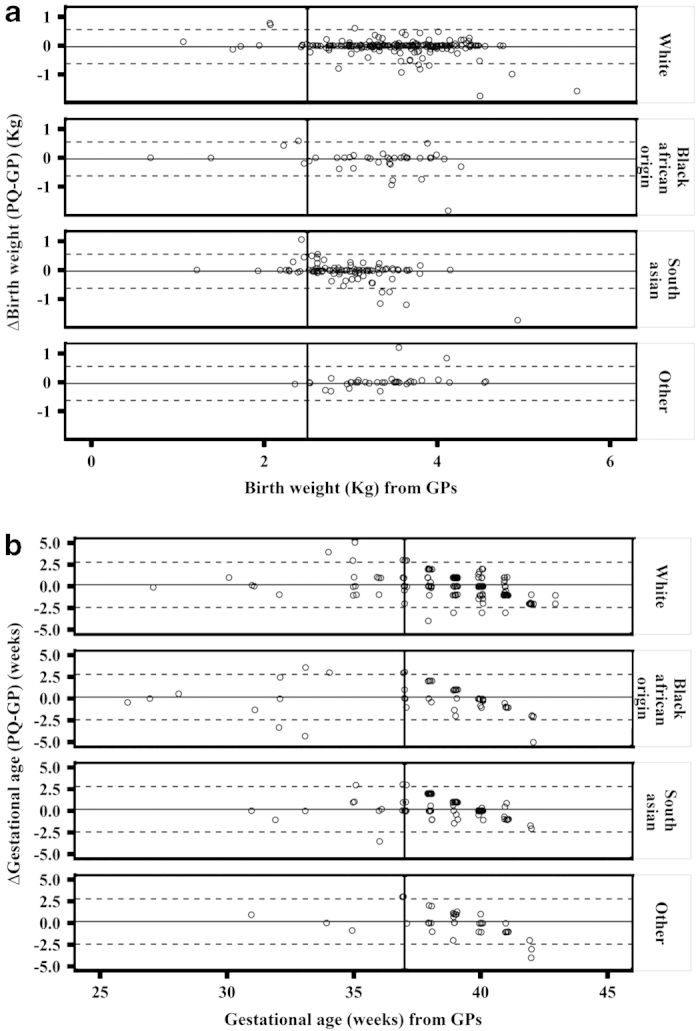
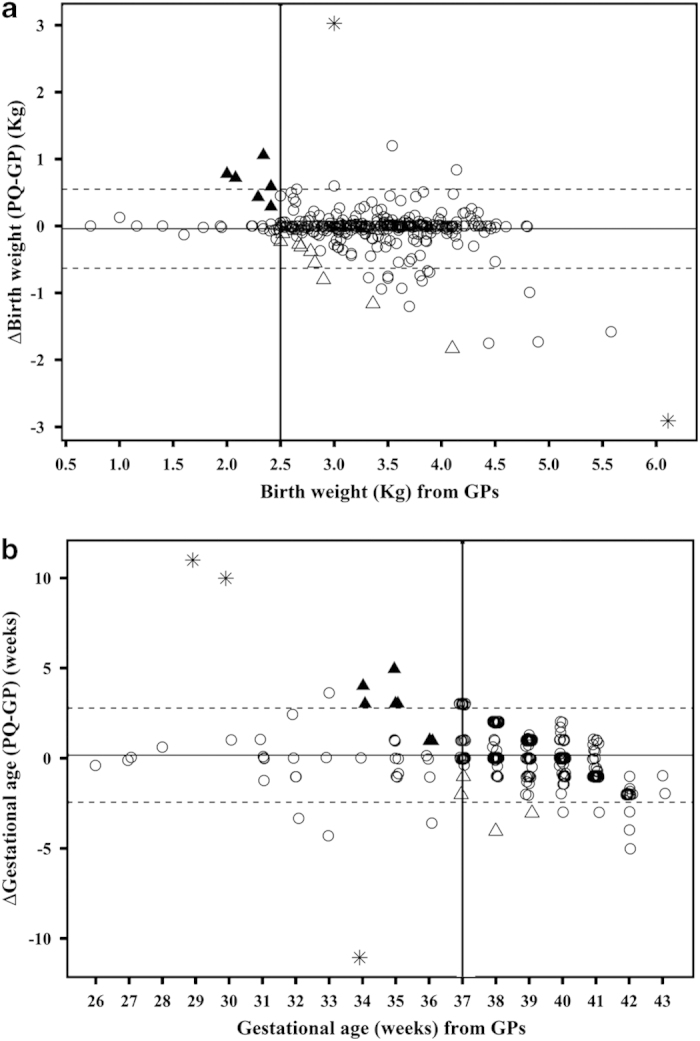
Information on BW and/or GA were obtained from parents for 2,052 (95%) children. Almost all parents (2,045) gave consent to access their children's health records held by GPs. On the basis of parental information, GPs of 1,785 children were successfully contacted, and GPs of 1,202 children responded. Birth data were retrieved for only 482 children (22% of 2,052). Missing birth data from GPs were associated with non-white ethnicity, non-UK born, English not the dominant language at home or socioeconomic disadvantage. Paired data were available in 376 children for BW and in 407 children for GA. No significant difference in BW or GA was observed between PQ and GP data, with <5% difference between sources regardless of normal or low birth weight, or term or preterm status.
Parental recall of birth data for primary schoolchildren yields high quality and rapid return of data, and it should be considered as a viable alternative in which there is limited access to birth records. It provides the potential to include children with an increased risk of health problems within epidemiological studies.
可靠的出生数据(出生体重(BW)和胎龄(GA))对于识别处于后续健康风险中的个体至关重要。
本研究旨在探索从父母问卷(PQ)和初级保健诊所的全科医生(GP)中回顾性收集城市内少数民族和弱势群体聚居区的学童出生数据的可行性。
作为一项更大的呼吸道健康研究的一部分,尝试从父母和 GP 那里获取 2171 名伦敦小学生(34%为白人,29%为非裔非洲裔,25%为南亚裔,12%为其他)的 BW 和/或 GA 信息。
为 2052 名(95%)儿童提供了 BW 和/或 GA 信息。几乎所有父母(2045 名)都同意访问他们的孩子由 GP 持有的健康记录。根据父母的信息,成功联系到 1785 名儿童的 GP,其中 1202 名 GP 做出回应。仅为 482 名儿童(2052 名中的 22%)检索到出生数据。GP 处缺少出生数据与非白人种族、非英国出生、家庭中英语不是主要语言或社会经济劣势有关。376 名儿童 BW 数据和 407 名儿童 GA 数据可进行配对。无论 BW 或 GA 是否正常,与 GP 数据相比,PQ 数据差异无统计学意义,且来源之间的差异均<5%。
父母回忆小学生的出生数据可快速高质量地获得数据,并且在获取出生记录有限的情况下,可以考虑作为一种可行的替代方法。它为在流行病学研究中纳入有健康问题风险增加的儿童提供了潜力。