Medeiros Gustavo Costa, Leppink Eric, Yaemi Ana, Mariani Mirella, Tavares Hermano, Grant Jon
Institute of Psychiatry, University of São Paulo, São Paulo, Brazil.
Department of Psychiatry, University of Chicago, Chicago, IL, USA.
Compr Psychiatry. 2015 Apr;58:116-21. doi: 10.1016/j.comppsych.2014.12.021. Epub 2014 Dec 31.
Gambling disorder (GD) in older adults is significantly increasing and became an important public health issue in different countries. However, little is known regarding GD in older adults. The prevalence and acceptance of gambling vary among different cultures and this raises the question of how and to what extent culture affects older gamblers. The majority of the important studies regarding GD in older adults have been conducted mainly in Anglo-Saxon cultures and little information is available regarding GD in other cultures. The objective of this paper is to perform the first standardized cross-cultural comparison regarding older adults presenting GD.
The total studied sample involved 170 subjects: 89 from the Brazilian (BR) sample and 81 from the American (US) sample. It consisted of 67 men and 103 women (average age=64.42, standard deviation=±3.86). They were evaluated for socio-demographics, gambling behavior variables and psychiatric antecedents.
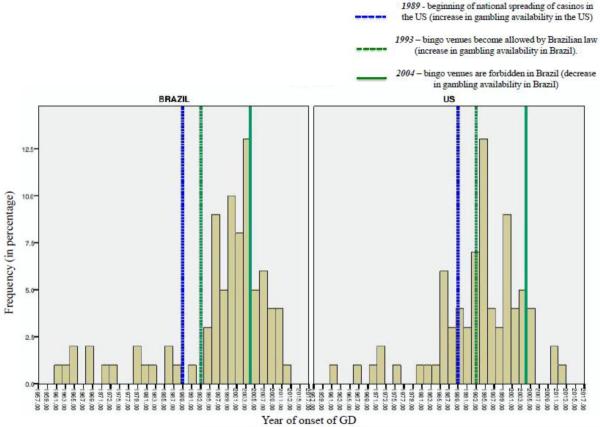
Overall, there were significant differences between BR and US older adult gamblers in marital status, onset of gambling activity, onset of GD and urge scores.
This study showed that there are important differences in gambling course, gambling behavior and personal antecedents between two samples of older adults presenting GD from countries with different social-cultural background. It weakens the possibility of generalization of results found in Anglo-Saxon countries to other cultures and reinforces for the need for development of research on GD in older adults outside the Anglo-Saxon culture.
老年人的赌博障碍(GD)显著增加,在不同国家已成为一个重要的公共卫生问题。然而,对于老年人的GD了解甚少。赌博的患病率和接受程度在不同文化中有所不同,这就引发了文化如何以及在多大程度上影响老年赌徒的问题。关于老年人GD的大多数重要研究主要在盎格鲁 - 撒克逊文化中进行,关于其他文化中GD的信息很少。本文的目的是对患有GD的老年人进行首次标准化的跨文化比较。
研究的总样本包括170名受试者:89名来自巴西(BR)样本,81名来自美国(US)样本。其中有67名男性和103名女性(平均年龄 = 64.42,标准差 = ±3.86)。他们接受了社会人口统计学、赌博行为变量和精神病史的评估。
总体而言,巴西和美国老年赌徒在婚姻状况、赌博活动开始时间、GD开始时间和冲动得分方面存在显著差异。
本研究表明,来自具有不同社会文化背景国家的两个患有GD的老年样本在赌博过程、赌博行为和个人病史方面存在重要差异。这削弱了将在盎格鲁 - 撒克逊国家发现的结果推广到其他文化的可能性,并强调了在盎格鲁 - 撒克逊文化之外开展老年人GD研究的必要性。