Girone Nicolaja, Limosani Ivan, Ciliberti Camilla, Turco Martina, Longo Laura, Colletti Maria Adele, Cocchi Maddalena, Zita Gianmaria, Fiocchi Mara Ida, Benatti Beatrice, Viganò Caterina, Percudani Mauro, Dell'Osso Bernardo
University of Milan, Department of Mental Health, Department of Biomedical and Clinical Sciences Luigi Sacco, Milan, Italy.
Department of Mental Health and Addiction Services, Niguarda Hospital, Milan, Italy.
Clin Neuropsychiatry. 2024 Aug;21(4):313-322. doi: 10.36131/cnfioritieditore20240407.
Although gender-specific evidence on Gambling Disorder (GD) is still limited, some studies reported specific differences, mainly in psychopathological profiles, gambling behavior patterns, and pathogenesis. In order to further examine the role of gender in GD, we conducted a multicenter investigation in a sample of Italian outpatients.
One hundred-four outpatients with a diagnosis of GD based on DSM-5 criteria were consecutively recruited at two clinics based in Milan. Socio-demographic and clinical variables were collected for the whole sample and analyzed for the effect of gender. The severity of illness was assessed using the Canadian Problem Gambling Index and the Gambling Attitudes and Beliefs (GABS).
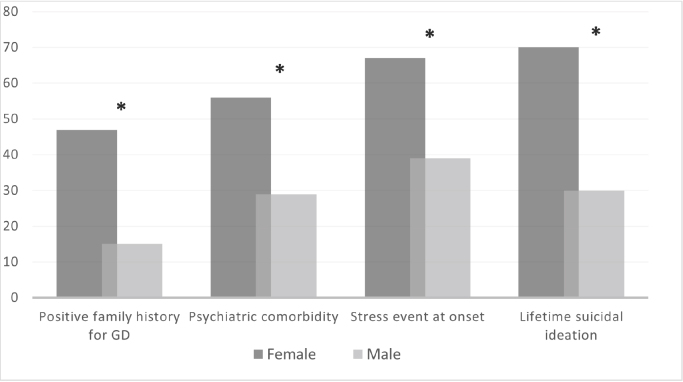
Among females, a significantly higher mean age (52.23 ± 10.95 vs. 40.96 ± 15.76; p=0.005) and older age at illness onset emerged (43.5 ± 11.92 vs. 29.22 ± 14.26; p<0.001). Females showed a significantly higher rate of psychiatric comorbidities, lifetime suicide ideation, stressful events at GD onset, and positive family history for GD compared to males. A predictive effect of male gender was found for the GABS questionnaires by performing a linear regression model, with males showing a higher risk to reach higher scores compared to females (B= 11.833; t=2.177; p=0.034).
Our study seems to confirm the hypotheses that gender in GD may influence psychopathological profiles, course, and comorbidity. GD in female gender is frequently a comorbid condition with other specific clinical characteristics compared to males. Identifying specific clinical factors by gender may prompt more focus on the public health of women in relation to gambling, while still recognizing that males are at-risk of earlier gambling problems. These findings should be considered in therapeutic perspectives.
尽管关于赌博障碍(GD)的性别特异性证据仍然有限,但一些研究报告了特定差异,主要体现在心理病理学特征、赌博行为模式和发病机制方面。为了进一步研究性别在GD中的作用,我们对一组意大利门诊患者进行了多中心调查。
根据DSM-5标准,在米兰的两家诊所连续招募了104名诊断为GD的门诊患者。收集了整个样本的社会人口统计学和临床变量,并分析了性别的影响。使用加拿大问题赌博指数以及赌博态度和信念(GABS)评估疾病严重程度。
女性的平均年龄显著更高(52.23±10.95岁对40.96±15.76岁;p = 0.005),发病年龄也更大(43.5±11.92岁对29.22±14.26岁;p<0.001)。与男性相比,女性的精神共病率、终生自杀意念、GD发病时的应激事件以及GD的阳性家族史显著更高。通过进行线性回归模型,发现男性性别对GABS问卷有预测作用,男性达到更高分数的风险高于女性(B = 11.833;t = 2.177;p = 0.034)。
我们的研究似乎证实了以下假设,即GD中的性别可能影响心理病理学特征、病程和共病情况。与男性相比,女性的GD通常是一种伴有其他特定临床特征的共病情况。按性别确定特定的临床因素可能促使人们更加关注与赌博相关的女性公共卫生问题,同时仍认识到男性有更早出现赌博问题的风险。这些发现应在治疗角度加以考虑。