Yao Yuan-Wei, Chen Pin-Ru, Li Song, Wang Ling-Jiao, Zhang Jin-Tao, Yip Sarah W, Chen Gang, Deng Lin-Yuan, Liu Qin-Xue, Fang Xiao-Yi
School of Psychology, Beijing Normal University, Beijing, China.
School of Mathematical Science, Beijing Normal University, Beijing, China.
PLoS One. 2015 Jan 23;10(1):e0116471. doi: 10.1371/journal.pone.0116471. eCollection 2015.
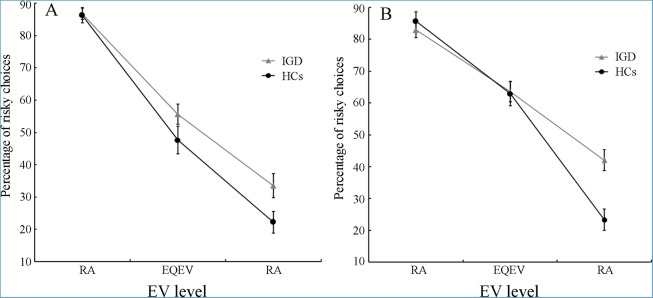
Individuals with Internet gaming disorder (IGD) tend to exhibit disadvantageous risky decision-making not only in their real life but also in laboratory tasks. Decision-making is a complex multifaceted function and different cognitive processes are involved in decision-making for gains and losses. However, the relationship between impaired decision-making and gain versus loss processing in the context of IGD is poorly understood. The main aim of the present study was to separately evaluate decision-making for risky gains and losses among college students with IGD using the Cups task. Additionally, we further examined the effects of outcome magnitude and probability level on decision-making related to risky gains and losses respectively. Sixty college students with IGD and 42 matched healthy controls (HCs) participated. Results indicated that IGD subjects exhibited generally greater risk taking tendencies than HCs. In comparison to HCs, IGD subjects made more disadvantageous risky choices in the loss domain (but not in the gain domain). Follow-up analyses indicated that the impairment was associated to insensitivity to changes in outcome magnitude and probability level for risky losses among IGD subjects. In addition, higher Internet addiction severity scores were associated with percentage of disadvantageous risky options in the loss domain. These findings emphasize the effect of insensitivity to losses on disadvantageous decisions under risk in the context of IGD, which has implications for future intervention studies.
患有网络游戏障碍(IGD)的个体不仅在现实生活中,而且在实验室任务中往往表现出不利的风险决策。决策是一项复杂的多方面功能,不同的认知过程参与收益和损失的决策。然而,在IGD背景下,受损决策与收益和损失处理之间的关系尚不清楚。本研究的主要目的是使用杯子任务分别评估患有IGD的大学生在风险收益和损失方面的决策。此外,我们进一步分别研究了结果大小和概率水平对与风险收益和损失相关决策的影响。60名患有IGD的大学生和42名匹配的健康对照者(HCs)参与了研究。结果表明,IGD受试者总体上比HCs表现出更大的冒险倾向。与HCs相比,IGD受试者在损失领域(而非收益领域)做出了更不利的风险选择。后续分析表明,这种损害与IGD受试者对风险损失的结果大小和概率水平变化不敏感有关。此外,更高的网络成瘾严重程度得分与损失领域中不利风险选项的百分比相关。这些发现强调了在IGD背景下,对损失不敏感对风险下不利决策的影响,这对未来的干预研究具有启示意义。