Engels C C, Charehbili A, van de Velde C J H, Bastiaannet E, Sajet A, Putter H, van Vliet E A, van Vlierberghe R L P, Smit V T H B M, Bartlett J M S, Seynaeve C, Liefers G J, Kuppen P J K
Department of Surgery, Leiden University Medical Center, Albinusdreef 2, 2300RC, Leiden, The Netherlands.
Breast Cancer Res Treat. 2015 Feb;149(3):587-96. doi: 10.1007/s10549-015-3269-7. Epub 2015 Jan 24.
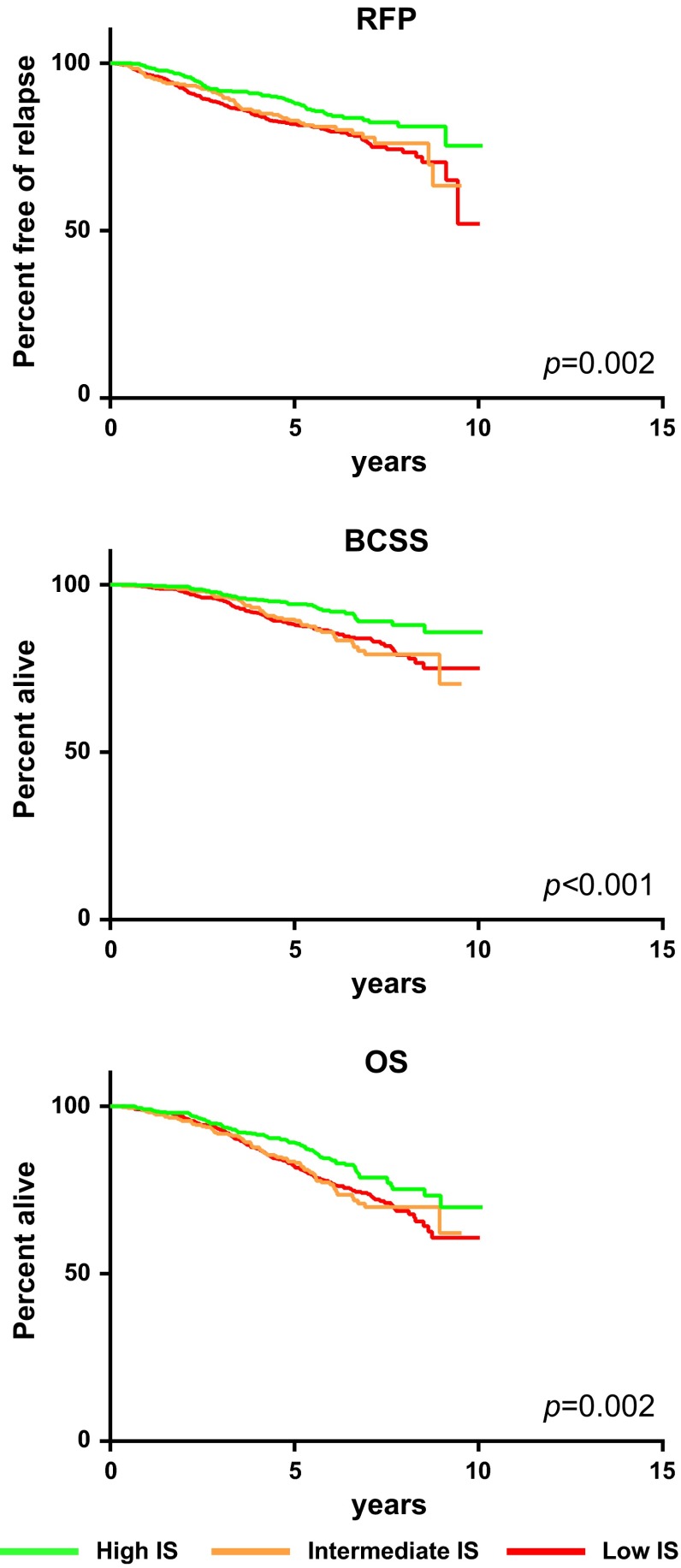
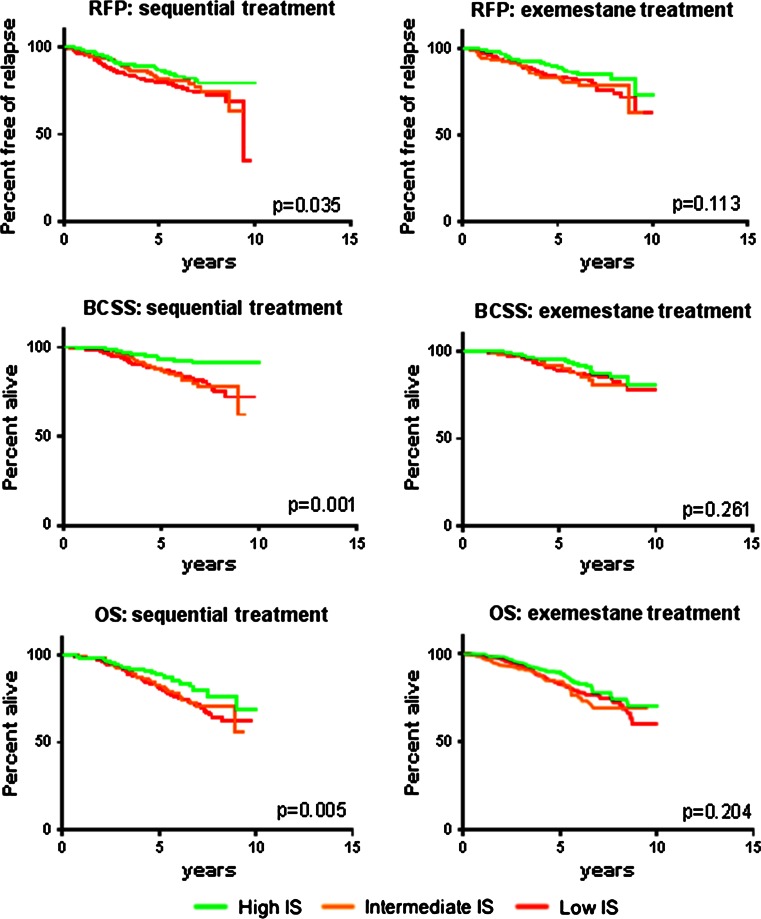
Evidence exists for an immunomodulatory effect of endocrine therapy in hormone receptor-positive (HR+ve) breast cancer (BC). Therefore, the aim of this study was to define the prognostic and predictive value of tumor immune markers and the tumor immune profile in HR+ve BC, treated with different endocrine treatment regimens. 2,596 Dutch TEAM patients were treated with 5 years of adjuvant hormonal treatment, randomly assigned to different regimens: 5 years of exemestane or sequential treatment (2.5 years of tamoxifen-2.5 years of exemestane). Immunohistochemistry was performed for HLA class I, HLA-E, HLA-G, and FoxP3. Tumor immune subtypes (IS) (low, intermediate & high immune susceptible) were determined by the effect size of mono-immune markers on relapse rate. Patients on sequential treatment with high level of tumor-infiltrating FoxP3+ cells had significant (p = 0.019, HR 0.729, 95% CI 0.560-0.949) better OS. Significant interaction for endocrine treatment and FoxP3+ presence was seen (OS p < 0.001). Tumor IS were only of prognostic value for the sequentially endocrine-treated patients (RFP: p = 0.035, HR intermediate IS 1.420, 95% CI 0.878-2.297; HR low IS 1.657, 95% CI 1.131-2.428; BCSS: p = 0.002, HR intermediate IS 2.486, 95% CI 1.375-4.495; HR low IS 2.422, 95% CI 1.439-4.076; and OS: p = 0.005, HR intermediate IS 1.509, 95% CI 0.950-2.395; HR low IS 1.848, 95% CI 1.277-2.675). Tregs and the tumor IS presented in this study harbor prognostic value for sequentially endocrine-treated HR+ve postmenopausal BC patients, but not for solely exemestane-treated patients. Therefore, these markers could be used as a clinical risk stratification tool to guide adjuvant treatment in this BC population.
有证据表明内分泌治疗对激素受体阳性(HR+ve)乳腺癌(BC)具有免疫调节作用。因此,本研究的目的是确定肿瘤免疫标志物和肿瘤免疫谱在接受不同内分泌治疗方案的HR+ve BC中的预后和预测价值。2596例荷兰TEAM研究患者接受了5年的辅助激素治疗,随机分配至不同方案:5年依西美坦或序贯治疗(2.5年他莫昔芬-2.5年依西美坦)。对HLA I类、HLA-E、HLA-G和FoxP3进行免疫组织化学检测。肿瘤免疫亚型(IS)(低、中、高免疫易感性)通过单一免疫标志物对复发率的效应大小来确定。接受序贯治疗且肿瘤浸润性FoxP3+细胞水平高的患者总生存期显著更好(p = 0.019,风险比0.729,95%置信区间0.560-0.949)。观察到内分泌治疗与FoxP3+细胞存在之间有显著交互作用(总生存期p < 0.001)。肿瘤IS仅对接受序贯内分泌治疗的患者具有预后价值(无复发生存期:p = 0.035,中免疫亚型风险比1.420,95%置信区间0.878-2.297;低免疫亚型风险比1.657,95%置信区间1.131-2.428;乳腺癌特异性生存期:p = 0.002,中免疫亚型风险比2.486,95%置信区间1.375-4.495;低免疫亚型风险比2.422,95%置信区间1.439-4.076;总生存期:p = 0.005,中免疫亚型风险比1.509,95%置信区间0.950-2.395;低免疫亚型风险比1.848,95%置信区间1.277-2.675)。本研究中呈现的调节性T细胞和肿瘤IS对接受序贯内分泌治疗的HR+ve绝经后BC患者具有预后价值,但对仅接受依西美坦治疗的患者无此价值。因此,这些标志物可作为临床风险分层工具,以指导该BC人群的辅助治疗。