Pai Melody Y, Lomenick Brett, Hwang Heejun, Schiestl Robert, McBride William, Loo Joseph A, Huang Jing
Molecular Biology Institute, University of California Los Angeles, Los Angeles, CA, USA.
Methods Mol Biol. 2015;1263:287-98. doi: 10.1007/978-1-4939-2269-7_22.
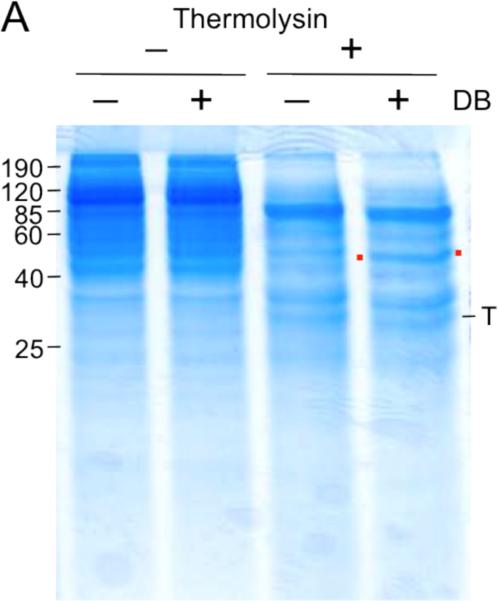
Drug affinity responsive target stability (DARTS) is a relatively quick and straightforward approach to identify potential protein targets for small molecules. It relies on the protection against proteolysis conferred on the target protein by interaction with a small molecule. The greatest advantage of this method is being able to use the native small molecule without having to immobilize or modify it (e.g., by incorporation of biotin, fluorescent, radioisotope, or photoaffinity labels). Here we describe in detail the protocol for performing unbiased DARTS with complex protein lysates to identify binding targets of small molecules and for using DARTS-Western blotting to test, screen, or validate potential small-molecule targets. Although the ideas have mainly been developed from studying molecules in areas of biology that are currently of interest to us and our collaborators, the general principles should be applicable to the analysis of all molecules in nature.
药物亲和力响应靶点稳定性(DARTS)是一种相对快速且直接的方法,用于识别小分子的潜在蛋白质靶点。它依赖于小分子与靶蛋白相互作用赋予靶蛋白的抗蛋白酶解作用。该方法的最大优势在于能够使用天然小分子,而无需对其进行固定或修饰(例如,通过掺入生物素、荧光、放射性同位素或光亲和标签)。在此,我们详细描述了使用复杂蛋白质裂解物进行无偏倚DARTS以识别小分子结合靶点,以及使用DARTS-蛋白质印迹法来测试、筛选或验证潜在小分子靶点的实验方案。尽管这些想法主要是在研究我们及我们的合作者目前感兴趣的生物学领域中的分子时发展而来的,但一般原则应适用于对自然界中所有分子的分析。