Wong Sie Chuong, Shirley Neil J, Little Alan, Khoo Kelvin H P, Schwerdt Julian, Fincher Geoffrey B, Burton Rachel A, Mather Diane E
ARC Centre of Excellence in Plant Cell Walls, School of Agriculture, Food and Wine, Waite Research Institute, The University of Adelaide, Waite Campus, Glen Osmond, SA 5064 Australia ; Faculty of Agriculture and Food Sciences, Universiti Putra Malaysia Bintulu Campus, 97000 Bintulu, Malaysia.
ARC Centre of Excellence in Plant Cell Walls, School of Agriculture, Food and Wine, Waite Research Institute, The University of Adelaide, Waite Campus, Glen Osmond, SA 5064 Australia.
Mol Breed. 2015;35(1):20. doi: 10.1007/s11032-015-0208-6. Epub 2015 Jan 20.
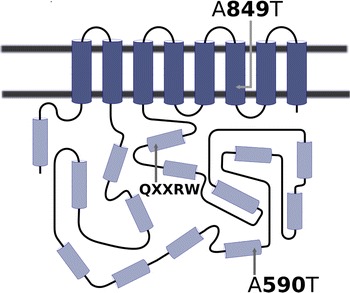
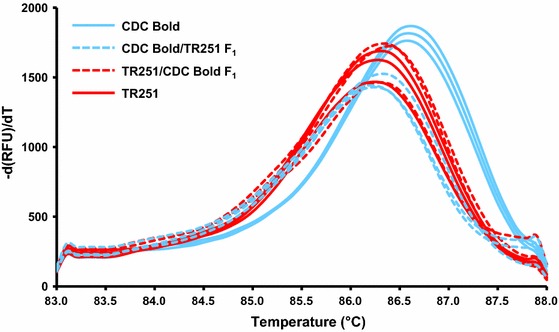
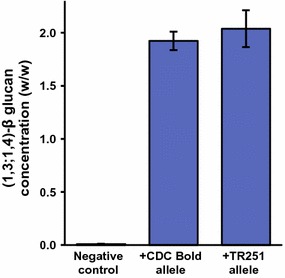
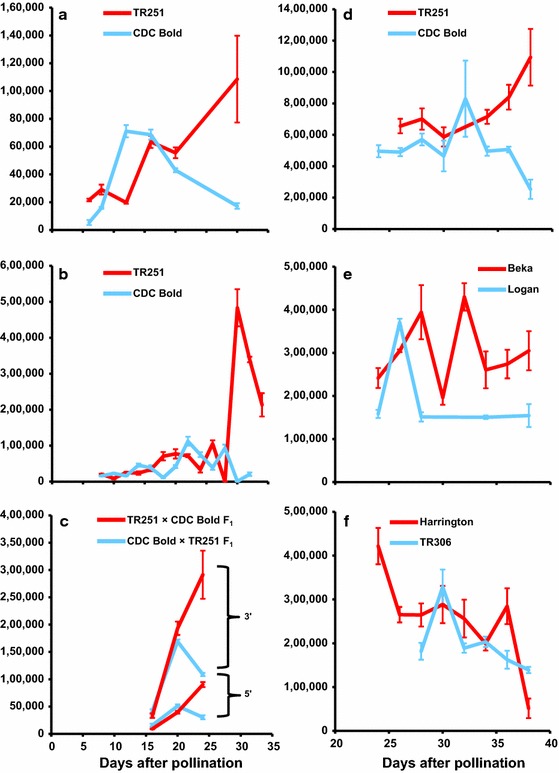
The cellulose synthase-like gene , which is essential for (1,3;1,4)-β-glucan biosynthesis in barley, collocates with quantitative trait loci (QTL) for grain (1,3;1,4)-β-glucan concentration in several populations, including CDC Bold × TR251. Here, an alanine-to-threonine substitution (caused by the only non-synonymous difference between the CDC Bold and TR251 alleles) was mapped to a position within HvCSLF6 that seems unlikely to affect enzyme stability or function. Consistent with this, transient expression of full-length cDNAs from CDC Bold and TR251 in led to accumulation of similar amounts of (1,3;1,4)-β-glucan accumulation. Monitoring of transcripts throughout grain development revealed a significant difference late in grain development (more than 30 days after pollination), with TR251 [the parent with higher grain (1,3;1,4)-β-glucan] exhibiting higher transcript levels than CDC Bold. A similar difference was observed between Beka and Logan, the parents of another population in which a QTL had been mapped in the region. Sequencing of a putative promoter region of revealed numerous polymorphisms between CDC Bold and TR251, but none between Beka and Logan. While the results of this work indicate that naturally occurring quantitative differences in (1,3;1,4)-β-glucan accumulation may be due to -regulated differences in expression, these could not be attributed to any specific DNA sequence polymorphism. Nevertheless, information on sequence polymorphism was used to develop molecular markers that could be used in barley breeding to select for the desired [low or high (1,3;1,4)-β-glucan] allele of the QTL.
纤维素合酶样基因对大麦中(1,3;1,4)-β-葡聚糖的生物合成至关重要,在包括CDC Bold×TR251在内的几个群体中,该基因与谷物(1,3;1,4)-β-葡聚糖浓度的数量性状位点(QTL)共定位。在此,一个丙氨酸到苏氨酸的替换(由CDC Bold和TR251等位基因之间唯一的非同义差异引起)被定位到HvCSLF6内的一个位置,该位置似乎不太可能影响酶的稳定性或功能。与此一致的是,CDC Bold和TR251的全长cDNA在[此处原文缺失具体宿主信息]中的瞬时表达导致了相似量的(1,3;1,4)-β-葡聚糖积累。对整个谷物发育过程中[此处原文缺失具体基因信息]转录本的监测显示,在谷物发育后期(授粉后30多天)存在显著差异,TR251[谷物(1,3;1,4)-β-葡聚糖含量较高的亲本]的转录本水平高于CDC Bold。在另一个群体的亲本Beka和Logan之间也观察到了类似的差异,该群体在[此处原文缺失具体区域信息]区域定位了一个QTL。对[此处原文缺失具体基因信息]假定启动子区域的测序揭示了CDC Bold和TR251之间存在许多多态性,但Beka和Logan之间没有。虽然这项工作的结果表明,(1,3;1,4)-β-葡聚糖积累的自然定量差异可能是由于[此处原文缺失具体调控信息]调控的[此处原文缺失具体基因信息]表达差异,但这些差异不能归因于任何特定的DNA序列多态性。尽管如此,关于[此处原文缺失具体基因信息]序列多态性的信息被用于开发分子标记,可用于大麦育种中选择QTL所需的[低或高(1,3;1,4)-β-葡聚糖]等位基因。