Shao Qian, Li Jianbin, Li Fengxiang, Wang Suzhen, Wang Wei, Liu Shanshan, Zhang Yingjie
Department of Radiation Oncology, Shandong Cancer Hospital and Institute, Jinan, Shandong 250117, P.R. China.
Oncol Lett. 2015 Feb;9(2):563-568. doi: 10.3892/ol.2014.2777. Epub 2014 Dec 8.
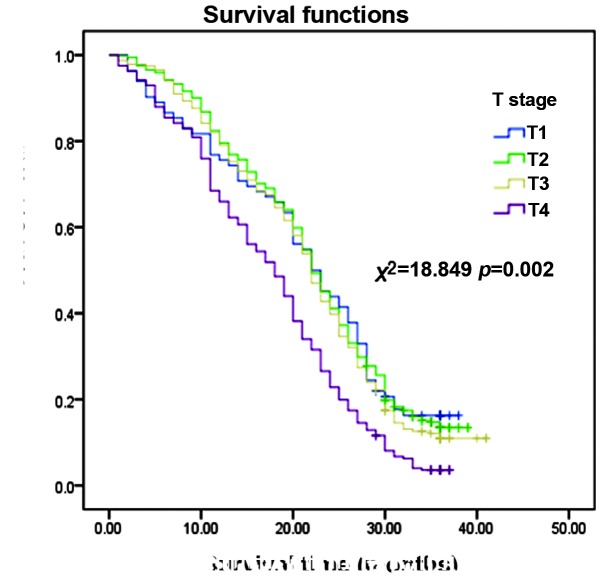
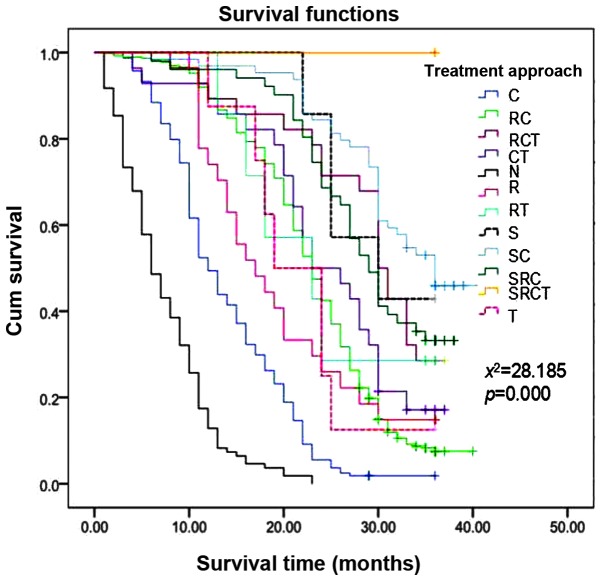
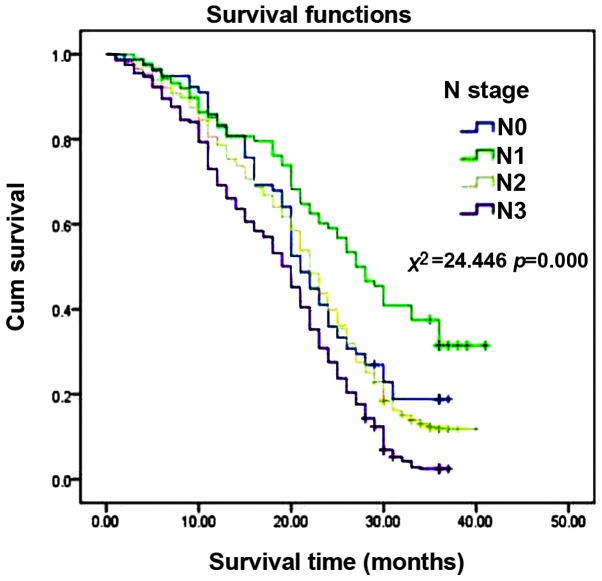
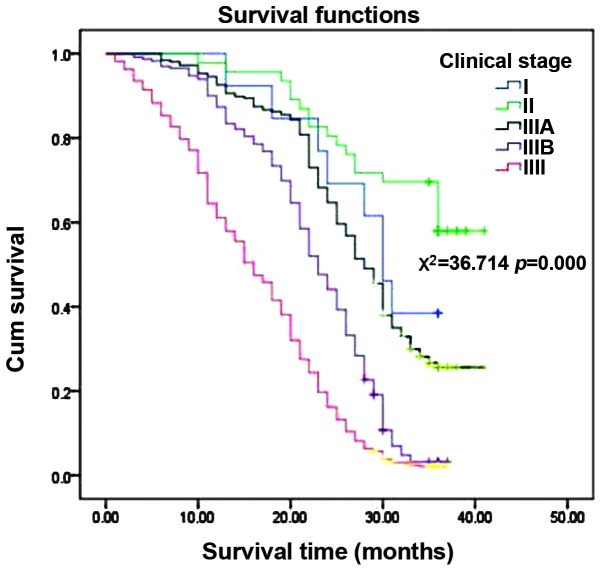
The aim of the present study was to analyse clinical data obtained from lung cancer patients, including the initial clinical symptoms upon diagnosis, duration of patient delay in presenting to a doctor, lung cancer stage, treatment strategy and prognosis. A retrospective analysis was conducted of the clinical features of 1,168 lung cancer patients who were initially diagnosed and treated at the Tumor Hospital of Shandong Province (Jinan, China) in 2009. The Kaplan-Meier method and multivariate Cox regression analysis were performed to analyse the influence of gender, age, predominant symptoms, histopathological or cytological type and clinical staging on the overall patient survival. The follow-up rate of the present study was 92.4%, and the 1-, 2- and 3-year survival rates were 80.4, 44.9 and 15.8%, respectively. Multivariate analysis demonstrated that the patient age, extent of the tumour (T stage), extent of lymph node spread (N stage), overall clinical stage and treatment strategy were independent risk factors associated with patient survival. The present study identified that the initial symptoms of lung cancer varied, patient delay was long, the lung cancer cases were diagnosed in late clinical stages and the prognosis was poor.
本研究的目的是分析从肺癌患者获得的临床数据,包括诊断时的初始临床症状、患者就诊延迟的时间、肺癌分期、治疗策略和预后。对2009年在山东省肿瘤医院(中国济南)首次诊断和治疗的1168例肺癌患者的临床特征进行了回顾性分析。采用Kaplan-Meier法和多因素Cox回归分析,分析性别、年龄、主要症状、组织病理学或细胞学类型以及临床分期对患者总生存的影响。本研究的随访率为92.4%,1年、2年和3年生存率分别为80.4%、44.9%和15.8%。多因素分析表明,患者年龄、肿瘤范围(T分期)、淋巴结转移范围(N分期)、总体临床分期和治疗策略是与患者生存相关的独立危险因素。本研究发现,肺癌的初始症状各不相同,患者就诊延迟时间长,肺癌病例在临床晚期被诊断,预后较差。