Lin Yu-Wei, Volk Holger A, Penderis Jacques, Anderson Thomas J, Añor Sonia, Lujan-Feliu-Pascual Alejandro, Stein Veronika M, Tipold Andrea, Ehlers Jan P
Department of Small Animal Medicine and Surgery, University of Veterinary Medicine Hannover, Buenteweg 9, Hannover, 30559, Germany.
Department of Clinical Science and Service, Royal Veterinary College, University of London, London, UK.
BMC Vet Res. 2015 Jan 27;11:10. doi: 10.1186/s12917-014-0314-4.
Specialization in veterinary medicine in Europe is organized through the Colleges of the European Board of Veterinary Specialization. To inform updating of the curriculum for residents of the European College of Veterinary Neurology (ECVN) job analysis was used. Defining job competencies of diploma holders in veterinary neurology can be used as references for curriculum design of resident training. With the support of the diplomates of the ECVN and the members of the European Society of Veterinary Neurology (ESVN) a mixed-method research, including a qualitative search of objectives and quantitative ranking with 149 Likert scale questions and 48 free text questions in 9 categories in a survey was conducted. In addition, opinions of different groups were subjected to statistical analysis and the result compared.
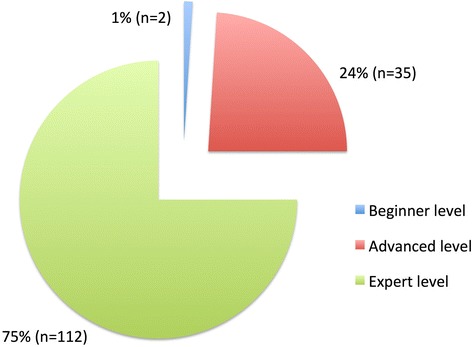
A return rate of 62% (n = 213/341) was achieved. Of the competencies identified by the Delphi process, 75% objectives were expected to attain expert level; 24% attain advanced level; 1% entry level. In addition, the exercise described the 11 highly ranked competencies, the 3 most frequently seen diseases of the central and peripheral nervous systems and the most frequently used immunosuppressive, antiepileptic and chemotherapeutic drugs.
The outcomes of this "Delphi job analysis" provide a powerful tool to align the curriculum for ECVN resident training and can be adapted to the required job competencies, based on expectations. The expectation is that for majority of these competencies diplomates should attain an expert level. Besides knowledge and clinical skills, residents and diplomates are expected to demonstrate high standards in teaching and communication. The results of this study will help to create a European curriculum for postgraduate education in veterinary neurology.
欧洲兽医学专业认证是通过欧洲兽医专业委员会下属的各个学院来组织实施的。为了给欧洲兽医神经科学学院(ECVN)住院医师课程的更新提供参考依据,开展了工作分析。明确兽医神经学文凭持有者的工作能力,可为住院医师培训课程设计提供参考。在ECVN的专科医师和欧洲兽医神经科学学会(ESVN)成员的支持下,开展了一项混合方法研究,包括一项定性目标搜索以及一项包含149个李克特量表问题和48个自由文本问题(分9类)的定量排序调查。此外,对不同群体的意见进行了统计分析并比较了结果。
问卷回收率为62%(n = 213/341)。在德尔菲法确定的能力中,75%的目标预期达到专家水平;24%达到高级水平;1%为入门水平。此外,该活动还描述了排名靠前的11项能力、中枢和周围神经系统最常见的3种疾病以及最常用的免疫抑制药、抗癫痫药和化疗药。
这项“德尔菲工作分析”的结果为调整ECVN住院医师培训课程提供了有力工具,可根据预期调整以适应所需的工作能力。预期大多数这些能力专科医师应达到专家水平。除了知识和临床技能外,住院医师和专科医师还应在教学和沟通方面展现高标准。本研究结果将有助于创建欧洲兽医神经学研究生教育课程。