Sagar D R, Nwosu L, Walsh D A, Chapman V
Arthritis Research UK Pain Centre, University of Nottingham, Nottingham, UK; School of Life Sciences, University of Nottingham, Nottingham, NG7 2UH, UK.
Arthritis Research UK Pain Centre, University of Nottingham, Nottingham, UK; Department of Academic Rheumatology, University of Nottingham, Clinical Sciences Building, Nottingham City Hospital, NG5 1PB, UK.
Osteoarthritis Cartilage. 2015 Jun;23(6):906-13. doi: 10.1016/j.joca.2015.01.010. Epub 2015 Jan 24.
Although analgesic approaches targeting nerve growth factor (NGF) for the treatment of osteoarthritis (OA) pain remain of clinical interest, neurophysiological mechanisms by which NGF contribute to OA pain remain unclear. We investigated the impact of local elevation of knee joint NGF on knee joint, vs remote (hindpaw), evoked responses of spinal neurones in a rodent model of OA pain.
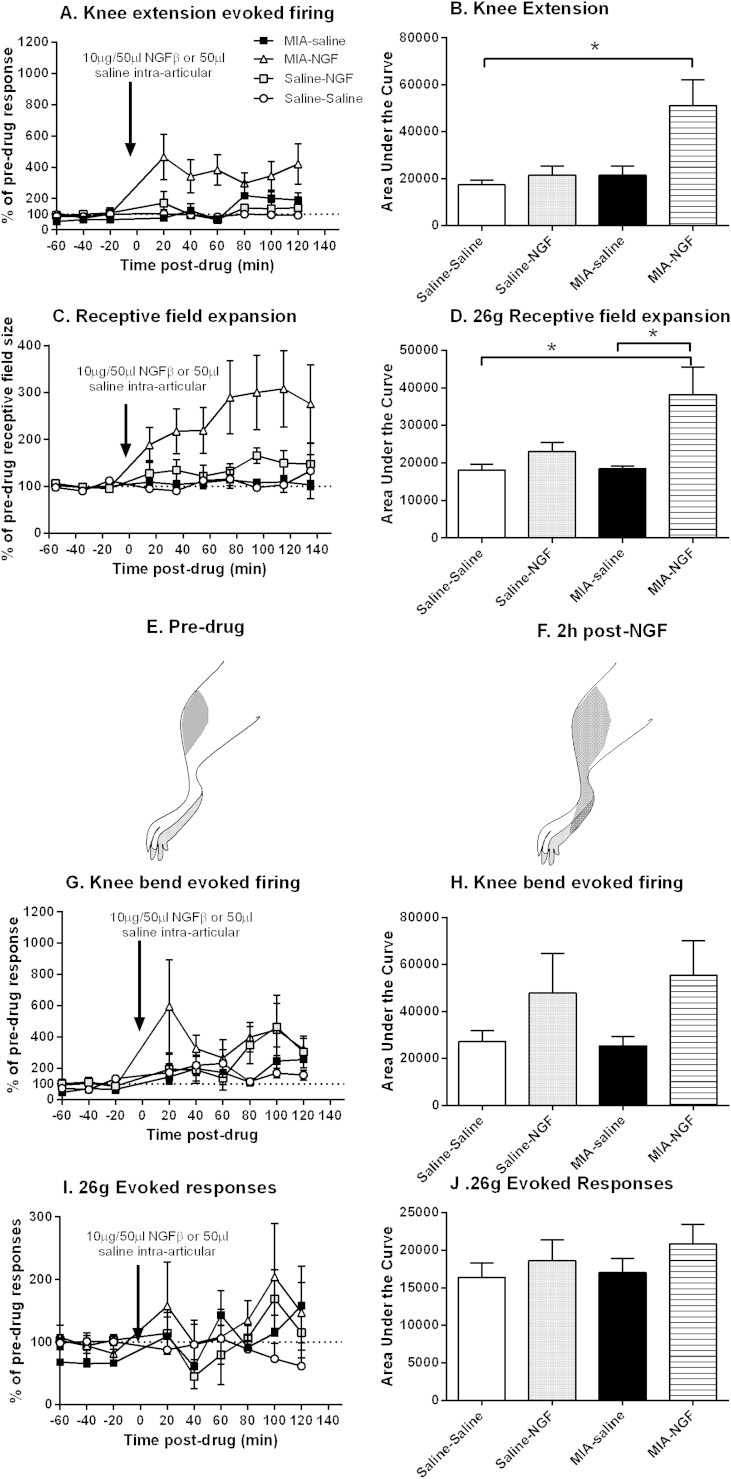
In vivo spinal electrophysiology was carried out in anaesthetised rats with established pain behaviour and joint pathology following intra-articular injection of monosodium iodoacetate (MIA), vs injection of saline. Neuronal responses to knee joint extension and flexion, mechanical punctate stimulation of the peripheral receptive fields over the knee and at a remote site (ipsilateral hind paw) were studied before, and following, intra-articular injection of NGF (10 μg/50 μl) or saline.
MIA-injected rats exhibited significant local (knee joint) and remote (lowered hindpaw withdrawal thresholds) changes in pain behaviour, and joint pathology. Intra-articular injection of NGF significantly (P < 0.05) increased knee extension-evoked firing of spinal neurones and the size of the peripheral receptive fields of spinal neurones (100% increase) over the knee joint in MIA rats, compared to controls. Intra-articular NGF injection did not significantly alter responses of spinal neurones following noxious stimulation of the ipsilateral hind paw in MIA-injected rats.
The facilitatory effects of intra-articular injection of NGF on spinal neurones receiving input from the knee joint provide a mechanistic basis for NGF mediated augmentation of OA knee pain, however additional mechanisms may contribute to the spread of pain to remote sites.
尽管针对神经生长因子(NGF)治疗骨关节炎(OA)疼痛的镇痛方法仍具有临床研究价值,但NGF导致OA疼痛的神经生理机制尚不清楚。我们在OA疼痛的啮齿动物模型中,研究了膝关节局部NGF升高对膝关节与远处(后爪)诱发的脊髓神经元反应的影响。
对已建立疼痛行为和关节病理的麻醉大鼠进行体内脊髓电生理学研究,这些大鼠关节内注射碘乙酸钠(MIA),对照组注射生理盐水。在关节内注射NGF(10μg/50μl)或生理盐水之前和之后,研究神经元对膝关节伸展和屈曲、膝关节及远处部位(同侧后爪)外周感受野的机械点状刺激的反应。
注射MIA的大鼠在疼痛行为和关节病理方面表现出显著的局部(膝关节)和远处(后爪退缩阈值降低)变化。与对照组相比,关节内注射NGF显著(P<0.05)增加了MIA大鼠脊髓神经元对膝关节伸展诱发的放电以及膝关节上方脊髓神经元外周感受野的大小(增加100%)。关节内注射NGF并未显著改变注射MIA大鼠同侧后爪受到伤害性刺激后脊髓神经元的反应。
关节内注射NGF对接受来自膝关节输入的脊髓神经元的促进作用为NGF介导的OA膝关节疼痛加剧提供了机制基础,然而可能还有其他机制导致疼痛扩散至远处部位。