Rahman Wahida, Dickenson Anthony H
Arthritis Res Ther. 2014 Dec 23;16(6):509. doi: 10.1186/s13075-014-0509-x.
Alterations in voltage-gated sodium channel (VGSC) function have been linked to chronic pain and are good targets for analgesics. Lacosamide (LCM) is a novel anticonvulsant that enhances the slow inactivation state of VGSCs. This conformational state can be induced by repeated neuronal firing and/or under conditions of sustained membrane depolarisation, as is expected for hyperexcitable neurones in pathological conditions such as epilepsy and neuropathy, and probably osteoarthritis (OA). In this study, therefore, we examined the antinociceptive effect of LCM on spinal neuronal and behavioural measures of pain, in vivo, in a rat OA model.
OA was induced in Sprague Dawley rats by intraarticular injection of 2 mg of monosodium iodoacetate (MIA). Sham rats received saline injections. Behavioural responses to mechanical and cooling stimulation of the ipsilateral hind paw and hindlimb weight-bearing were recorded. In vivo electrophysiology experiments were performed in anaesthetised MIA or sham rats, and we recorded the effects of spinal or systemic administration of LCM on the evoked responses of dorsal horn neurones to electrical, mechanical (brush, von Frey, 2 to 60 g) and heat (40°C to 50°C) stimulation of the peripheral receptive field. The effect of systemic LCM on nociceptive behaviours was assessed.
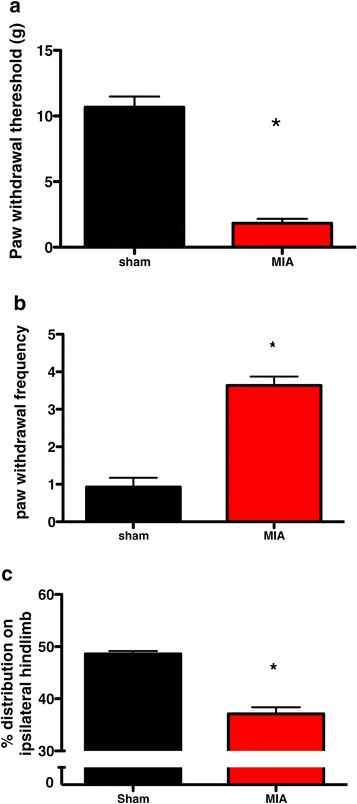
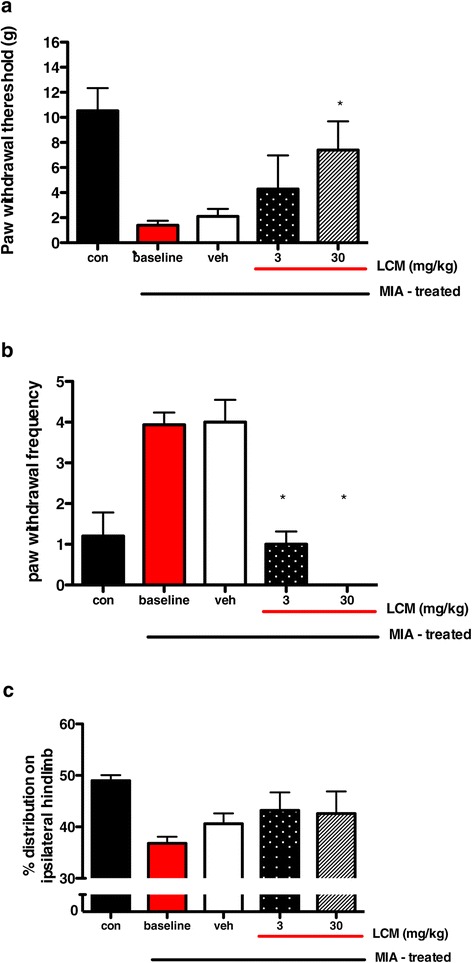
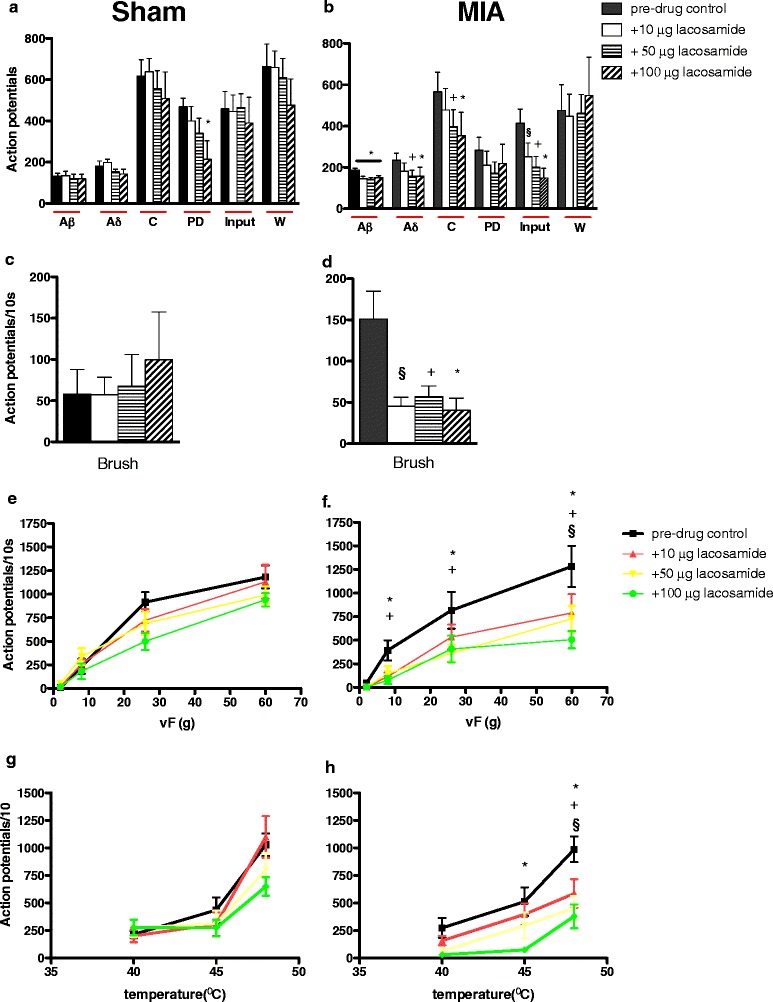
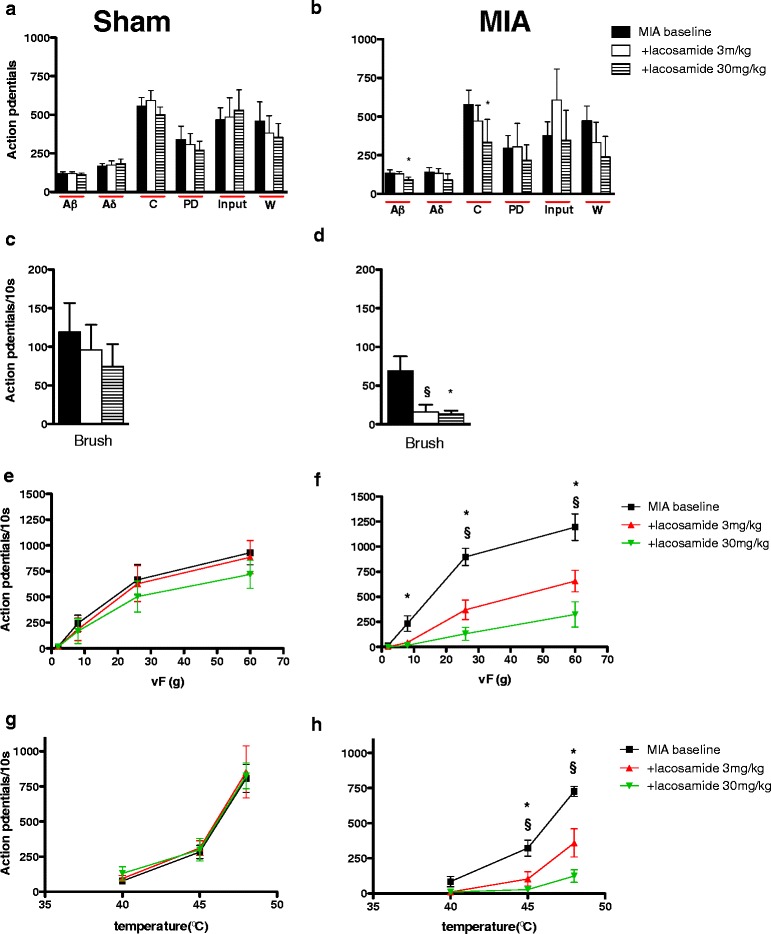
Behavioural hypersensitivity ipsilateral to knee injury was seen as a reduced paw withdrawal threshold to mechanical stimulation, an increase in paw withdrawal frequency to cooling stimulation and hind limb weight-bearing asymmetry in MIA-treated rats only. Spinal and systemic administration of LCM produced significant reductions of the electrical Aβ- and C-fibre evoked neuronal responses and the mechanical and thermal evoked neuronal responses in the MIA group only. Systemic administration of LCM significantly reversed the behavioural hypersensitive responses to mechanical and cooling stimulation of the ipsilateral hind paw, but hind limb weight-bearing asymmetry was not corrected.
Our in vivo electrophysiological results show that the inhibitory effects of LCM were MIA-dependent. This suggests that, if used in OA patients, LCM may allow physiological transmission but suppress secondary hyperalgesia and allodynia. The inhibitory effect on spinal neuronal firing aligned with analgesic efficacy on nociceptive behaviours and suggests that LCM may still prove worthwhile for OA pain treatment and merits further clinical investigation.
电压门控钠通道(VGSC)功能改变与慢性疼痛相关,是镇痛药的良好靶点。拉科酰胺(LCM)是一种新型抗惊厥药,可增强VGSC的慢失活状态。这种构象状态可由重复的神经元放电和/或在持续膜去极化条件下诱导产生,就像癫痫和神经病变等病理状态下以及可能在骨关节炎(OA)中过度兴奋的神经元所预期的那样。因此,在本研究中,我们在大鼠OA模型中,在体内研究了LCM对脊髓神经元和疼痛行为指标的抗伤害感受作用。
通过关节内注射2 mg碘乙酸钠(MIA)在Sprague Dawley大鼠中诱导OA。假手术大鼠接受盐水注射。记录对同侧后爪的机械和冷刺激以及后肢负重的行为反应。在麻醉的MIA或假手术大鼠中进行体内电生理实验,我们记录了脊髓或全身给予LCM对背角神经元对周围感受野的电、机械(刷、von Frey,2至60 g)和热(40°C至50°C)刺激的诱发反应的影响。评估了全身给予LCM对伤害感受行为的影响。
仅在MIA处理的大鼠中,膝部损伤同侧的行为超敏反应表现为对机械刺激的爪退缩阈值降低、对冷刺激的爪退缩频率增加以及后肢负重不对称。仅在MIA组中,脊髓和全身给予LCM可显著降低电Aβ和C纤维诱发的神经元反应以及机械和热诱发的神经元反应。全身给予LCM可显著逆转对同侧后爪机械和冷刺激的行为超敏反应,但后肢负重不对称未得到纠正。
我们的体内电生理结果表明LCM的抑制作用依赖于MIA。这表明,如果用于OA患者,LCM可能允许生理传导,但抑制继发性痛觉过敏和异常性疼痛。对脊髓神经元放电的抑制作用与对伤害感受行为的镇痛效果一致,表明LCM可能仍然值得用于OA疼痛治疗,值得进一步临床研究。