Reaves Denise K, Ginsburg Erika, Bang John J, Fleming Jodie M
Department of BiologyNorth Carolina Central University, MTSC Room 2247, 1801 Fayetteville Street, Durham, North Carolina 27707, USANational Cancer InstituteNational Institutes of Health, Center for Cancer Training, Bethesda, Maryland 20892, USADepartment of BiologyNorth Carolina Central University, Durham, North Carolina 27707, USA.
Department of BiologyNorth Carolina Central University, MTSC Room 2247, 1801 Fayetteville Street, Durham, North Carolina 27707, USANational Cancer InstituteNational Institutes of Health, Center for Cancer Training, Bethesda, Maryland 20892, USADepartment of BiologyNorth Carolina Central University, Durham, North Carolina 27707, USA
Endocr Relat Cancer. 2015 Apr;22(2):R69-86. doi: 10.1530/ERC-14-0411. Epub 2015 Jan 26.
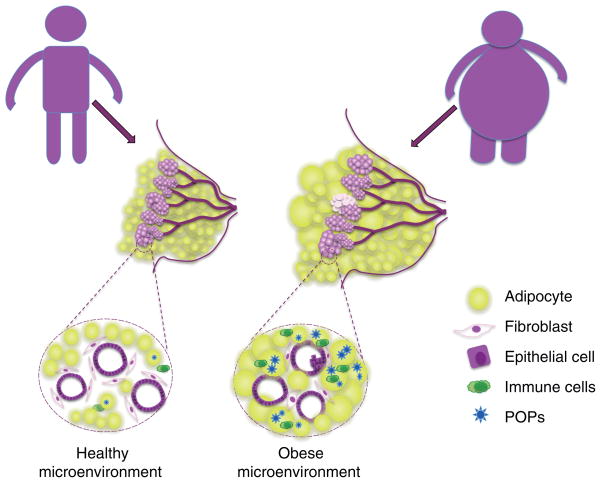
Dietary ingestion of persistent organic pollutants (POPs) is correlated with the development of obesity. Obesity alters metabolism, induces an inflammatory tissue microenvironment, and is also linked to diabetes and breast cancer risk/promotion of the disease. However, no direct evidence exists with regard to the correlation among all three of these factors (POPs, obesity, and breast cancer). Herein, we present results from current correlative studies indicating a causal link between POP exposure through diet and their bioaccumulation in adipose tissue that promotes the development of obesity and ultimately influences breast cancer development and/or progression. Furthermore, as endocrine disruptors, POPs could interfere with hormonally responsive tissue functions causing dysregulation of hormone signaling and cell function. This review highlights the critical need for advanced in vitro and in vivo model systems to elucidate the complex relationship among obesity, POPs, and breast cancer, and, more importantly, to delineate their multifaceted molecular, cellular, and biochemical mechanisms. Comprehensive in vitro and in vivo studies directly testing the observed correlations as well as detailing their molecular mechanisms are vital to cancer research and, ultimately, public health.
饮食中摄入持久性有机污染物(POPs)与肥胖的发生相关。肥胖会改变新陈代谢,诱发炎症性组织微环境,还与糖尿病及乳腺癌风险/疾病进展有关。然而,关于这三个因素(POPs、肥胖和乳腺癌)之间的相关性,尚无直接证据。在此,我们展示了当前相关研究的结果,表明通过饮食接触POPs及其在脂肪组织中的生物累积之间存在因果联系,这会促进肥胖的发展,并最终影响乳腺癌的发展和/或进展。此外,作为内分泌干扰物,POPs可能会干扰激素反应性组织功能,导致激素信号传导和细胞功能失调。本综述强调了迫切需要先进的体外和体内模型系统,以阐明肥胖、POPs和乳腺癌之间的复杂关系,更重要的是,描绘它们多方面的分子、细胞和生化机制。直接测试观察到的相关性并详细说明其分子机制的全面体外和体内研究,对癌症研究乃至公共卫生至关重要。