Lee Tih-Shih, Quek Shin Yi, Goh Siau Juinn Alexa, Phillips Rachel, Guan Cuntai, Cheung Yin Bun, Feng Lei, Wang Chuan Chu, Chin Zheng Yang, Zhang Haihong, Lee Jimmy, Ng Tze Pin, Krishnan K Ranga Rama
Department of Neuroscience and Behavioral Disorders, Duke-NUS Graduate Medical School, Singapore.
Singapore Clinical Research Institute, Singapore.
Clin Interv Aging. 2015 Jan 9;10:217-27. doi: 10.2147/CIA.S73955. eCollection 2015.
There is growing evidence that cognitive training (CT) can improve the cognitive functioning of the elderly. CT may be influenced by cultural and linguistic factors, but research examining CT programs has mostly been conducted on Western populations. We have developed an innovative electroencephalography (EEG)-based brain-computer interface (BCI) CT program that has shown preliminary efficacy in improving cognition in 32 healthy English-speaking elderly adults in Singapore. In this second pilot trial, we examine the acceptability, safety, and preliminary efficacy of our BCI CT program in healthy Chinese-speaking Singaporean elderly.
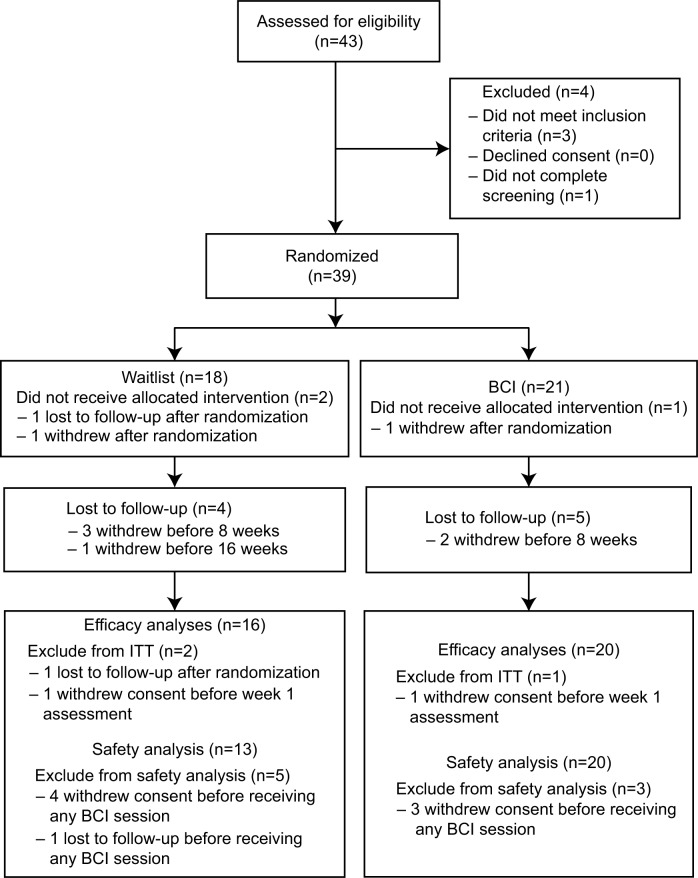
Thirty-nine elderly participants were randomized into intervention (n=21) and wait-list control (n=18) arms. Intervention consisted of 24 half-hour sessions with our BCI-based CT training system to be completed in 8 weeks; the control arm received the same intervention after an initial 8-week waiting period. At the end of the training, a usability and acceptability questionnaire was administered. Efficacy was measured using the Repeatable Battery for the Assessment of Neuropsychological Status (RBANS), which was translated and culturally adapted for the Chinese-speaking local population. Users were asked about any adverse events experienced after each session as a safety measure.
The training was deemed easily usable and acceptable by senior users. The median difference in the change scores pre- and post-training of the modified RBANS total score was 8.0 (95% confidence interval [CI]: 0.0-16.0, P=0.042) higher in the intervention arm than waitlist control, while the mean difference was 9.0 (95% CI: 1.7-16.2, P=0.017). Ten (30.3%) participants reported a total of 16 adverse events - all of which were graded "mild" except for one graded "moderate".
Our BCI training system shows potential in improving cognition in both English- and Chinese-speaking elderly, and deserves further evaluation in a Phase III trial. Overall, participants responded positively on the usability and acceptability questionnaire.
越来越多的证据表明,认知训练(CT)可以改善老年人的认知功能。CT可能会受到文化和语言因素的影响,但对CT项目的研究大多是在西方人群中进行的。我们开发了一种创新的基于脑电图(EEG)的脑机接口(BCI)CT项目,该项目在改善新加坡32名健康的英语老年成年人的认知方面已显示出初步疗效。在第二项试点试验中,我们研究了我们的BCI CT项目在健康的新加坡华语老年人中的可接受性、安全性和初步疗效。
39名老年参与者被随机分为干预组(n = 21)和候补对照组(n = 18)。干预包括使用我们基于BCI的CT训练系统进行24次半小时的课程,需在8周内完成;对照组在最初8周的等待期后接受相同的干预。训练结束时,发放了一份可用性和可接受性问卷。使用用于评估神经心理状态的可重复成套测验(RBANS)来测量疗效,该测验已针对华语当地人群进行了翻译和文化适应性调整。作为安全措施,询问用户每次课程后经历的任何不良事件。
老年用户认为该训练易于使用且可接受。干预组改良RBANS总分训练前后变化分数的中位数差异比候补对照组高8.0(95%置信区间[CI]:0.0 - 16.0,P = 0.042),而平均差异为9.0(95%CI:1.7 - 16.2,P = 0.017)。10名(30.3%)参与者报告了总共16起不良事件——除1起为“中度”外,其余均为“轻度”。
我们的BCI训练系统在改善英语和华语老年人的认知方面显示出潜力,值得在III期试验中进一步评估。总体而言,参与者对可用性和可接受性问卷的回答是积极的。